At a glance
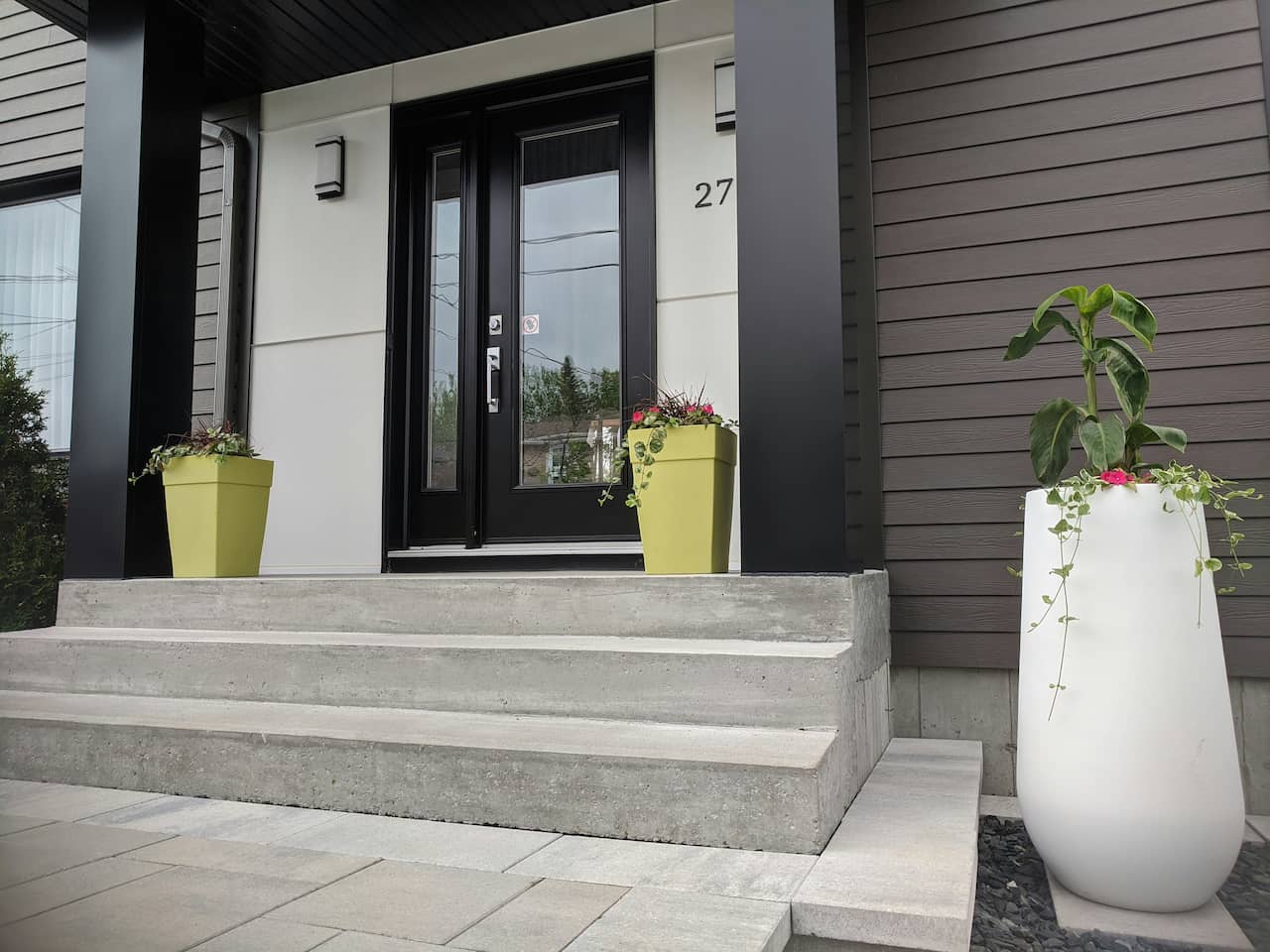
Tall outdoor planters bring vertical scale to a patio or terrace that standard-height containers cannot achieve. A pair of well-planted column planters flanking a doorway, a single large jar planter as a focal point in a courtyard, or a row of tall fibreglass containers marking a boundary – height changes the character of an outdoor space in a way that horizontal planting cannot replicate. The challenge is that height multiplies the practical demands on both the planter and the gardener: a tall container topples more easily in wind, dries out faster through its greater surface area, is harder to move once planted, and creates more intense root restriction for plants trying to establish in a relatively narrow column of compost.
Getting the most from a tall outdoor planter in a UK garden requires choosing the right material for the position, ballasting correctly against wind, managing the watering regime that tall containers demand, and selecting plants whose root requirements suit the limited depth. The five types ranked below cover the most commonly available options for UK buyers, from practical fibreglass through to premium stone and ceramic vessels. All are evaluated against the conditions that actually matter for UK patio and garden use – frost resistance, weight, drainage and real-world stability in wind.
Quick Verdict Summary
All 5 Tall Planter Types Ranked
Fibreglass tall planters are the most practical choice for UK outdoor use, combining light weight with convincing material finishes and complete frost resistance. The best fibreglass column and jar planters replicate the appearance of lead, stone, aged terracotta and zinc at normal viewing distance, and modern manufacturing quality has removed the obvious plasticity that made earlier fibreglass products look cheap. At height, a fibreglass planter’s light weight becomes a genuine advantage for moving and repositioning, but also a disadvantage for stability – tall fibreglass planters in exposed positions must be ballasted with a layer of gravel or stones in the base before filling with compost, or secured to adjacent walls or structures. The combination of light weight, frost resistance, and the widest range of styles available makes fibreglass the most versatile choice for most UK buyers.
As an Amazon Associate I earn from qualifying purchases.
The traditional Mediterranean jar or Ali-Baba shape in terracotta or frost-proof ceramic is one of the most iconic tall planter forms and remains genuinely beautiful when well-planted and positioned. The rounded, bulbous form with a narrow neck focuses attention on the planting emerging from the top and creates a focal point quality that straight-sided column planters cannot match. The critical specification issue for UK use is frost resistance – standard terracotta in the Ali-Baba form is particularly vulnerable because the narrow neck traps water which expands during freezing and cracks the widest part of the vessel. Only buy frost-proof certified examples for outdoor year-round use. Frost-proof versions are available and are the only appropriate choice for UK gardens. Weight is also a consideration – a large frost-proof ceramic jar is extremely heavy once filled.
As an Amazon Associate I earn from qualifying purchases.
Tall zinc and galvanised steel planters suit contemporary and industrial garden styles and have become widely popular in UK garden design over the last five years. They are fully frost-proof, reasonably priced, and the graduated grey finish weathers attractively without degrading. The main practical limitation for tall versions is the same as for all metal containers – the metal conducts heat rapidly, causing root zone temperatures to fluctuate more than in terracotta or fibreglass, which stresses plants in both summer heat and winter cold. For tall planters, this is moderated somewhat by the greater volume of compost insulating the roots, but in south-facing exposed positions, lining the interior with bubble wrap before planting significantly improves plant performance. They are a good choice for plants that are relatively unfussy about root temperatures – grasses, agapanthus and cordylines all perform well.
As an Amazon Associate I earn from qualifying purchases.
Cast stone tall planters – made from a mixture of natural stone aggregate and cement – are the most durable and permanent option available, and the closest in character to genuinely aged stone urns without the cost. They are fully frost-resistant when properly cured, extremely stable due to their weight, and develop a pleasing patina of moss and weathering over time that improves their appearance. The weight is both the greatest advantage and the significant limitation: a tall cast stone planter can weigh 50-80kg empty, and positioning must be final or near-final before filling. They are not suitable for balconies or rooftop terraces where structural weight limits apply, and require two people for any movement. For a permanent garden feature in a ground-level position, cast stone is the most satisfying long-term investment.
As an Amazon Associate I earn from qualifying purchases.
Wicker-effect and rattan-look tall planters – typically made from UV-stabilised polypropylene woven over a steel frame – offer the widest range of sizes and styles at the lowest price point. Their natural-textured appearance works well in cottage and informal garden settings and they are light enough to move easily when planted up. The lifespan is the key limitation: even UV-stabilised synthetic wicker degrades in extended outdoor exposure, and most products begin to show cracking and fading in the weave after three to five years of year-round UK outdoor use. They are a practical choice for a position that will be redesigned within a few years, or for renters who need attractive, moveable containers. For a permanent feature, the materials ranked above will serve better long-term.
As an Amazon Associate I earn from qualifying purchases.
What to Plant in Tall Planters
The best plants for tall outdoor planters in UK gardens are those that offer a strong single vertical statement – a matching pair of topiary bay trees flanking a doorway, a bold architectural grass like Stipa gigantea, a striking cordyline, or a standard rose. Plants with naturally upright or fountain habits suit the tall planter form far better than spreading or bushy plants whose growth obscures the planter itself. The planting should enhance the architectural quality of the vessel rather than compete with it. A common mistake is planting a tall container with too many species, creating a complicated, busy arrangement that loses the bold simplicity that makes a statement planter effective.
Fill the bottom third of tall planters with lightweight drainage material rather than compost. A large fibreglass or zinc column planter filled entirely with compost becomes unnecessarily heavy and the deep lower compost stays too wet in UK winters, encouraging root rot. Use a layer of perlite, broken polystyrene chunks or even scrunched plastic bottles in the bottom third before adding compost. This reduces weight significantly, improves drainage, and the plant roots do not typically penetrate that deep anyway.
Stability, Drainage and Winter Care
Stability is the primary practical concern with tall planters and it is directly proportional to the height-to-base-width ratio of the vessel. A planter twice as tall as it is wide is inherently less stable than one of equal height and width, and in exposed positions even a fully planted heavy-based planter can be knocked over by a strong gust. Secure tall lightweight planters in exposed positions by placing a layer of heavy gravel or stones in the base before planting, positioning against a wall or fence that can act as a windbreak, or fixing to adjacent stonework or decking with a discreet tie. In very exposed coastal or rooftop positions, tall planters of any material require fixing or they will eventually blow over.
Tall planters dry out significantly faster than standard containers. The greater surface area to volume ratio of a narrow column planter means moisture evaporates from the compost surface more quickly, and tall planters in a sunny, exposed position may need watering daily in summer. Consider fitting a drip irrigation system on a timer for any tall planter collection that will be left unattended, and always use a moisture-retentive loam-based compost rather than a standard multipurpose which dries and shrinks away from the sides of the container very rapidly.
Share on socials: