At a glance
A window box is one of the highest-return small-space gardening investments available to a UK homeowner or flat dweller. It requires no ground space, no planning permission and no structural commitment, and a well-planted box transforms a bare facade into something genuinely attractive while producing herbs or flowers from a surface that would otherwise contribute nothing to the garden. The range of plants that perform well in window boxes is far wider than many people assume – not just summer bedding but vegetables, herbs, winter colour, trailing perennials and seasonal bulbs – and the method adapts equally well to a sun-baked south-facing ledge and a shaded north-facing one.
The practical requirements of window box gardening are straightforward but unforgiving of shortcuts. Drainage, appropriate compost, consistent watering and seasonal replanting are the four variables that determine whether a window box looks good or looks neglected. Get them right and very little else needs attention. Get the watering wrong – particularly the common mistake of allowing the compost to dry out completely in summer – and even expensive plants will decline rapidly. This guide covers every practical aspect from box selection and mounting through to the best plants for every aspect and orientation.
Choosing the right window box
The most important practical consideration when choosing a window box is weight, particularly for boxes attached to first-floor or higher windowsills. A large wooden box filled with wet compost can weigh 20kg or more, and many older UK window ledges are not designed to take this load. Lightweight alternatives – plastic boxes, fibreglass, or foam-core composite materials that mimic terracotta – are significantly safer for elevated positions and are the practical choice for most UK window boxes above ground floor level. The visual difference between a well-planted good-quality plastic box and an expensive terracotta one is minimal once the box is full of plants in active growth.
Drainage holes are non-negotiable. A window box without drainage becomes waterlogged within days of heavy rain and will kill most plants within a fortnight. If a chosen box has no holes, drill them – a minimum of one 12mm hole per 15cm of box length, positioned at the lowest point. For boxes on windowsills that overhang pavements or gardens below, a drip tray prevents water staining walls and dropping on passers-by, but empty the tray after heavy rain to prevent standing water wicking back up into the compost. Secure mounting is critical for safety – use proper window box brackets rated for the weight and fix into masonry with wall plugs rather than relying on the window frame alone.
Line wooden window boxes with polythene before filling. Unlined wood in contact with damp compost rots rapidly – even treated timber typically lasts only 3-4 seasons before the base fails. Lining with heavy-gauge polythene sheeting, pierced at the drainage holes, significantly extends box life. Alternatively, insert a plastic liner box inside a decorative wooden outer – easy to swap liners for replanting while the decorative box stays in place permanently.
Compost, drainage and feeding
Container compost is the correct growing medium for window boxes – garden soil is too heavy, drains poorly in containers and compacts into a solid mass over a season. A peat-free multi-purpose or container compost with added loam gives a good balance of drainage and moisture retention. Pure multi-purpose compost dries out and shrinks away from the box edges very rapidly in summer – mixing in 10-15% perlite or horticultural grit significantly improves water distribution and prevents the rapid dry-shrink cycle that makes re-wetting so difficult. Adding slow-release fertiliser granules at the time of planting reduces the feeding regime needed through the summer and gives a steady baseline of nutrients that helps plants establish quickly.
Window boxes dry out faster than any other container type because of their large surface area relative to volume and their exposed position in wind and sun. In summer, a south-facing box may need watering once or even twice daily. Self-watering window boxes with a built-in reservoir reduce this demand considerably and are genuinely worthwhile for busy gardeners or boxes in very exposed positions. Feed established boxes with a liquid tomato fertiliser every one to two weeks from June to September to maintain flowering – without feeding, even the best-planted box will look tired and stop producing by August, because the starter nutrients in the compost are exhausted well before the season ends.
Plants for sunny window boxes
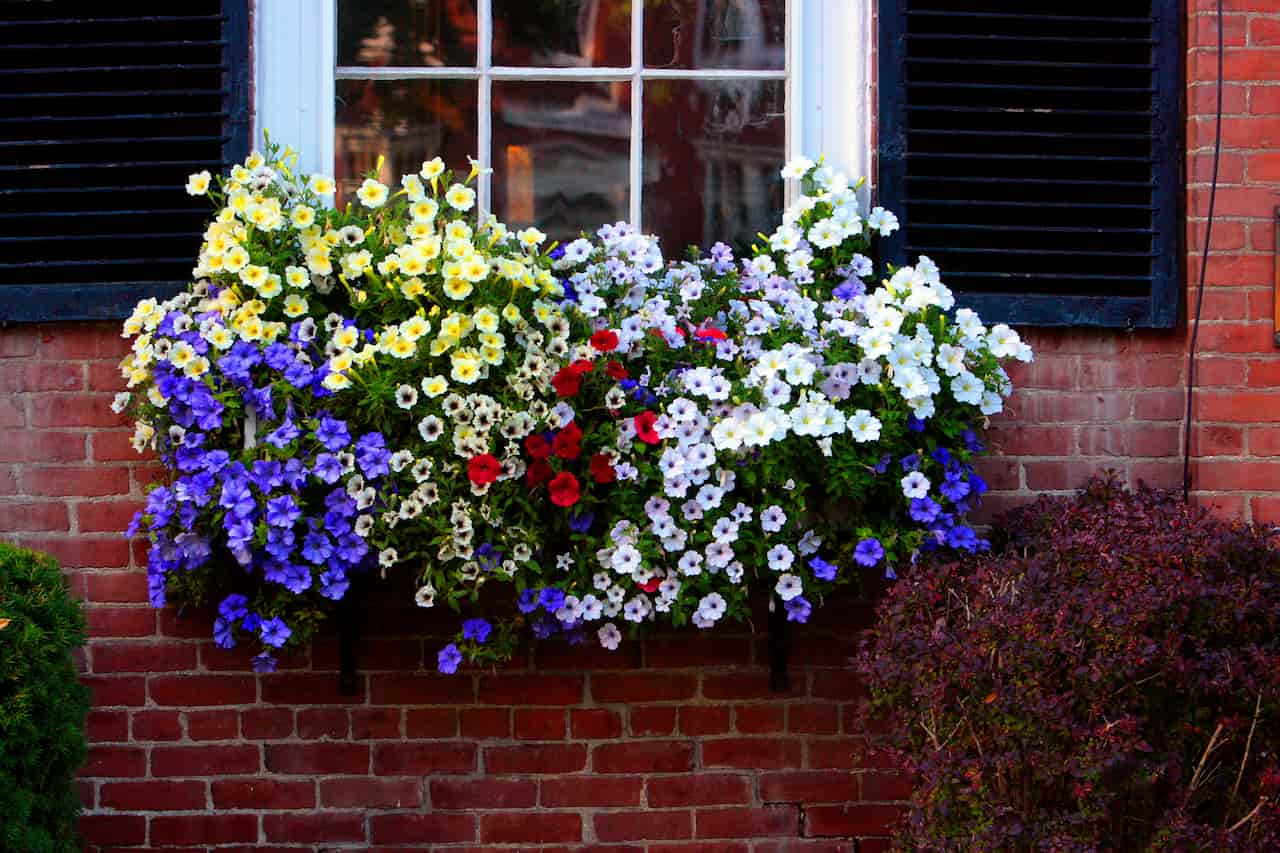
South and west-facing window boxes in full sun support the widest range of plants and can be the most visually spectacular over the longest season. Trailing pelargoniums (ivy-leaved geraniums) are the classic choice – drought-tolerant, long-flowering from May to October, available in a huge colour range and genuinely low-maintenance once established. They forgive occasional missed waterings better than almost any other summer bedding plant and continue flowering prolifically right through to autumn frosts. Calibrachoa (million bells) provides continuous small-flowered colour throughout summer with no deadheading required. Bacopa, verbena, bidens and trailing lobelia all work well as gap-fillers around more upright anchor plants.
For a structured planting, combine one or two upright thriller plants – osteospermum, upright salvias or agapanthus in a larger box – with trailing fillers around the edges. This thriller-filler-spiller approach creates visual depth and interest that a single-variety planting cannot achieve. In late summer, replant sunny boxes with ornamental kale, winter pansies, cyclamen and trailing ivy for autumn and winter colour. A winter box that looks good through January and February is far more satisfying than a bare box from October to April, and the winter plants are inexpensive and require almost no maintenance through the cold months.
Plants for shaded window boxes
North and east-facing window boxes present more of a planting challenge but are by no means impossible. Begonias – particularly the Illumination and Pendula series – are the most reliable shade-tolerant summer bedding for window boxes. They flower prolifically in quite deep shade where almost nothing else manages and produce a long season of colour from June through to the first frosts. New Guinea Impatiens hybrids, bred specifically for downy mildew resistance, have replaced standard busy Lizzies as the reliable option for shaded positions. Fuchsias with their pendulous flowers suit shadier positions well and are among the most elegant window box plants available, combining well with trailing foliage plants to create a layered, textured display.
For the most challenging north-facing positions, the most productive approach is to lean into foliage rather than flowers. A combination of trailing ivy, variegated euonymus, silver-leaved helichrysum and the occasional fuchsia or begonia for colour provides a box that looks genuinely good even in the most difficult position. Winter interest in a shaded box is actually easier to achieve than summer colour – ivy, dwarf conifers, winter pansies and heathers all perform perfectly well on a north-facing ledge and create a display that requires virtually no attention through the coldest months.
Herbs and vegetables in window boxes
A south or west-facing window box is one of the most practical places to grow culinary herbs – right outside the kitchen window, easy to pick from and productive enough for regular use. Basil, parsley, chives, thyme, mint and coriander all grow well in boxes of at least 15cm depth and produce a continuous supply when harvested regularly by pinching rather than stripping. Avoid planting mint with other herbs as it is invasive – give it its own box or confine it in a sunken pot within a mixed planting. A partially shaded box where other herbs struggle is actually well-suited to mint, which tolerates lower light levels better than most culinary herbs.
Herbs in window boxes need more frequent harvesting than herbs in a garden border – regular cutting prevents them running to seed and encourages bushy, productive growth throughout the season. Basil in particular needs pinching out every week once it begins to produce flower spikes, which should be removed immediately as the plant stops producing aromatic leaves once it sets seed. Thyme, chives and parsley are more forgiving and will continue producing through light harvesting, but all benefit from a hard cut back to half their height in midsummer to stimulate a flush of fresh growth for autumn use.
Container-suited vegetable varieties are specifically bred for confined root space and reduced watering, and perform significantly better than standard garden varieties in a window box situation. Compact cherry tomatoes such as Tumbling Tom, dwarf French beans and trailing courgettes can be grown in deep window boxes of 25cm or more in full sun, producing a genuine crop from a window ledge over the course of the summer. The key requirements for vegetable window boxes are depth – the minimum that will support a productive crop is around 20-25cm – and consistent feeding once plants are established and actively growing. The same high-potash regime used for container tomatoes applies to all fruiting vegetable crops in window boxes.
Never mount a heavy window box on a window frame or sill without checking it can take the load. A 60cm wooden box filled with wet compost and mature plants can easily exceed 20kg. Many UK window frames, particularly in older properties and flats, are not structurally designed to bear this weight. Fix brackets into the masonry of the wall below or beside the window, not into the frame itself. If in doubt, weigh the planted box on bathroom scales and have a builder or surveyor confirm the fixing method is adequate before mounting it at height.
Share on socials: