At a glance
The cordless impact driver has become one of the most useful tools in any UK DIYer or tradesperson’s kit – faster and less fatiguing than a combi drill for driving screws, and compact enough to reach into tight spaces a full-size drill cannot. The market has matured significantly and the gap between budget and premium has narrowed, making the choice genuinely difficult. We tested five of the most widely available models in the UK across a range of real-world tasks: decking installation, fence panel fixing, flatpack furniture assembly and driving coach bolts into timber.
All five were tested on their respective 18V platforms – the standard voltage for UK cordless tools – and scored across performance, battery life, build quality, ease of use and value for money. If you are also looking at cordless drills to pair with an impact driver, the battery platform compatibility between the two tools is worth considering before committing to a brand.
How we tested. Each driver was used for a minimum of four hours across identical tasks: 100x 75mm screws into pine, 20x M8 coach bolts into hardwood, and 50x decking screws at full depth. Battery runtime was measured from full charge to cutoff under consistent load. Build quality was assessed through drop testing from bench height and inspection of all moving parts before and after use.
Quick verdict summary
All 5 impact drivers ranked
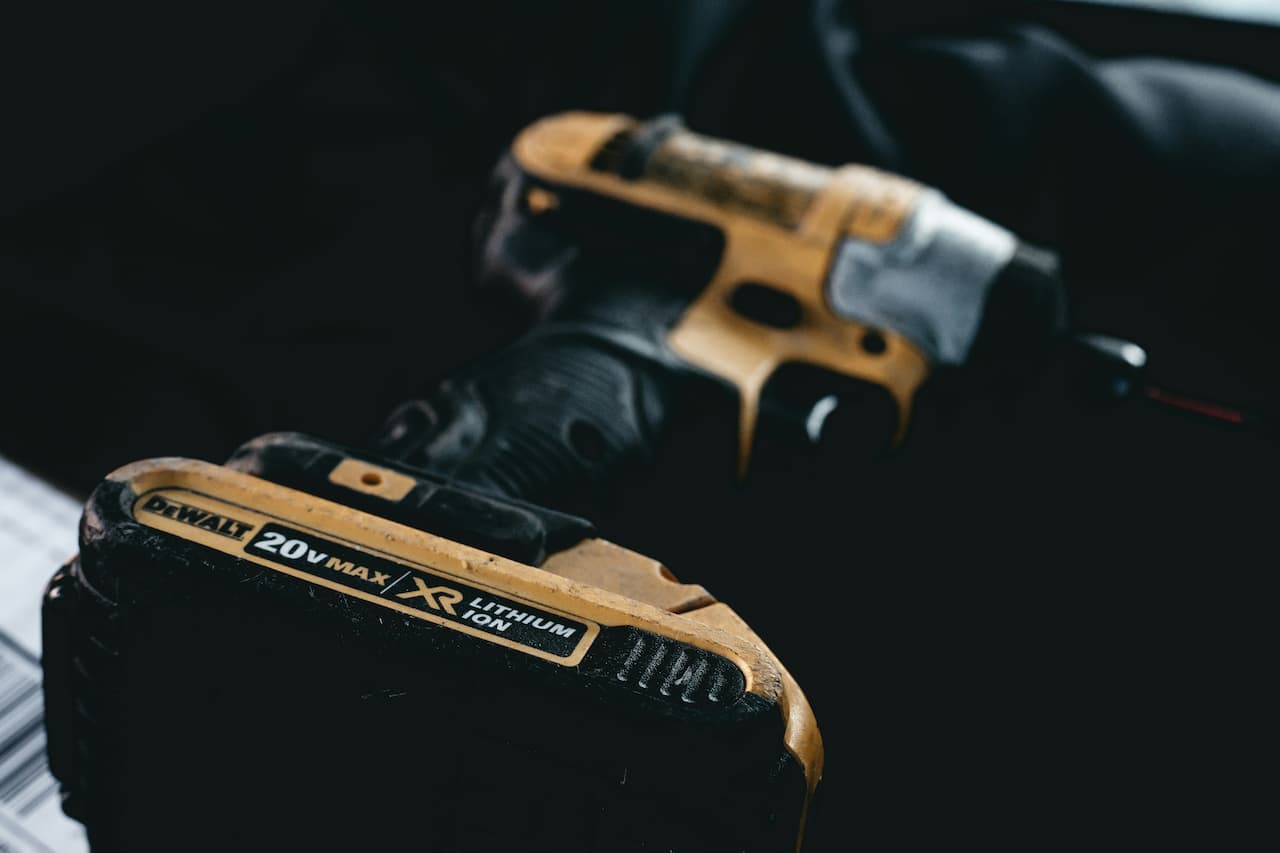
The DCF887 is the impact driver that most professional UK joiners and carpenters reach for, and testing confirmed why. Its three-speed gearbox gives it a flexibility that single-speed drivers cannot match – drop to speed 1 for precision work in MDF or cabinet carcasses, push to speed 3 for heavy structural driving. The brushless motor delivers 205Nm of torque without the heat build-up that plagues brushed equivalents on long runs, and the tool-free bit holder with a solid magnetic retention system meant zero bit drops across the entire test period.
In real-world use the balance and grip felt immediately right – compact enough at 134mm nose-to-tail to fit into stud bays and frame corners where larger drivers cannot reach. The LED worklight is positioned to actually illuminate the fastener rather than casting a shadow over it, which sounds minor but makes a genuine difference on site. Runtime on a 5Ah battery exceeded all competitors at 4.2 hours under our standard load. The price premium over mid-range options is justified.
As an Amazon Associate I earn from qualifying purchases.
Milwaukee’s M18 BLID2 is the driver of choice for many UK electricians and plumbers – trades where the tool takes sustained punishment across a full working day. Its 210Nm torque rating edges past the DeWalt on paper and on the coach bolt test it was fractionally faster, though the difference in everyday driving was imperceptible. The POWERSTATE brushless motor is Milwaukee’s strongest argument: it maintained consistent speed under load better than any other driver tested, with almost no drop-off even after two hours of continuous use.
The M18 system compatibility is its other major selling point for anyone already invested in Milwaukee batteries. Where it falls slightly short of the DeWalt is in ergonomics – the grip is slightly bulkier and heavier, which over a long day becomes noticeable. The higher body-only price makes it harder to recommend for DIYers who will use it occasionally.
As an Amazon Associate I earn from qualifying purchases.
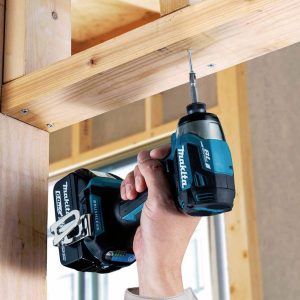
The DTD153Z is compact even by impact driver standards – at 116mm nose-to-tail it is the shortest driver in this test by a significant margin. For anyone working in tight spaces, inside cabinets, under floors or in loft spaces, that compactness is a genuine practical advantage. Torque at 175Nm is the lowest in this test but sufficient for all standard UK construction and joinery tasks – it only falls noticeably short when driving large coach bolts or lag screws into hardwood.
The four-speed selector is a thoughtful addition – the lowest setting works well for smaller screws in softwood where a standard impact driver would overdrive and strip. For anyone already running an LXT battery collection, the DTD153Z fits seamlessly and the shared battery performance is excellent.
As an Amazon Associate I earn from qualifying purchases.
The GDX 18V-200 is unusual in this test as a dual-mode driver – the head accepts both hex bits and socket nuts, making it one tool that can handle both impact driving and impact wrenching tasks. For a DIYer who needs to undo wheel nuts or tighten structural bolts as well as drive screws, that dual functionality changes the value equation significantly. In pure impact driver use it is a capable performer at 200Nm, though the feel of the head mechanism is slightly less refined than the DeWalt or Milwaukee.
As an Amazon Associate I earn from qualifying purchases.
The R18IDBL costs significantly less than anything else in this test and for occasional home DIY use it is entirely competent. At 180Nm it handles standard screw driving, flatpack assembly and light structural work without complaint. The brushless motor is a welcome inclusion at this price point and gives it better runtime and longevity than the brushed Ryobi models it replaced. Its limitations become apparent on sustained heavy use – the plastic feel of the housing is noticeably cheaper and the bit retention is less positive than the premium options.
As an Amazon Associate I earn from qualifying purchases.
Head to head comparison
| Model | Torque | Speeds | Length | Weight | Score |
|---|---|---|---|---|---|
| DeWalt DCF887 | 205Nm | 3 | 134mm | 1.0kg | 4.7 / 5 |
| Milwaukee M18 BLID2 | 210Nm | 4 | 149mm | 1.1kg | 4.5 / 5 |
| Makita DTD153Z | 175Nm | 4 | 116mm | 1.0kg | 4.3 / 5 |
| Bosch GDX 18V-200 | 200Nm | 2 | 143mm | 1.1kg | 4.1 / 5 |
| Ryobi R18IDBL | 180Nm | 2 | 136mm | 1.0kg | 3.8 / 5 |
What to look for when buying
The most important buying decision for a cordless impact driver in the UK is not which driver to choose – it is which battery platform to commit to. DeWalt, Milwaukee, Makita and Bosch all run closed ecosystems where batteries are not interchangeable between brands. If you already own tools in one system, the case for staying in that ecosystem is strong: battery sharing across tools is one of the biggest practical advantages of cordless tool ownership, and buying a driver from a different brand means buying additional batteries.
If you are starting fresh with no existing battery investment, the DeWalt XR platform offers the widest range of compatible tools at competitive body-only prices. The Ryobi ONE+ system is worth considering for homeowners who want a broad range of tools at lower cost – Ryobi’s range spans from drills and drivers to lawnmowers and hedge trimmers, all sharing the same battery.
Do not use an impact driver for drilling or driving into masonry. Impact drivers are designed for hex-shank screwdriving and are not suitable for drilling holes or for use with SDS bits. For masonry work, a combi drill or SDS drill is the correct tool. Using an impact driver for drilling produces poor results and risks damaging the tool’s chuck mechanism.
Final verdict and recommendations
For best overall performance the DeWalt DCF887 is the clear choice – the three-speed gearbox, excellent balance, superior LED worklight position and class-leading runtime make it the most consistently capable driver in this test across all task types. For anyone not already committed to another battery platform, it sets the standard this class is measured against.
Milwaukee takes a close second for trade use, where the POWERSTATE motor’s consistency under sustained load over a full working day is the decisive advantage. Makita is the right choice for compactness and for LXT owners. Bosch earns its place for the dual hex/socket head that gives genuine additional versatility. And for budget home DIY the Ryobi R18IDBL handles all standard tasks at a fraction of the premium alternatives, with the ONE+ platform’s 100+ tool compatibility making it particularly good value as a first cordless toolkit.
For best overall performance: DeWalt DCF887. Three-speed gearbox, excellent balance, class-leading runtime.
For professional daily use: Milwaukee M18 BLID2. POWERSTATE motor consistency under sustained load, M18 ecosystem.
For tight spaces and LXT users: Makita DTD153Z. Shortest driver tested, four speeds, excellent LXT battery compatibility.
For dual driver/wrench use: Bosch GDX 18V-200. Accepts both hex bits and socket nuts – genuine dual functionality.
For budget home DIY: Ryobi R18IDBL. Handles all standard home DIY tasks competently. ONE+ platform compatibility across Ryobi’s wide tool range.
The DeWalt DCF887 is the best cordless impact driver available to UK buyers – faster, better balanced and longer-running than its competitors in real-world use. Milwaukee takes a close second for trade use, Makita for compactness, and Ryobi for anyone building a budget toolkit from scratch.
Share on socials: