At a glance
Hoverflies are the UK’s second most important group of pollinators after bees, with over 280 native species visiting gardens from early spring through to late autumn. Unlike bees, they are completely harmless – they cannot sting, they do not bite, and the yellow-and-black banding many species display is pure mimicry of wasps, a defence mechanism rather than a genuine threat. Hoverflies are also one of the most valuable natural pest controllers available to any gardener. Many species lay their eggs directly into aphid colonies, and the larvae that hatch spend two to three weeks consuming aphids at a rate that no spray or physical intervention can match.
Despite this, hoverflies are considerably less well known and less deliberately catered for than bees or butterflies. The plants that attract them most effectively, the larval habitats they depend on, and the management practices that support their populations are all straightforward and inexpensive to implement. A garden that provides the right flower types across as long a season as possible, alongside some undisturbed ground and decaying organic matter, will support a hoverfly community that delivers meaningful pest control and pollination year after year.
Why hoverflies matter more than most gardeners realise
The pollination contribution of hoverflies is frequently underestimated because they are less visible and less studied than bees. Research into crop pollination has consistently found that hoverflies are significant pollinators of a wide range of vegetables and soft fruit crops including onions, carrots, brassicas, strawberries and raspberries. In years when bee populations are low, hoverfly pollination becomes disproportionately important. Some hoverfly species are also capable of long-distance migration – the marmalade hoverfly regularly migrates in vast numbers from continental Europe each summer, supplementing resident populations and providing a seasonal boost to pollination activity across the UK.
The aphid control provided by hoverfly larvae is one of the most underappreciated natural services in any garden. A single hoverfly larva can consume several hundred aphids before it pupates. A garden with an established hoverfly population will experience visibly lower aphid pressure on roses, beans, brassicas and soft fruit than one without – not because the hoverflies eliminate aphids entirely but because they are present and active throughout the aphid breeding season, consuming eggs and young larvae before infestations build to damaging levels. This is a fundamentally different kind of pest management from reactive spraying – it is continuous, invisible and free.
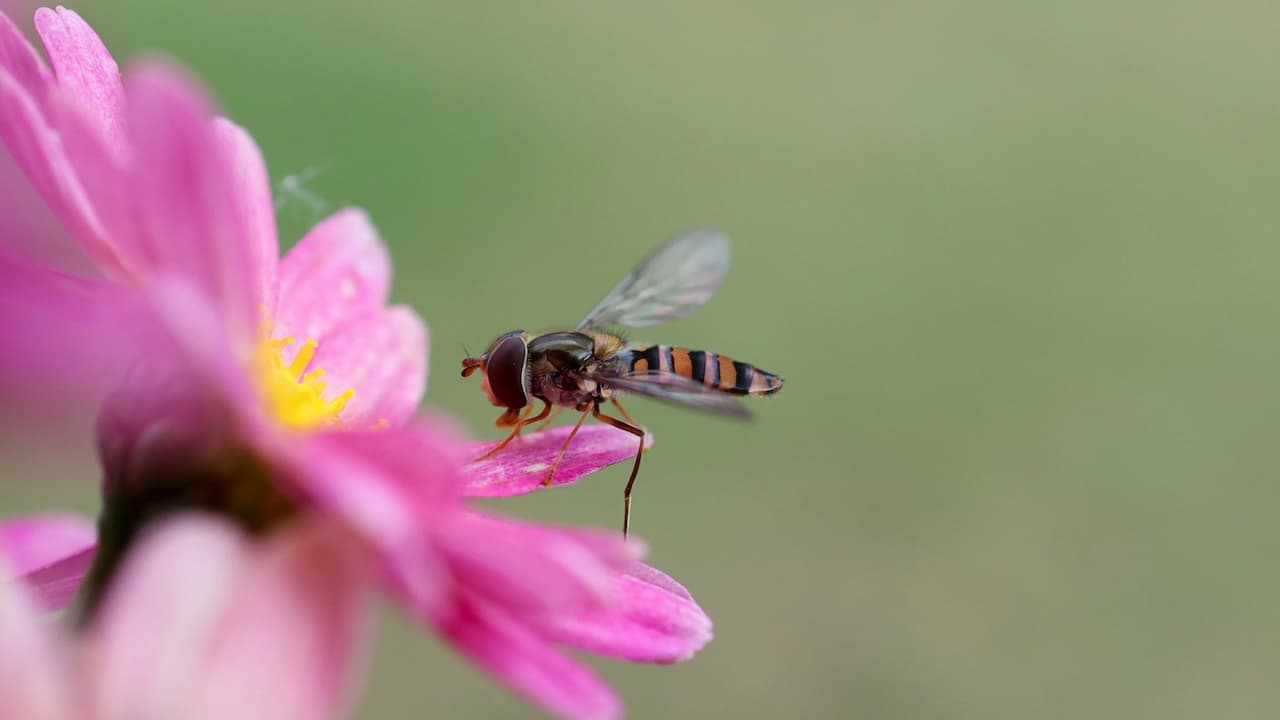
Hoverflies are not wasps. The yellow-and-black colouring of many UK hoverfly species is Batesian mimicry – a harmless species imitating a harmful one to deter predators. Hoverflies have no sting, no venom and no defensive capability. They are entirely harmless to handle. A hoverfly sitting on your hand is simply resting or investigating a salt trace. The easiest way to distinguish them from wasps is the eyes: hoverflies have enormous compound eyes that often meet at the top of the head, and they hover with a distinctive stationary stability that wasps do not replicate.
The best plants for hoverflies
Hoverflies feed exclusively on pollen and nectar as adults, and their mouthparts are shorter and less specialised than those of bees. This means they can only access pollen and nectar from flowers with shallow or open structure – deep tubular flowers that bumblebees can reach are simply not accessible to most hoverfly species. This makes the choice of flower shape more important than the choice of flower species. Flat-topped, open and shallow flowers are the key design criterion. Umbellifers – the carrot family – are particularly valuable because their tiny individual florets are arranged in flat-topped clusters that are almost perfectly designed for hoverfly access.
Phacelia tanacetifolia is often described as the single best hoverfly plant available in the UK. It flowers prolifically over a long season, its open bell-shaped flowers are perfectly accessible to hoverfly mouthparts, and it can be direct-sown in succession from April through July to maintain a continuous nectar source across the season. It is also one of the best green manures available, and its blue-purple flowers attract a wider range of beneficial insects than almost any other annual. Sow a patch near vulnerable vegetable crops – beans, brassicas and soft fruit – and the combination of adult nectar source and larval aphid colony nearby creates conditions where hoverfly populations establish and maintain themselves naturally.
Avoid double-flowered varieties of any plant where a single-flowered alternative exists. Double flowers have their petals arranged so densely that pollen and nectaries are physically inaccessible to most hoverfly species. A double-flowered marigold or rose provides almost no benefit to hoverflies regardless of how many are planted, while the equivalent single-flowered variety of the same plant is highly valuable. This distinction matters particularly with marigolds, which are commonly planted for pest control but only deliver that benefit in their single-flowered forms.
Larval habitat and breeding sites
Understanding hoverfly larvae is key to understanding why a garden that looks pollinator-friendly can still fail to support a healthy hoverfly population. Adult hoverflies feed on nectar and pollen, but the larvae have entirely different requirements depending on species, and those larval requirements are what actually determine whether a hoverfly population can establish and reproduce in a given garden rather than just passing through.
The most garden-relevant larval type is the aphidophagous group – species such as Episyrphus balteatus (the marmalade hoverfly) and Syrphus ribesii whose larvae live directly in aphid colonies. These are the species that provide the most obvious pest control benefit, and supporting their reproduction requires nothing more than tolerating small aphid infestations on plants like nettles, beans and roses long enough for hoverfly females to lay eggs among the colony. The larvae that hatch are pale green or creamy-coloured and may be visible on stems among the aphids if you look closely – they move slowly and can be distinguished from aphids by their legless, tapering body shape.
Saprophagous larvae, which feed on decaying organic matter, support a large proportion of UK hoverfly species including some of the most attractive and least commonly seen. Wet rotting wood, compost heaps, and the accumulated damp organic matter at the base of old trees are all important breeding habitats. A log pile allowed to decay in a shaded corner, or a compost heap with some consistently damp organic matter, will support several saprophagous hoverfly species that would not otherwise breed in the garden. These species tend to be among the better wasp mimics – the large, convincingly wasp-like hoverflies often seen hovering at eye height in woodland glades are typically from this group.
Insecticide sprays kill hoverfly larvae before adults can remove aphids naturally. A garden with hoverfly eggs or young larvae present in an aphid colony will resolve the infestation naturally within two to three weeks if left unsprayed. Spraying kills not only the aphids but the beneficial larvae already working through the colony, preventing natural control and leaving the plant more vulnerable to the next aphid flush. If aphid pressure on a specific plant is severe, use a targeted physical removal rather than a broad-spectrum spray.
Garden management for hoverflies
The garden management decisions that most benefit hoverflies are not about adding things but about stopping removing them. Hoverfly populations decline primarily when gardens are managed too intensively – when every dead stem is cut back, every leaf pile removed, every aphid colony sprayed before larvae can develop, and every flower replaced with a double-flowered variety. The most impactful changes are the ones that add some tolerance of natural processes to the standard garden maintenance routine.
Timing the garden tidying routine is one of the most impactful changes. Autumn cutbacks remove not only plant material but the pupae sheltering within hollow stems and the eggs laid in leaf litter. Delaying the annual cutback from October or November to February or March allows those overwintering stages to complete development and emerge in spring. The garden looks slightly untidier through winter, but the population of hoverflies that emerges in March is significantly larger than one from a garden that was cut back hard in autumn.
Common UK hoverfly species
Identifying hoverfly species is a specialist skill that requires magnification and a good field guide, but several species are distinctive enough to recognise in the garden without specialist knowledge. The marmalade hoverfly is the most commonly seen species in UK gardens – it is medium-sized with distinctive orange-yellow and black banding interrupted by two dark smudges on the abdomen, and it is seen hovering over flowers from spring right through to autumn. It migrates into the UK in large numbers each summer, supplementing the resident breeding population.
The presence of multiple hoverfly species in a garden is one of the strongest indicators of a healthy insect community. Hoverflies sit mid-way in the food chain – their larvae are preyed upon by birds and other invertebrates, while adult hoverflies are themselves taken by spiders, robins and other insectivores. A garden that supports a diverse hoverfly population is invariably one that also supports a richer community of the birds, bats and other predators that feed on them. The management changes required to support hoverflies are almost entirely the same as those that benefit other beneficial insects, so the effort investment has multiplying returns across the whole garden ecosystem.
Share on socials: