At a glance
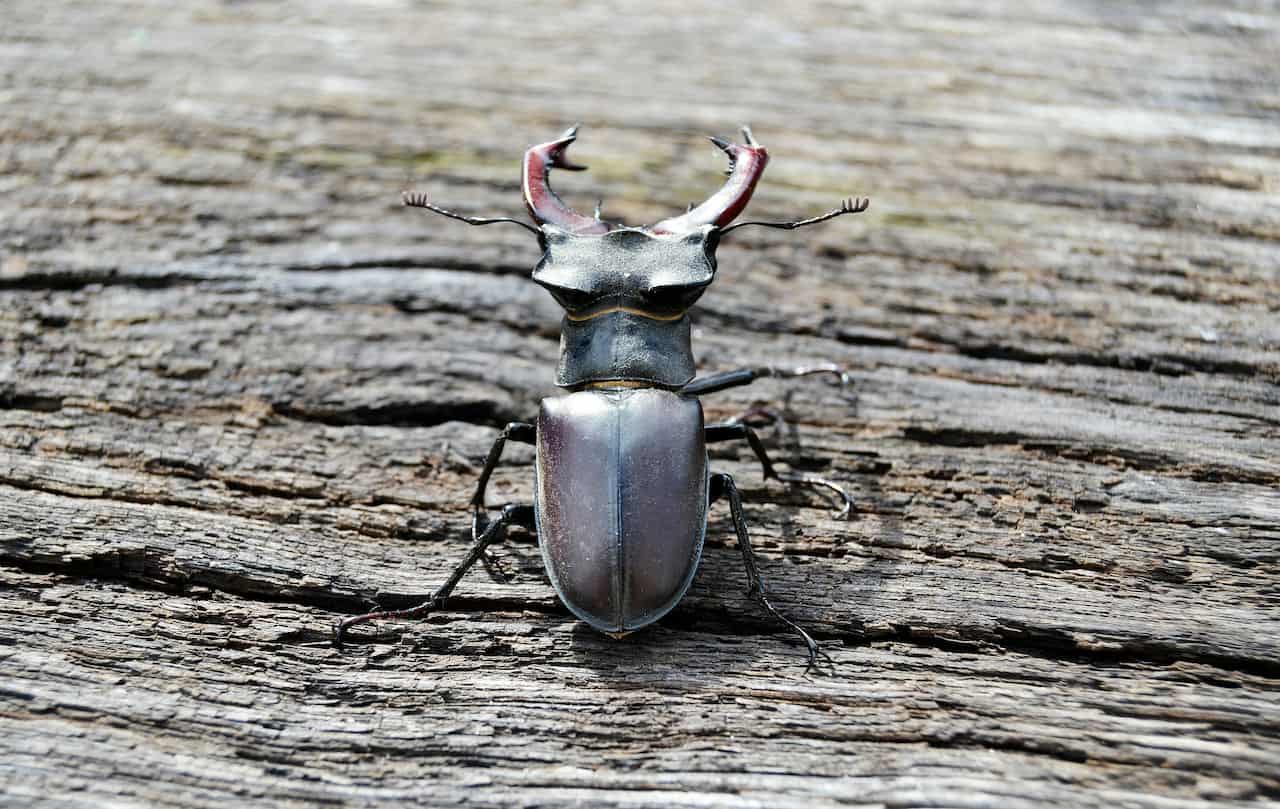
The stag beetle is Britain’s largest native beetle and one of its most striking insects. Males can reach 7.5cm in length and carry the spectacular branched mandibles that give the species its name. Despite their dramatic appearance they are entirely harmless – the mandibles are used for competing with other males rather than for defence or feeding, and adults survive primarily on fruit juice and tree sap rather than anything that would make them a pest. They are also, unfortunately, in serious decline across much of their European range, and the UK holds one of the most important remaining populations.
Stag beetles are a species of the south and southeast of England – the majority of UK sightings come from London, Surrey, Sussex, Hampshire and neighbouring counties, with populations becoming sparser further north and west. If you live outside this range, attracting stag beetles to your garden is unlikely to be achievable simply because there may be no local population within flight range. Within the core range, however, garden habitat genuinely matters: stag beetle larvae spend 3-7 years underground in rotting wood, and a garden with suitable habitat can support a breeding population for decades if managed correctly.
About stag beetles
Understanding the stag beetle’s lifecycle is essential to providing the right habitat, because what the beetle needs at each stage is very different from what most people imagine. Adults are seen flying on warm evenings from May to August, particularly at dusk, but the adult stage lasts only a few weeks and the beetles do not feed significantly during this time. The remarkable part of the lifecycle is the larval stage, which lasts between 3 and 7 years. The larvae live underground in decaying wood – specifically the soft, crumbling heartwood of dead or dying broadleaf trees and buried timber – where they feed and grow through several instars before pupating and emerging as adults.
The most critical thing to understand is that stag beetles cannot use fresh wood. The larvae require timber that has already begun to decay – specifically wood that has been in contact with the soil for long enough that fungi have started the decomposition process, softening the heartwood into the material the larvae can digest. This is why simply placing logs on top of the soil is less effective than burying them, and why old tree stumps are prime stag beetle habitat while freshly cut timber is not.
Never disturb or remove stag beetle larvae if you uncover them in the garden. The large cream grubs – sometimes mistaken for chafer grubs – are stag beetle larvae and represent years of development. Replace any disturbed soil immediately and avoid the area. If you find larvae while digging, carefully replace them in the same location at the same depth and leave them undisturbed. Stag beetles are a Priority Species under the UK Biodiversity Action Plan.
Creating log pile habitat
A log pile is the most recognisable wildlife habitat feature in a UK garden, and for stag beetles it provides two things: potential egg-laying sites for females, and the beginning of the long decomposition process that will eventually produce the soft rotting wood larvae need. Not all log piles are equally useful, and the details of how they are constructed and positioned make a significant difference to how quickly they become functional habitat.
Oak is the preferred timber and produces the best results – oak wood decays slowly, maintaining its structural integrity for years while the inner material softens into the consistency larvae prefer. Ash, beech, fruit woods and other broadleaf species all work. Avoid conifers – their resinous wood is not suitable for stag beetle larvae and the resin actively inhibits the fungal decay that the larvae depend on. Never treat logs with preservative. The whole point is controlled decay, and any chemical treatment that slows or prevents fungal activity defeats the purpose entirely.
Burying logs – the most effective method
Burying logs vertically so that roughly half their length is below soil surface is the single most effective thing a UK gardener can do for stag beetles. The buried portion decays faster than the above-ground section because it is in direct, sustained contact with the fungi and moisture in the soil. It also creates the underground environment that females actively seek out for egg-laying – a subterranean mass of softening wood connected to the soil, which is exactly what a stag beetle needs.
To create a buried log feature, dig a hole at least 40cm deep and wide enough for one or more substantial logs. Oak is ideal – sections of trunk or large branch at least 20cm diameter. Lower the logs vertically into the hole and backfill with the original soil, leaving 10-15cm of log protruding above ground. The exposed section allows female beetles to locate the feature and begin egg-laying at the soil interface, while the buried section provides the decaying habitat the larvae need. A cluster of three to five buried logs in a shaded area of the garden, left completely undisturbed, represents the highest-value stag beetle habitat a domestic garden can create.
An old tree stump left in situ is the best stag beetle habitat a garden can contain. If you have an old broadleaf tree stump in the garden that is already decaying, do not remove it. Cut it level with the ground if necessary for safety but leave the root system in place – this is exactly what stag beetle larvae need, and an established stump with an existing root system underground may already be supporting a larval population without you knowing it.
Garden management for stag beetles
The way a garden is managed has a significant impact on whether stag beetles can use it, beyond the specific provision of log piles and buried timber. Several common garden practices actively harm stag beetle populations, and avoiding them is as important as the positive habitat creation work.
Reducing outdoor artificial lighting on summer evenings is particularly relevant. Stag beetles fly at dusk and in the early evening, and bright exterior lighting disorients them and disrupts the mating flights that are essential for reproduction. Motion-sensitive lighting that activates only when needed is preferable to all-night lighting from May to August.
If you spot one – what to do
Stag beetles are seen most often on warm evenings in June and July. Males fly at dusk in a characteristic heavy, buzzing flight, typically at around head height. Females are less often seen in flight but walk on the ground searching for egg-laying sites – a female stag beetle walking along a path or pavement is looking for suitable soil and should be helped to the nearest garden, lawn or soil area rather than left on hard surfaces where she is vulnerable to being stepped on or run over.
Share on socials: