At a glance
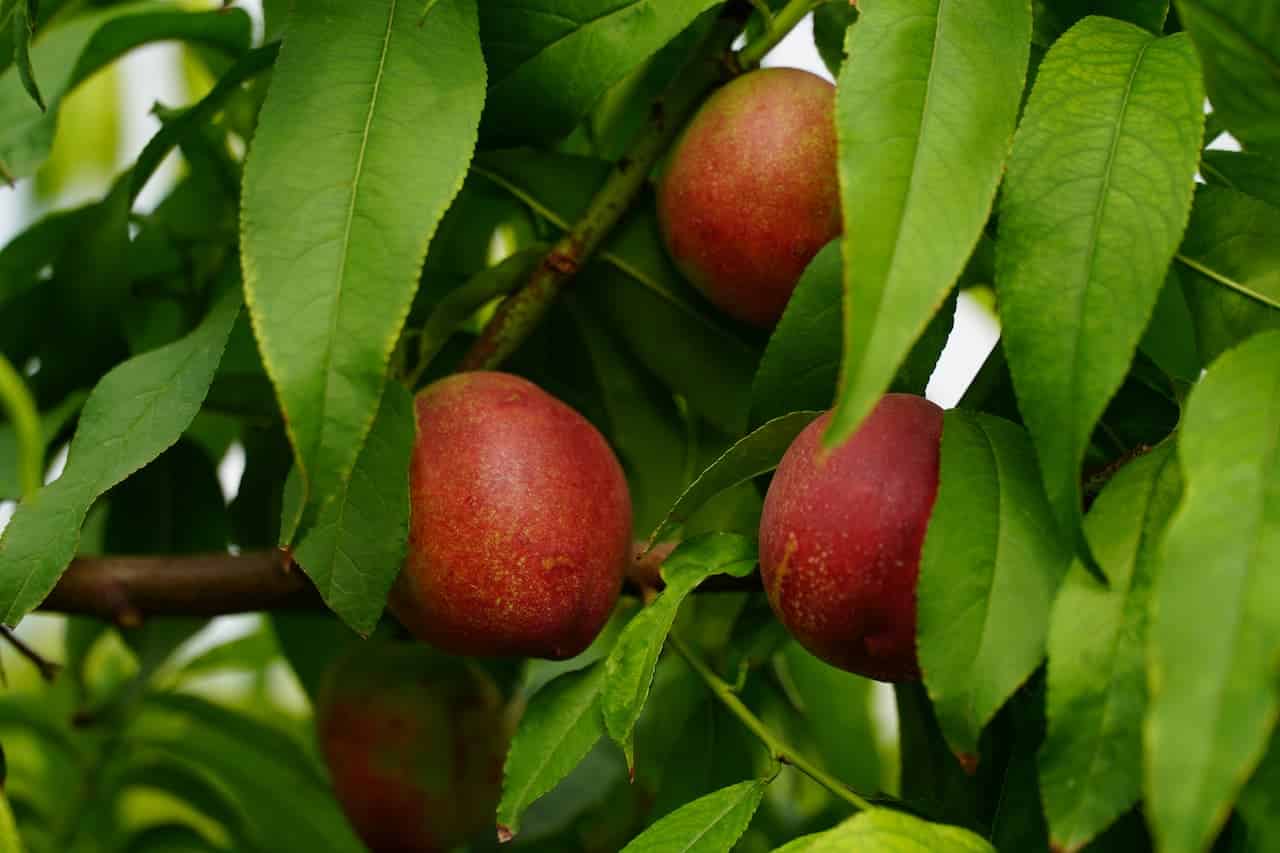
Nectarines are smooth-skinned peaches – botanically the same species (Prunus persica), differing only in the gene that controls skin texture. In terms of growing requirements, pruning, training and care they are identical to peaches, and everything that applies to growing peaches in the UK applies equally to nectarines. The practical distinction is that nectarines tend to be slightly more tender than peaches, making them marginally more demanding of a warm, sheltered position – but in return they often produce fruit of exceptional quality and flavour, particularly the white-fleshed varieties.
For UK gardens, the same south-facing wall approach that makes peaches possible makes nectarines possible too. The main challenge is peach leaf curl disease – a fungal condition caused by Taphrina deformans that spreads through rain splash onto swelling buds – and the most effective solution is a simple rain shelter fitted over the tree from November to mid-May. If you can grow peaches successfully, you can grow nectarines. A well-ripened nectarine harvested in August from a wall-trained tree is among the finest fruits a British garden can produce.
Nectarine vs peach
The only genetic difference between a nectarine and a peach is a single recessive gene controlling skin texture. In practical growing terms, nectarines are slightly less cold-tolerant at blossom time and their thinner skin makes the developing fruit more susceptible to cold, wet conditions. Everything else – soil, position, rootstock, pruning and disease management – is the same. Both flower in March and carry the same risk of frost damage to blossom, which is why a sheltered, south-facing wall with some thermal mass is important for both.
Best varieties for UK gardens
Lord Napier has been grown in British kitchen gardens since the 1860s and is the most reliable nectarine for UK conditions. Its white-fleshed fruit ripens in early August, and it flowers slightly later than most varieties, which reduces the risk of frost damage to blossom – a meaningful advantage in unpredictable British springs. Early Rivers is the earliest-ripening variety available, ready from late July, and the best choice for northern gardens where the season is shortest. Fantasia is yellow-fleshed, productive and a reliable cropper. Nectarella is a compact genetic dwarf that stays under 1.5m and grows well in a large container, making it the practical choice where wall space is not available.
Planting and position
Plant nectarines against a south or south-west facing wall in a sheltered garden. The wall provides two things a nectarine needs: reflected heat to ripen the fruit, and protection from the cold north and east winds that damage blossom in March. Soil should be well-drained and fertile, ideally slightly alkaline to neutral. Prepare the planting hole generously and work in well-rotted organic matter. Plant the tree 20-30cm away from the wall base so the roots are not in the driest ground, and angle the stem back toward the wall. The graft union – the swollen joint between rootstock and scion – should sit slightly above soil level. Plant between November and March when the tree is dormant, firm well and water thoroughly after planting.
Fix horizontal training wires at 30cm intervals before or immediately after planting so the first canes can be tied in straight away. Most UK nurseries graft nectarines onto one of two rootstocks. St Julien A is semi-vigorous and the standard choice for wall-trained fans, producing a tree that will eventually cover 3-4m of wall. Pixy is more dwarfing, producing a smaller tree of around 2-2.5m – useful for confined walls or for keeping a fan compact and accessible. Both work well in the ground; Pixy is also suitable for very large containers. Neither rootstock affects fruit quality directly, but trees on Pixy will need more careful watering and feeding as the restricted root system has less access to soil moisture and nutrients.
Soil pH should ideally sit between 6.0 and 6.5 – slightly acidic to neutral. Outside this range, nutrient uptake becomes impaired regardless of how much fertiliser is applied. If your soil is markedly alkaline, annual mulching with acidic organic matter and high-potassium feeds will help, but it is worth checking pH with a simple soil test before planting and adjusting with sulphur if needed. Avoid planting on soil where a peach, nectarine or cherry tree has recently grown – replant disease caused by microscopic soil organisms can severely check establishment in the first season. If replanting on the same spot is unavoidable, replace the soil in the planting hole with fresh compost and topsoil from another part of the garden.
Nectarines in containers need a pot at least 45cm wide and deep. Use a soil-based compost mix such as John Innes No. 3, which holds moisture and nutrients better than lightweight peat-free mixes and is heavy enough to keep the pot stable. Container-grown trees can be moved under cover – a cold greenhouse or porch – during the wettest months to reduce leaf curl spore exposure, and brought back outside once hard frost risk has passed in late April. Feed container trees with a liquid high-potassium feed every two weeks from when the fruit begins to swell in June until harvest, and with a balanced fertiliser in early spring. In dry weather, container trees may need daily watering – push a finger into the compost and water if the top 5cm feels dry.
Hand-pollinate in March for better fruit set. Nectarines flower when pollinating insects are largely absent. On a dry, still day when flowers are fully open, run a soft dry paintbrush gently over each open flower. This transfers pollen between flowers and significantly improves fruit set on sheltered wall-trained trees where bees cannot easily reach every flower.
Pruning and training
Nectarines are fan-trained against a wall using the same method as peaches. A permanent framework of radiating branches is established in the first two to three years from a young maiden tree, then annual pruning renews the fruiting wood each season. Nectarines fruit on shoots produced the previous year, so the aim is always to have replacement shoots developing alongside the current season’s fruiting shoots, ready to take their place after harvest. All pruning should be carried out between late March and August, when the tree can seal its wounds. Never prune in autumn or winter as this is when silver leaf fungus – Chondrostereum purpureum – enters through open cuts most easily.
Establishing the fan framework takes patience in the first three years and should not be rushed. Year one: after planting a maiden feathered tree, select two well-placed lateral branches growing roughly 30-40cm from the ground, one on each side, and tie them in at 40 degrees from the main stem on canes fixed to the wires. Cut out the main stem cleanly just above these two branches, and remove all other laterals flush with the main stem. These two arms become the basis of the fan. Year two: allow three or four shoots to develop from each arm, tying them in as they grow to create an evenly-spaced fan. Remove any shoots growing straight out or straight back. Year three: continue extending the framework by selecting shoots to fill gaps, and the tree should begin producing its first modest crop. Full productivity usually arrives in years four and five once the framework is well established across the wall space.
Disease and pest management
Peach leaf curl is the single most significant obstacle to growing nectarines in the UK. The fungus overwinters on the bark and in bud scales, and spreads through rain onto swelling buds between autumn and late spring. Once the leaves have emerged infected, there is no spray treatment that will cure them – the only effective management is prevention. A rain shelter is by far the most effective method. Fix a polythene or polycarbonate lean-to over the wall-trained tree from after leaf fall in November and keep it in place until mid-May, with the sides open at the bottom to allow air circulation and access for pollinating insects. This alone achieves near-complete control of the disease.
Brown rot is the second disease to watch for. It appears in late summer as a circular brown patch on developing fruit that spreads rapidly, turning the fruit to a brown mummified mass. It is caused by Monilinia fructigena and spreads through damaged or cracked skin – often following a period of dry then wet weather that causes the skin to split. Remove and bin affected fruit at once. Never leave mummified fruit on the tree over winter as it harbours spores. Improving air circulation through good annual pruning reduces the conditions brown rot needs to establish. Avoid wetting the fruit when watering – direct water at the base of the tree, not the canopy.
Late frost is the third major threat. Nectarines flower in March, often when night frosts are still possible across most of the UK. A single night below -1C during full bloom can destroy the entire crop. If frost is forecast while the tree is in flower, hang a double layer of horticultural fleece over the branches for the night and remove it by mid-morning to allow pollinating insects access. Container-grown trees can be moved into a cold greenhouse or unheated porch overnight. The difference between a wall-trained tree that flowers against a south-facing wall and one on a more exposed site can be several degrees of frost protection – the thermal mass of the wall radiates stored daytime heat overnight and can make a decisive difference in a marginal spring.
Care, feeding and harvesting
Feed nectarines in early spring with a balanced general fertiliser and again in early summer with a high-potassium feed to support fruit swelling and sweetness. Water regularly during dry spells from June to harvest and mulch the root zone each spring with well-rotted compost or manure, keeping the mulch clear of the main stem. Consistent moisture through fruit development is important – irregular watering causes fruit to split or drop prematurely. When conditions are dry, water deeply twice a week rather than lightly every day to encourage roots to go down rather than stay near the surface where they are most vulnerable to drought stress.
Nectarines are ready to harvest when the fruit gives slightly to gentle thumb pressure near the stalk and lifts away from the branch with a gentle upward twist. Do not pull fruit directly downward or the stalk breaks and the skin tears. A ripe Lord Napier will have a cream-white background flushed with deep crimson. Like peaches, nectarines continue to ripen after picking and should be eaten within two to three days. The quality of a home-grown nectarine at peak ripeness is exceptional – the flavour of fruit bought commercially rarely comes close, since supermarket fruit is always picked before full ripeness to survive transport.
Nectarines do not keep well once ripe – two to three days at room temperature is the realistic window. For surplus fruit, halving and stoning then freezing on a tray before bagging is the most practical method; frozen nectarine flesh works well in smoothies, crumbles and jam. To slightly extend shelf life of freshly picked fruit, store in a single layer in a cool place (not the fridge unless very ripe) and allow to ripen at room temperature. Fruit picked while still slightly firm will continue ripening over one to two days. Resist the urge to pick early – a nectarine harvested a day too soon will never achieve the flavour of one picked at the right moment, and there is nothing more disappointing after a season of careful management than eating fruit that was not quite ready.
Never use old creosote-treated railway sleepers around nectarines or any edible crop. Creosote is classified as a hazardous substance in the UK and is no longer sold for garden use. If raising the bed or building a border near the tree, use untreated or pressure-treated new timber only.
Share on socials: