At a glance
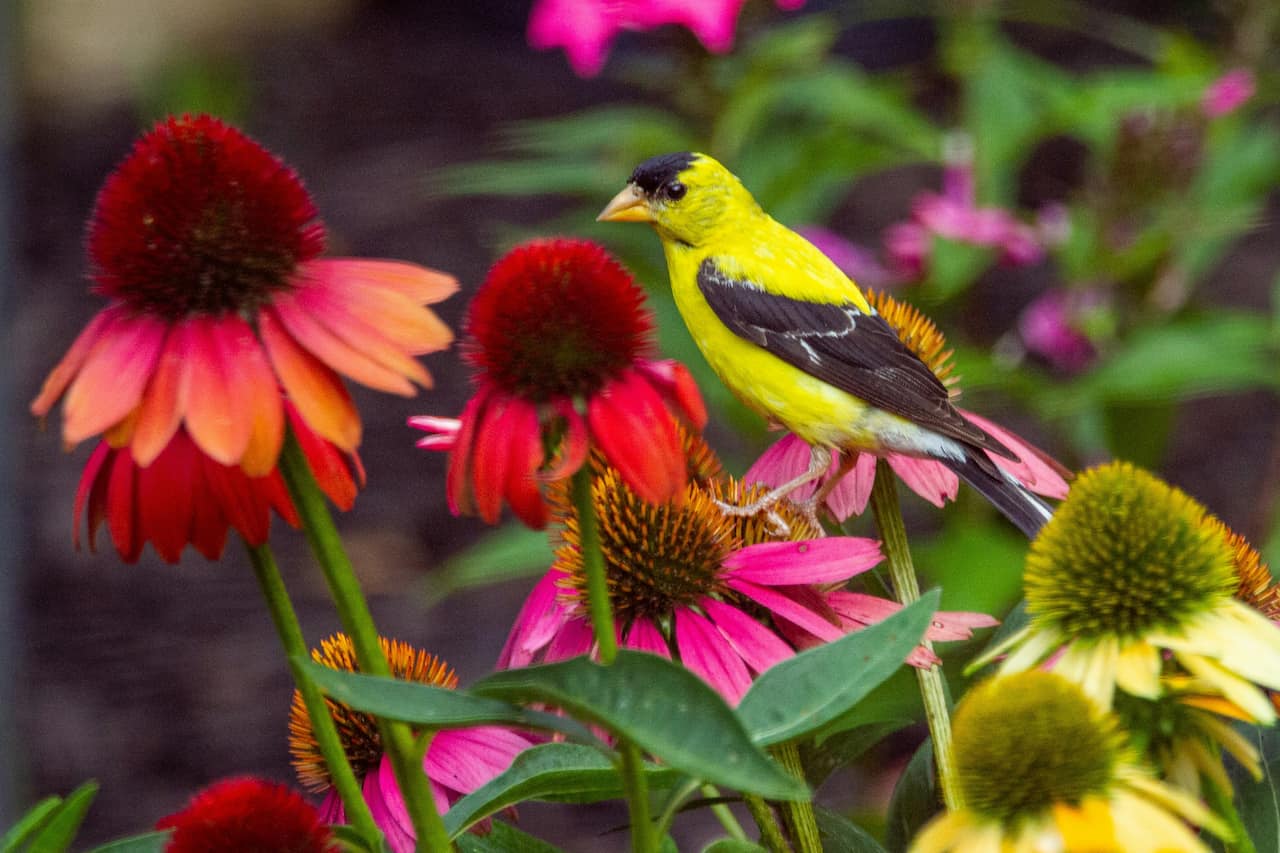
The first time you get a charm of goldfinches on your feeder, a proper group of them, seven or eight birds all squabbling for the best perch, it becomes obvious why people go to considerable lengths to attract them. Red faces, yellow wings, liquid tinkling call, and the spectacle of watching them hang sideways off a mesh feeder working it like a puzzle. Getting them there takes a bit of thought.
If you have never attracted goldfinches before, the quickest route in is niger seed in the right feeder, positioned correctly. Everything else builds on that.
Knowing what you’re looking at
Once you know the goldfinch, you cannot confuse it. The red face mask is the give-away, a vivid red covering the front of the head and framed by black and white. Unusually for UK finches, both male and female carry this pattern. The sexes tend to look quite different in most finch species, but in goldfinches you have to look carefully to tell them apart. On a male the red extends a little further behind the eye, the nose hairs are black, and the wing feathers are pure black. On females the red stops more neatly, the nose hairs are white, and the wing feathers have a slight brown tinge. Honestly, unless you are watching one bird closely and can compare it to another, you often cannot be sure. The yellow wing bar settles the identification regardless: broad, bright, and unmissable when the bird flies.
They are small birds. Twelve centimetres, roughly the length of your hand, under twenty grams. When you see a flock land on a teasel patch, you notice how light they are. The plant barely moves.
Juveniles look quite different. No red face, no black-and-white head, just a streaky buff-brown. They still have the yellow wing bar, which is the clue, and they are almost always seen with adults. You see them from early summer onwards as the first broods fledge.
A group of goldfinches is called a charm, which is one of the better collective nouns in English. Whether that comes from the Latin carmen meaning magic song, or just from what the word means, is open to argument. Watching fifteen of them descend on a patch of teasel does make the name feel right.
Setting up a feeder that actually works
Everything about this bird comes back to seeds. Even the names tell you: Carduelis from the Latin for thistle, Thisteltuige from Anglo-Saxon meaning thistle-tweaker. The bill is built for one job: long for a finch, pointed, precise, designed to prise individual seeds out of tightly packed seed heads. Watch one on a teasel and you can see it working. A quick vibration of the beak in the seed hole widens the gap, then out comes the seed.
Niger seed is the most reliable way to get them to a feeder. Small, black, oil-rich, high in protein and fat, it closely replicates the profile of thistle seed that goldfinches evolved to eat. Squirrels have no interest in it. Most larger birds ignore it. You will not end up feeding everything in the neighbourhood, which is a real benefit.
The critical thing people get wrong is the feeder. Niger seed is so fine it pours straight through the ports of a standard seed feeder. You need a dedicated niger feeder, a narrow-port tube or mesh feeder specifically designed for small seeds. This is not optional. Put niger seed in the wrong feeder and it will all be on the ground within minutes, having fed nothing but the lawn.
Sunflower hearts are their other preference. These are sunflower seeds with the shell already removed, so there is no waste beneath the feeder. A standard hanging feeder works, or a high bird table. Goldfinches also collect sunflower hearts to carry back and regurgitate into nestlings’ mouths, so availability during the breeding season genuinely matters.
The following table covers both seeds and the feeder setup each requires. It is worth reading before you buy anything, because the feeder type is where most people spend money incorrectly the first time.
Freshness matters here more than with most bird foods. Goldfinches will bypass stale or damp seed before a sparrow would even notice anything wrong. Keep quantities small enough that everything is eaten within a day or two, and replace rather than topping up over old seed. This matters for disease prevention as well, which is covered in the hygiene section below.
Positioning the feeder takes a bit of thought. Goldfinches do not feed on the ground. In the wild they feed high up. Hang feeders at head height or above from a branch or feeding station, and position them near a tree where birds can perch and wait their turn. A flock of goldfinches can be ten or twenty birds. They are patient and will queue in nearby branches, but only if the branches are close enough. A feeder isolated in the middle of the lawn with nothing to perch on nearby will get fewer visitors.
When you put up a new feeder, expect to wait. It can take two weeks for goldfinches to find it, sometimes longer. Tying something bright yellow to the feeder when you first put it up catches their eye faster. This sounds too simple to work, but it does.
Water matters as much as food. Goldfinches drink considerably more than most garden birds because their diet is almost entirely dry seed. A bird bath near the feeders is not a nice extra, it is part of the setup. They also bathe energetically, and if you have a moving water feature they find that particularly attractive.
Plants that bring them in naturally
The feeder gets them started. Plants keep them. And if you get the planting right, you will have goldfinches visiting from July through to late winter whether or not you are running the feeders.
Teasel is the plant to start with. The relationship between goldfinches and teasel is one of the neatest things in garden natural history: the male goldfinch’s beak is fractionally longer than the female’s, long enough to reach the seeds inside the teasel’s narrow seed holes. The female cannot. So when you watch a flock on a teasel patch, the birds you see actually on the teasel heads extracting seeds are males. The females are on the thistles nearby.
Teasel is a biennial, which is the thing you need to understand about growing it. Year one is a flat rosette of leaves, nothing dramatic. Year two is a tall stem up to two metres, purple flowers in July and August that draw bees and butterflies, then the brown seed heads that goldfinches work from autumn right through to the following spring. To have flowering, seeding plants every year, you need to sow in two consecutive seasons so there are both first-year and second-year plants coming through together. After that it self-seeds freely enough to maintain itself. Be thoughtful about where you plant it in a small garden. It can get away from you.
It is not fussy about soil, heavy clay included, and manages sun or partial shade without complaint. Sow direct where you want it in autumn, leave the seed heads standing through winter, and let it do the rest. The dried brown heads frosted over on a clear morning are worth having in the garden for their own sake.
Thistles bring the females. You do not need to manage a thistle patch particularly. Leave an area of ground unmown and they will come in on their own. A wild corner with thistles, dandelions, lavender, and knapweed gives goldfinches a rotating natural food source through the year: dandelions come first in early summer, then lavender, then thistle and teasel. Leave all of them seeding and standing through winter rather than cutting back in autumn. That single habit change does more for seed-eating birds than anything else in the garden.
Here are the plants most worth growing, with the time of year each becomes useful to goldfinches.
Leave seed heads standing. The single most useful habit change for goldfinches is not cutting back in autumn. Teasel, thistle, lavender and knapweed all hold seed into winter, and removing them in October takes away months of natural food that costs nothing to provide.
Water: the part people overlook
Almost everyone puts out food and forgets the water, and with goldfinches in particular this is a mistake. Because they eat almost exclusively dry seed, they need to drink far more than birds that get moisture from insects or berries. The water bath next to your feeder is not decorative.
Keep it clean. Stagnant, dirty water in a bird bath is not just unappealing, it is a disease vector for the same parasites that are killing UK finch populations. Fresh water every day is the standard. Disinfect the bath weekly using the same approach as the feeders. If you cannot commit to that maintenance, leave the bath dry rather than letting it become a parasite hotspot. A dry bath is better than a contaminated one.
Shallow is better than deep. Goldfinches are small, light birds. They want to stand in a few centimetres of water to bathe, not swim. If your bath is deep, a stone or some pebbles in the base to create a shallow edge will get them using it.
Moving water draws them faster than still. A solar-powered dripper or small pump creates movement that birds detect from a distance.
What happens if they decide to breed
Most garden birds are wrapping up their breeding by July. Goldfinches are just getting started. Their first brood hatches around June, with further broods as late as September. They timed the whole thing to coincide with peak seed abundance, which means the chicks arrive when the thistles and teasels are at their best.
If you find a goldfinch nest, it will be somewhere you had to look up to find it. The female builds in the outer tips of tall branches or deep inside thick hedgerows, always high, always concealed, positioned where the flexible branch absorbs the movement and a predator has no easy approach. The nest itself is properly made: grass, moss, lichen and wool in a deep cup, sometimes with flower heads pressed into the outside. They nest in loose colonies, so one pair settling in is often followed by others.
There is not much you can do directly to invite them to nest. Goldfinches do not use nest boxes. What they need is tall trees, thick hedging, and a garden that does not feel hostile. Avoid heavy garden disturbance from June through to September. If you have hedging or trees, manage them outside that window. That is about all you can do.
What actually brings breeding goldfinches is having all the other things in place: reliable food, particularly in late winter and early spring when they are forming pairs, water, and the natural planting that makes the garden worth staying in. A pair that has been visiting your feeders since February is a pair that knows your garden. That is how breeding starts.
The table below shows what goldfinches need and when through the year, useful for knowing where to focus effort each season.
Why feeder hygiene matters more than people realise
The greenfinch used to be one of the most common birds on UK feeders. Over the past thirty years its population has fallen by almost two thirds. It is now Red-listed in the UK. The cause is trichomonosis, a parasitic throat infection that spreads when birds share contaminated food or water. One infected bird visiting a dirty feeder can expose every bird that comes after it.
Goldfinches get this disease too. It has been confirmed in British goldfinches. And because goldfinches tend to feed in flocks, with multiple birds at the same feeder in a short time window, a dirty feeder hits them hard.
The practical response is a cleaning routine that you actually stick to. Here is what it involves.
Keep only as much seed in the feeder as the birds will eat in one to two days. Top it up rather than leaving it to accumulate. Damp, stale seed is a more dangerous pathogen environment than fresh seed. Moving the feeder to a different spot every few weeks prevents droppings concentrating in one ground patch.
Flat bird tables have been dropped from recommendations following research into disease transmission rates. Tube feeders and mesh feeders, which keep birds separated from where the seed pools, are considerably safer. If you have a bird table and goldfinches are visiting it, the risk is not negligible.
If you see a sick bird, stop feeding immediately. Take everything down, clean it thoroughly, and stay off feeding for at least three weeks. It is counterintuitive, but a contaminated feeder spreads disease faster than not feeding at all. Restart only when the sick bird has not been seen for some time.
Share on socials: