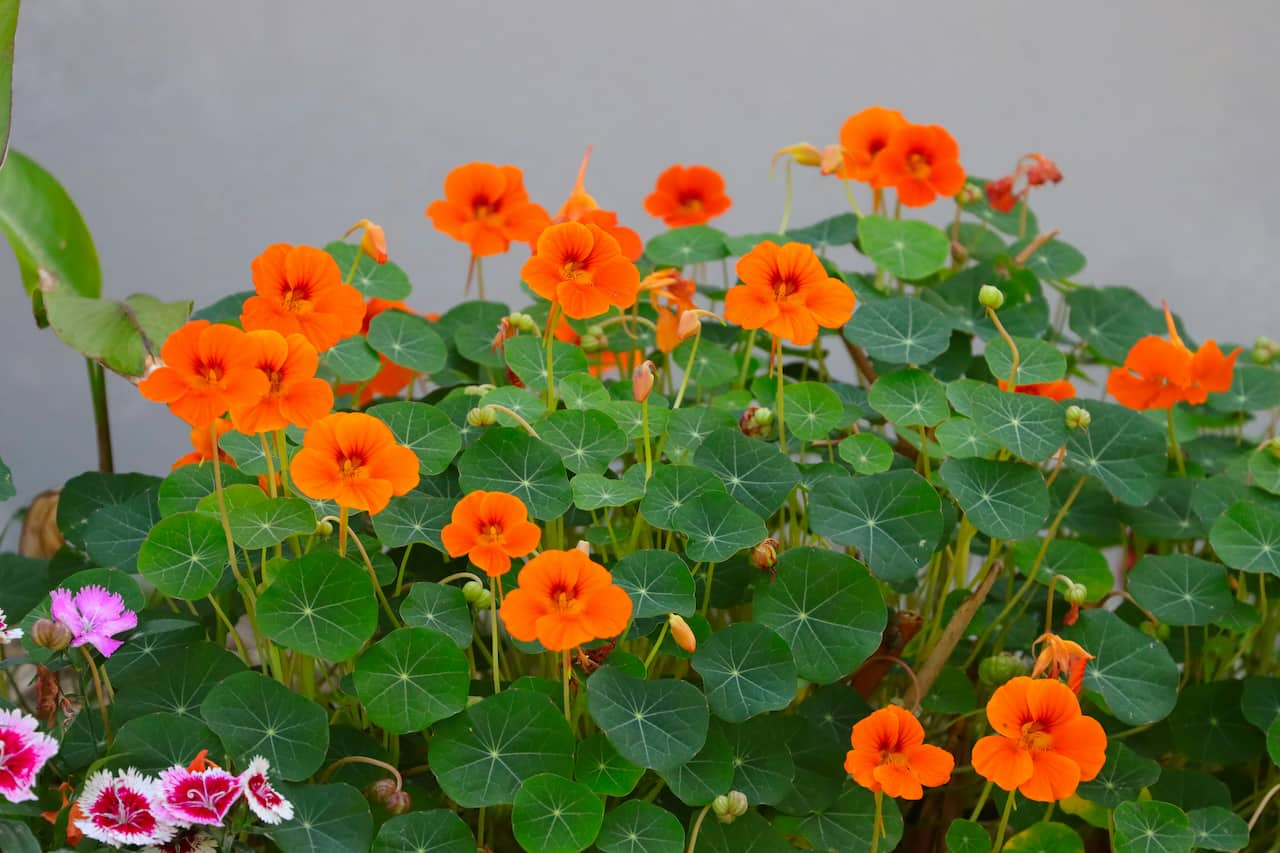
At a glance
The mistake most people make with nasturtiums is feeding them. They treat them like everything else, fork in some compost, give them a feed every couple of weeks, and then wonder why they have a mass of round, lush, umbrella-shaped foliage and not a flower in sight. Nasturtiums are mountain plants from South America that evolved in thin, stony, barely-there soil. Give them what they evolved in and they flower from June to the first frost. Give them what you give your dahlias and you get leaves.
That said, nasturtiums are genuinely one of the most useful annuals you can grow in a productive garden. The flowers and young leaves are edible and taste like a sharper, more interesting version of watercress. The green seed pods pickled in vinegar make a decent caper substitute. Grown at the end of bean rows they pull blackfly away from the beans. They cost almost nothing, take almost no effort once established, and deliver all of that from June to October. The only thing they require is that you resist the instinct to improve them.
The rule about poor soil: why being mean to nasturtiums makes them flower
Rich, fertile soil produces lush foliage at the expense of flowers. This is not a guideline or a mild preference on the plant’s part. It is the main fact about growing nasturtiums, and the reason most people who complain that their nasturtiums did not flower were simply growing them in ground that was too good. Freshly composted beds, borders that have been heavily fed for years, containers with slow-release fertiliser built into the compost: all of these produce the same result, which is a plant that puts everything into leaves.
In poor ground, with nothing to spare on vegetative growth, nasturtiums put what they have into flowering and setting seed. In rich ground they just keep making leaves because the resources are there and the pressure to reproduce is not. This applies to other annuals in poor soil but nowhere near as dramatically as it applies to nasturtiums. So do not feed them. Do not amend the soil especially for them. If anything, grow them in the worst corner of the garden and let them get on with it.
Full sun matters almost as much as soil poverty. A south or west-facing position with at least six hours of direct sunlight produces the most vivid colours and the heaviest flowering. Nasturtiums tolerate partial shade but flower less and grow thinner. They are South American mountain plants and the sun in their native habitat works harder than ours does. Give them the best light you have.
On soil type: they grow in almost anything as long as it drains. Clay, loam, sand, chalk: all fine. The one condition they genuinely fail in is waterlogged ground. In heavy clay, a handful of horticultural grit per planting hole is enough to improve drainage without enriching the soil.
The number one reason nasturtiums do not flower. Rich soil, slow-release fertiliser built into container compost, or a border that has been heavily fed for years: any of these produce the same result. Grow them in the poorest, driest spot you have and resist every instinct to improve the conditions.
How to sow nasturtiums and why you sow them differently from most annuals
Nasturtiums resent root disturbance. This shapes how you sow them and is the main thing to get right when starting indoors. The seeds are large, easy to handle individually, and germinate quickly. The plant does not recover well from being pricked out of a shared seed tray with its roots disturbed. If you sow into modules or individual 9 centimetre pots, one seed per pot, the plant goes into the ground with its root system intact and gets off to a strong start. Sow into a shared tray that requires pricking out and you can expect weaker, slower growth and sometimes losses.
For outdoor direct sowing, wait until late April in southern England and mid-May in northern England and Scotland. The soil needs to be above 12 degrees for reliable germination. Make drills 2 centimetres deep and drop seeds individually 20 to 30 centimetres apart. Water gently and keep the soil moist. Germination takes 10 to 14 days at the right temperature. Soaking seeds in lukewarm water overnight before sowing softens the hard outer coat and can cut germination time by three to five days, which is useful when you want the earliest possible start.
For indoor sowing, start from mid-March. One seed per 9 centimetre pot of multipurpose compost. Germinate at 20 to 27 degrees, then grow on cooler at around 10 degrees on a bright windowsill. Harden off for a week before planting outside and plant out after the last frost: late May in most of England, early June in the north.
Once established, nasturtiums self-seed freely in sheltered spots without any help from you. Seedlings appear from April onwards and are easy to identify by their round, shield-shaped first leaves. They transplant without trouble while still small. Most years after the first I do not bother sowing at all because there are always self-sown plants coming up in the right places from the previous season.
The three sowing routes and what each one gives you:
Climbing, trailing, and dwarf: what the different types actually give you
There are three main habits available in nasturtiums, and the choice matters more than which specific named variety you pick within each group. Most people simply buy whichever packet is available and are then surprised when the climbing type takes over the container or the dwarf type disappears against a fence. Match the habit to the situation first, then worry about variety.
Climbing types reach 1.5 to 1.8 metres using leaf stalks that twine around any available support. They are vigorous, they cover ground quickly, and they are the right choice when you want to clothe a fence, scramble through an obelisk, or create fast summer cover on a trellis. Tall Trailing Mixed is the most widely available and reliably covers any support by midsummer. Flame Thrower is newer with a warmer, more focused orange-to-red colour range.
Trailing types are shorter at 30 to 45 centimetres and spread rather than climb, which makes them the correct choice for hanging baskets and window boxes where you want the stems to fall naturally over the edge. The Gleam Series holds an RHS Award of Garden Merit and earns it: semi-double flowers in orange, scarlet, and yellow on long arching stems that drape well over pot edges and flower heavily from June to October.
Dwarf or bush types stay compact at 15 to 30 centimetres. Tom Thumb is the classic at around 25 centimetres, tidy and covered in single flowers across a wide colour range. Alaska is worth growing specifically for the foliage: the variegated cream-and-green leaves look striking from the moment the plant emerges, before there is a flower in sight. Empress of India has dark blue-green leaves and deep crimson flowers, a combination that looks genuinely ornamental rather than just cheerful. Whirlybird produces semi-double flowers on low mounds and works well in window boxes where you want something that stays below the sill rather than cascading from it.
There are also perennial Tropaeolum species worth knowing about if you want something beyond the familiar annual. T. speciosum, the flame nasturtium, is a genuinely hardy climbing perennial with vivid scarlet flowers. It prefers cool, acid soil and a shaded wall and is at its best growing through a rhododendron or up a yew hedge: the scarlet flowers against dark evergreen foliage is an exceptional combination. It is not easy to establish but extraordinary when it works. T. tuberosum is a half-hardy perennial climber grown in South America for its knobbly edible tubers. In the UK the flowers often come too late, but the variety ‘Ken Aslet’ flowers earlier and grows well on a sunny wall. Lift the tubers after the first light frost and store them frost-free over winter.
The three annual habit types compared:
What nasturtiums actually do in the vegetable garden
The companion planting case for nasturtiums is more specific than most growing guides suggest, and it is worth being precise about it. The main use is as a trap crop for black bean aphid: the blackfly that colonises broad beans and runner beans from late May onwards, building dense colonies on the growing tips and turning what has been a healthy crop into something miserable in a fortnight.
Nasturtiums produce mustard oils and amino acids that aphids find more attractive than most vegetable crops. The aphids find the nasturtiums first and settle there in preference to your beans. Once the nasturtiums are heavily colonised, you pull them up, bag them, and put them in the green waste bin. The aphid population goes with them. I have planted a row of nasturtiums along the edge of my broad bean bed every year for a long time and the beans come through clean the majority of seasons. The nasturtiums are cheap, they require nothing in the way of maintenance, and they earn their space.
Plant nasturtiums at the ends of bean rows and along the edges of brassica beds, one plant per metre of crop row. Sow them at the same time as your crops so they are already growing when the aphid pressure builds in May and June. The timing matters: nasturtiums sown after the aphid pressure has started are less effective as a diversion.
The other companion benefit is attracting hoverflies. Adult hoverflies feed on nasturtium nectar and pollen. Their larvae eat aphids. The nasturtiums are drawing in both the pest and the predator simultaneously, which is a more useful situation than it sounds: even if the aphids colonise the nasturtiums, the hoverfly population builds alongside them and works its way through the colony.
Cabbage white and large white butterflies also lay eggs on nasturtium leaves and prefer them over brassicas, which is useful as a diversion. The catch is that once you have nasturtiums nearby you need to check the underside of their leaves weekly from May to September and remove the clusters of yellow eggs before they hatch. The diversion only helps if you manage it.
What nasturtiums actually deliver in the vegetable garden:
Flowers, leaves, and pickled seed pods: what to do with all of it
Every part of the nasturtium above ground is edible, and each part has a distinct use rather than just being different intensities of the same thing. The flavour throughout is peppery and watercress-like, sharpest in the seeds, mildest in the flowers.
Flowers are the most accessible entry point. They have a mild peppery note with a hint of sweetness and look striking in food. Pick them in the morning when fully open and use them the same day: they wilt within a few hours and do not store well. Drop whole flowers into salads, float them in cold drinks, or use them as garnishes. Darker red and crimson flowers are marginally more peppery than yellow and orange forms, but the difference is slight.
Young leaves under about 5 centimetres across are tender enough to eat raw. They go well in sandwiches as a replacement for rocket or watercress: sharper and more interesting than rocket, without the bitterness that rocket can develop later in the season. Blend young leaves with olive oil, garlic, pine nuts, and a hard cheese for a pesto that is different enough from basil pesto to be worth making in its own right. Larger leaves that have developed on a fully established plant in midsummer get tough and intensely pungent. Pick young if you want something palatable.
The seed pods are the most interesting and the least used. The pods form in groups of three on the stems immediately after the flower drops. Harvest them while still green, soft, and slightly springy: if you wait until they start to harden and pale you have missed the window. Pack the green pods into a clean jar, pour over hot white wine vinegar, seal the jar, and leave for two weeks. The result is a caper substitute with real sharpness and a peppery kick. They work well in tartare sauce, on smoked fish, or anywhere you would use a conventional caper. They were used widely in British kitchens during the Second World War when capers were unavailable, and they hold up to that comparison well.
One precaution applies to all of this: only eat nasturtiums you have grown yourself from seed without pesticide treatment. Plants sold in garden centres as bedding may have been treated with systemic insecticide. Homegrown, untreated plants only.
Each part of the plant and how to use it:
Catch the pods at the right moment. The window between usable and wasted is narrow. The pods form just after the flower drops, while they are still bright green and give slightly when squeezed. Once they start to pale and harden, they are past it for pickling. Check the plants every couple of days from midsummer.
Problems, containers, and collecting seed for next year
The most common problem with nasturtiums is the one that is not actually a problem when you have planned for it: blackfly. If you are using nasturtiums as a trap crop, a heavy blackfly colony is the plant doing its job. Bag the infested plants and move on. On ornamental plantings where you do not want the colony, a jet of water from a hosepipe removes most aphids and the ladybird and hoverfly populations usually deal with the rest within a couple of weeks. No spray needed.
No flowers and masses of foliage: the soil is too rich. This is the issue that frustrates people most and the fix is to stop adding anything to the soil and move the plant to a sunnier spot if shade is also a factor. In containers, repot into plain multipurpose compost without added slow-release feed. Do not fertilise. Accept that you may not get flowers this season if the plant is already established in rich ground, and sow fresh into poorer soil next year.
Slugs and snails eat young seedlings in the first few weeks after germination. Protect newly sown areas with copper tape around containers, beer traps, or a ring of sharp grit until plants reach 10 centimetres. Once the stems have toughened, slugs tend to leave them alone.
Powdery mildew appears on the leaves in late summer, particularly in dry, warm, still conditions. By the time it usually appears in August the plants have been flowering well for two months and the cosmetic damage is largely irrelevant. Remove badly affected leaves to slow spread but the plants rarely die from it before the frosts finish them anyway.
In containers, nasturtiums need watering when the top 3 centimetres of compost dries out, which in hot summer weather can mean daily. They wilt quickly when dry but recover fast once watered. The minimum pot size is 20 centimetres with drainage holes. Fill with standard multipurpose compost, add nothing, and do not feed through the season.
For seed saving: let a handful of pods ripen fully on the plant until they turn from green to pale brown and feel hard. Bring them inside and spread on newspaper for a week to finish drying. Store in a labelled paper envelope in a cool, dry, dark place. Viable for three to five years. Each plant produces dozens of seeds, so a single well-managed plant gives you enough to sow an entire allotment bed the following year. Most seasons, some will have self-sown already and you will find seedlings appearing in April with no intervention required.
Problems and what causes them:
Share on socials: