At a glance
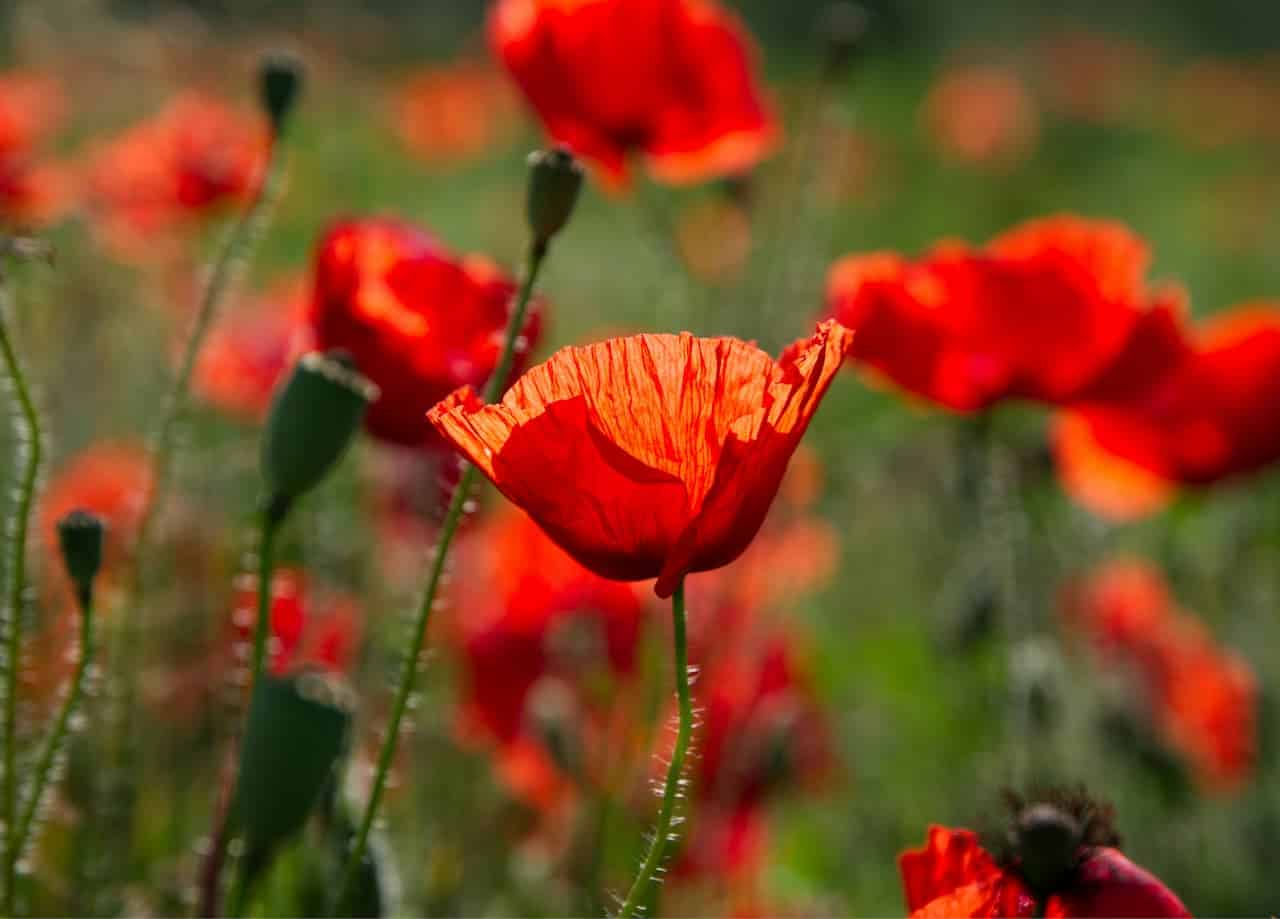
The word poppy covers a remarkable range of plants – from the vast dinner-plate blooms of Oriental poppies that dominate a border for three weeks in May and June before disappearing entirely underground, to the delicate annual field poppies that self-seed into gravel and dry soil and produce flowers the colour of traffic lights from June onwards, to the sumptuous double opium poppies whose blowsy blooms come in every shade from white and palest lilac through deep burgundy and near-black. What they share is an immediacy of impact and a specific cultural requirement – all poppies perform best in lean, free-draining conditions and almost all are harmed by fertile, moisture-retentive soil that encourages foliage at the expense of flowers.
Understanding which type of poppy you are growing is the starting point for everything else. The three groups behave quite differently: Oriental poppies (Papaver orientale) are hardy herbaceous perennials that die back to nothing after flowering and re-emerge the following spring. Annual poppies – principally the field poppy (Papaver rhoeas) and the opium poppy (Papaver somniferum) – complete their entire life cycle in a single year and persist in a garden only by self-seeding. Both groups are easy to grow, but the approach to planting and aftercare differs enough that treating one type like the other is the most common cause of disappointment.
The three main types of garden poppy
Oriental poppies are the most dramatic option for a UK border. Individual flowers can reach 15-20cm across in the largest varieties and the combination of silky, tissue-paper petals and dark blotches at the base of each petal produces an effect of extraordinary intensity for the three or four weeks they are in bloom. The drawback is the gap they leave when they die back in July – large and conspicuous in a small garden, but easily managed in a larger border by surrounding them with perennials that fill the space as they emerge in midsummer. Annual poppies require much less forward planning and their self-seeding habit eventually creates a naturalistic, spontaneous effect that feels as though the plants chose their own positions – which, in a sense, they did.
Oriental poppies – growing and care
Oriental poppies are best planted in autumn as bare-root crowns, which establish quickly and will produce their first flowering display the following May. Pot-grown plants can be planted at any time of year. They are not fussy about soil provided drainage is adequate, but they will not persist in waterlogged conditions. Choose a position in full sun or partial shade – they are one of the few poppies that will tolerate some shade, though flowering is reduced and stems become more lax without direct sun.
The most important management decision with Oriental poppies is what to do after flowering. When the petals fall in late June or July the plant produces seed pods and then the foliage yellows and collapses entirely, leaving an empty space in the border that can be surprisingly large – a mature clump of ‘Patty’s Plum’ or ‘Beauty of Livermere’ will leave a gap of 60-80cm across. The traditional approach is to cut the yellowing stems back to ground level once they are truly spent and fill the gap with fast-growing annuals planted in as the poppy dies back. Hardy geraniums, Alchemilla mollis and ornamental grasses all make effective neighbours that will close over the gap naturally without intervention. A more considered planting approach works particularly well: position the Oriental poppy behind or among medium-height perennials that will not yet be at full height when the poppy is in flower but will expand outward and fill the vacated space from July onwards. Nepeta, phlox and late-starting ornamental grasses are all reliable gap-fillers that require no additional planting effort once the initial scheme is established.
Best Oriental poppy varieties for UK gardens: ‘Patty’s Plum’ (dusky mauve, outstanding), ‘Beauty of Livermere’ (deep crimson with black blotch, classic), ‘Karine’ (shell pink, compact at 60cm), ‘Cedric Morris’ (pale grey-pink, one of the most subtle and beautiful), ‘Lauren’s Grape’ (deep purple, unusual), ‘Turkenlouis’ (fringed red petals, very large).
Oriental poppies can be propagated by root cuttings taken in late autumn or early winter when the plant is fully dormant. Lift a portion of the root system, cut sections 5-7cm long and lay them horizontally in trays of gritty compost, just below the surface. Keep in a cold frame over winter and they will produce shoots in spring. This is both the easiest method of increasing stock and the best way to move a plant to a better position – the main crown can be left undisturbed while cuttings are taken from the outer roots. Division of the main crown is possible but plants resent it and may take a full season to recover normal flowering performance after being disturbed.
Annual poppies – sowing and naturalising
Annual poppies must be sown direct – they germinate best in open ground and strongly dislike transplanting. Both field poppies and opium poppies can be sown in either autumn (September-October) or early spring (March-April). Autumn sowing produces the strongest plants and the earliest flowering – the seedlings overwinter as small rosettes, establishing a good root system before they bolt to flower in June. Spring sowing flowers from late June into August. Scatter seed thinly on prepared, raked soil and barely cover it – poppy seed needs light to germinate and burying it even a centimetre deep significantly reduces germination rates. Thin to 15-20cm spacings once seedlings are large enough to handle.
Opium poppies (Papaver somniferum) are among the most architectural annuals available for UK gardens. The flowers come in single, semi-double and fully double forms – the double forms in particular, such as ‘Black Peony’ and ‘Lauren’s Grape’, produce blooms of extraordinary depth and complexity. After flowering the seed pods themselves are highly decorative, standing on tall glaucous stems through July and August and providing material for dried arrangements. Allow some pods to ripen and split naturally and the plants will self-seed freely, reappearing in the same positions each year without any deliberate effort. A well-established opium poppy colony becomes genuinely self-sustaining, requiring only occasional editing to prevent overcrowding.
Common problems and solutions
The field poppy deserves more deliberate use in UK gardens beyond its familiar appearance in wildflower mixes. Papaver rhoeas cultivars developed from the Reverend Wilks’ famous Shirley strain in the late nineteenth century introduced a range of colours – shell pink, salmon, pale lavender, white and bicolours – that the wild red form does not produce. Shirley poppies, as these cultivars are collectively known, are among the most delicate and beautiful of all annual flowers and are particularly effective in a cutting garden where their translucent petals catch the light in a way no photograph adequately captures. Sow a broad scatter in autumn across any bare, well-drained soil and let them find their own way – they will flower in June and, if a few seed heads are left to ripen, return each year without further intervention.
Do not disturb dormant Oriental poppy crowns in summer. After flowering and dying back in July, the roots remain alive underground even though there is no visible growth above soil level. Digging into this area to fill the gap with other plants – a tempting move given the empty space – very easily damages or destroys the dormant crown. Mark the position with a small cane immediately after the foliage dies back and work around it. The plant will reappear from the same point each spring for many years if the crown is left undisturbed.
Share on socials: