Bindweed is one of the most frustrating weeds a UK gardener faces in a planted border – and understanding why it is so difficult to deal with makes the whole process significantly less demoralising. It is not that the weed is impossible to eradicate. It is that the root system is so extensive and so deep that complete eradication takes years of consistent treatment rather than a single application season. Approach it with realistic expectations and a consistent strategy and it is fully beatable.
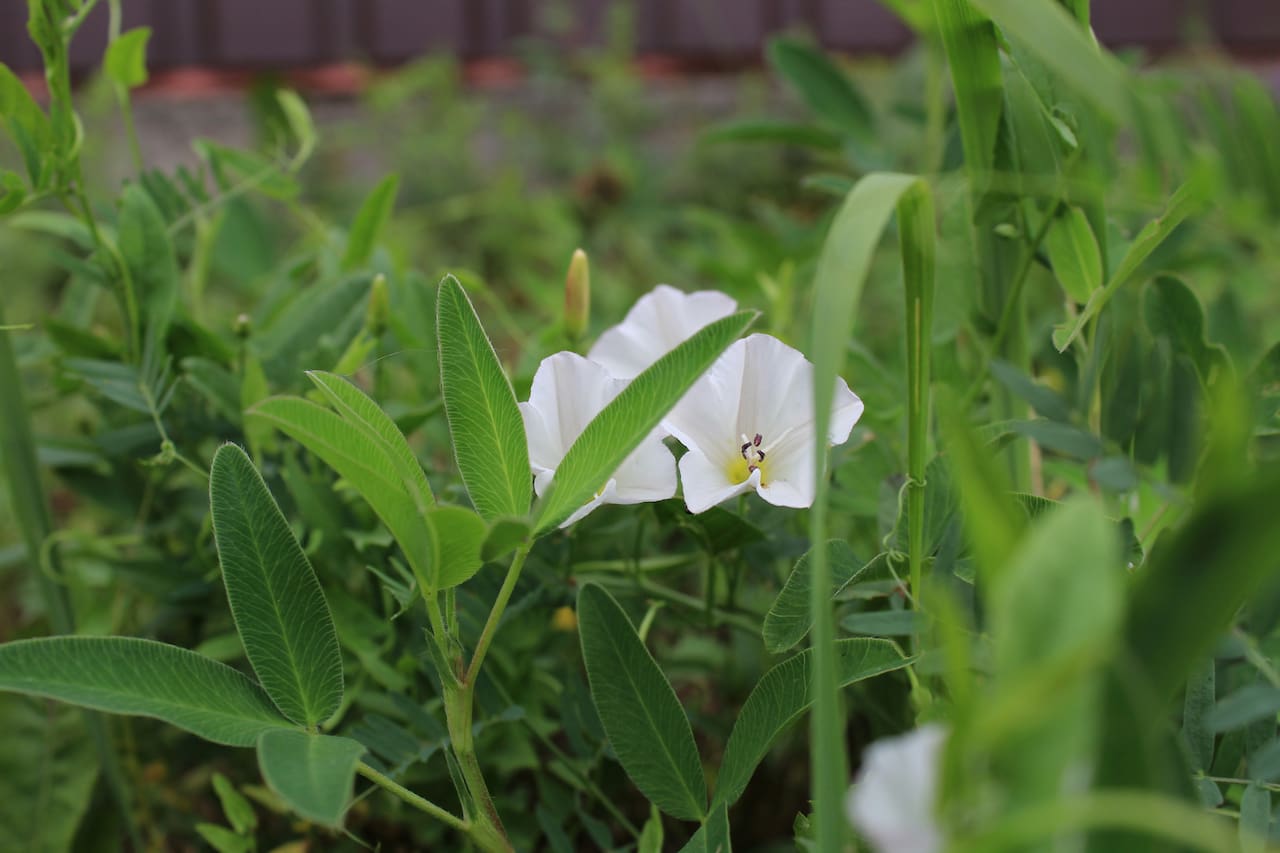
There are two species common in UK gardens – hedge bindweed (Calystegia sepium) with large white trumpet flowers, and field bindweed (Convolvulus arvensis) with smaller pink and white striped flowers. Both behave similarly and respond to the same treatment approaches, though field bindweed has slightly deeper roots and is generally considered the harder of the two to eradicate. The first step is confirming which one you are dealing with and making sure it is not a garden plant being removed by mistake.
Identifying bindweed correctly
Before treating anything, confirm the identification. Bindweed is occasionally confused with morning glory (Ipomoea), which is a cultivated garden plant sold in UK garden centres with very similar flowers. The distinction matters because one is a weed to eliminate and the other is a plant you have chosen to grow. The stem is the fastest check: bindweed has smooth stems, morning glory has noticeably hairy stems.
Bindweed identification – two species compared
Feature
Hedge bindweed
Field bindweed
Flowers
Large white trumpets, up to 7cm
Small pink and white striped, 2-3cm
Leaves
Large arrowhead, up to 15cm
Smaller arrowhead, lobed at base
Stems
Smooth, twining anti-clockwise, 2-3m
Smooth, smaller, twining, 0.5-2m
Root depth
2-3 metres typical
Up to 5 metres – harder to treat
Difficulty
Hard
Very hard
💡The fastest way to tell bindweed from morning glory is the stem. Run your finger along it – bindweed stems are smooth and hairless. Morning glory stems feel distinctly rough and hairy. Morning glory is an annual that dies at the first frost and does not return from deep roots. Bindweed is a perennial that comes back from root fragments every year regardless of what happens above ground.
Why bindweed is so hard to kill
Three characteristics combine to make bindweed uniquely persistent. Understanding each one is essential to choosing the right treatment approach and, crucially, to avoiding the single biggest mistake gardeners make – which is rotovating or digging a bindweed-infested border without chemical treatment first.
Problem
Extreme root depth – field bindweed roots have been recorded at over 5 metres. Digging removes surface roots but leaves the deeper system intact and capable of regenerating the entire plant.
Solution
Never attempt to dig out bindweed without chemical treatment first. Treat foliage with glyphosate to translocate the chemical down to the root system before any digging or cultivation.
Problem
Root brittleness – the roots snap easily rather than pulling cleanly. Every fragment left in the soil regenerates a new plant. A single disturbed root can create dozens of new plants from its fragments.
Solution
Rotovating or deep digging in infested soil is the most counter-productive action possible – it spreads fragments throughout the border. Treat first. Cultivate only after plants have died completely.
Problem
Seed persistence – bindweed seed remains viable in the soil for up to 30 years. Even after the root system is fully eradicated, germination from buried seed continues for decades.
Solution
Eradication is a long-term commitment. Monitor for seedling germination for years after the roots are dealt with. Seedlings at 5-10cm are trivial to treat – allow them to establish and they become a new problem.
Glyphosate treatment in borders
Glyphosate is the most effective treatment for bindweed and works by being absorbed through the leaves and translocated down into the root system. In a planted border the challenge is applying it to bindweed without contacting surrounding plants. The wicker basket method is the most effective technique for this situation – it gets the chemical onto maximum leaf area without drift.
The wicker basket method – step by step
1
Wait for active growth. June to August is the optimal window. The plant is translocating actively and the chemical moves efficiently to the roots. Newly emerged shoots are too small. Wait until growth is 30 to 40cm long before treating.
Jun-Aug
2
Train stems onto a cane. Push a cane into the soil near the bindweed and wind the stems up and around it, unwinding carefully from surrounding plants. Get as much leaf area as possible exposed and away from garden plants before applying anything.
Prep
3
Paint glyphosate directly onto the leaves. Use an old paintbrush or glyphosate gel applied directly to bindweed leaves only. Painting is far more precise than spraying and eliminates drift onto surrounding plants.
Apply
4
Repeat every 6 to 8 weeks through the season. Multiple applications in a single season are far more effective than one. The plant will regrow – treat each flush. Three to four treatments per season is the target for best results.
Repeat
5
Expect regrowth next season and treat again. The root system will survive the first full season of treatment. Consistent treatment over 3 to 5 seasons progressively exhausts the root’s energy reserves and ability to regenerate.
Long term
Amazon
Bindweed control essentials – UK picks
As an Amazon Associate I earn from qualifying purchases. Prices correct at time of publishing.
Organic and non-chemical methods
For gardeners who prefer not to use glyphosate, organic control is possible but takes considerably longer and requires more sustained effort. The underlying principle is the same – deprive the root of photosynthesis consistently enough that it eventually exhausts its energy reserves. Without chemical translocation into the root, this process takes more seasons and requires more vigilance.
Persistent removal
Remove all above-ground growth as soon as it appears, every time, throughout the growing season. Do this consistently over 3 to 5 years and the root is progressively weakened. Missing even a few weeks in summer allows the plant to photosynthesise and rebuild its reserves. This method only works if it is genuinely sustained.
Dense planting
Establishing dense ground cover planting that shades out bindweed shoots suppresses it to more manageable levels. It does not eradicate it, but reduces the visible infestation significantly. Low-growing, spreading plants with dense canopy – such as Geranium macrorrhizum or Ajuga – are the most effective because bindweed cannot climb when there is nothing to climb.
Smothering
Covering infested areas with black polythene for a full growing season (March to October) kills above-ground growth and significantly weakens the root. Not suitable for planted borders but highly effective on empty ground before replanting. After removing the polythene, treat any regrowth promptly before replanting the bed.
⚠️Never rotovate a bindweed-infested area. Rotovating or deep digging in infested soil chops the root system into dozens of fragments, each of which regenerates as a new plant. This multiplies the infestation rather than reducing it. If you need to cultivate bindweed-infested ground, treat thoroughly with glyphosate first, allow the plants to die completely and the roots to begin breaking down before any soil cultivation.
Dealing with established infestations
An established infestation – one that has been in a border for several years and has spread through the root system of existing plants – requires a more radical approach. The most reliable method is to clear the border completely, treat the ground through a full season, and then replant. Attempting to treat around established plants that are intertwined with bindweed roots is possible but significantly less effective because consistent coverage is difficult to achieve.
Established infestation – clearance sequence
1
Clear and pot up any valuable plants, washing roots thoroughly under running water to remove every bindweed root fragment. Even small fragments left on roots will re-establish in the new position.
First
2
Cover the cleared bed with black polythene from March, or treat repeatedly with glyphosate throughout summer on any growth that emerges. Both approaches work – combine them for fastest results on a severe infestation.
Season 1
3
In the following autumn, carefully remove all visible dead root material from the soil surface. Do not disturb deeper soil layers – remove only what is visible without cultivation that could fragment deeper roots.
Autumn
4
Replant in autumn, then monitor carefully for regrowth the following season. Treat any new shoots immediately with glyphosate gel – a small shoot at this stage is easily treated and far simpler than allowing it to re-establish.
Replant
Stopping it coming back
Bindweed frequently re-enters from neighbouring gardens via roots travelling under fences, or germinates from the long-lived seed bank in the soil. Stopping re-establishment requires attention at the border margins and prompt treatment of any new shoots before they have a chance to build a root system. A single shoot treated at 10cm is infinitely simpler than a re-established plant treated at 2 metres.
Let new shoots grow before treating – they quickly rebuild the root system
Treat every new shoot immediately with glyphosate gel – never let them reach 15cm
Compost bindweed roots – they survive most home compost heaps and spread
Bag and bin all bindweed roots and top growth – never add to compost
Leave fence bases unchecked – bindweed travels under fences from neighbouring gardens
Check fence bases monthly through the growing season and treat any shoots emerging
Assume one season of treatment has solved the problem – bindweed always returns
Maintain consistent monitoring and treatment for at least 3 to 5 full growing seasons
Bindweed is beatable with the right approach and patience. Commit to consistent treatment over multiple seasons, never rotovate infested ground and treat every new shoot promptly. The same deep persistence that makes it such a difficult weed also means that every treatment session genuinely weakens its ability to regenerate. Sustained effort compounds – each successive season becomes easier as the root system exhausts itself.
Amazon
Bindweed control essentials – UK picks
As an Amazon Associate I earn from qualifying purchases. Prices correct at time of publishing.