At a glance
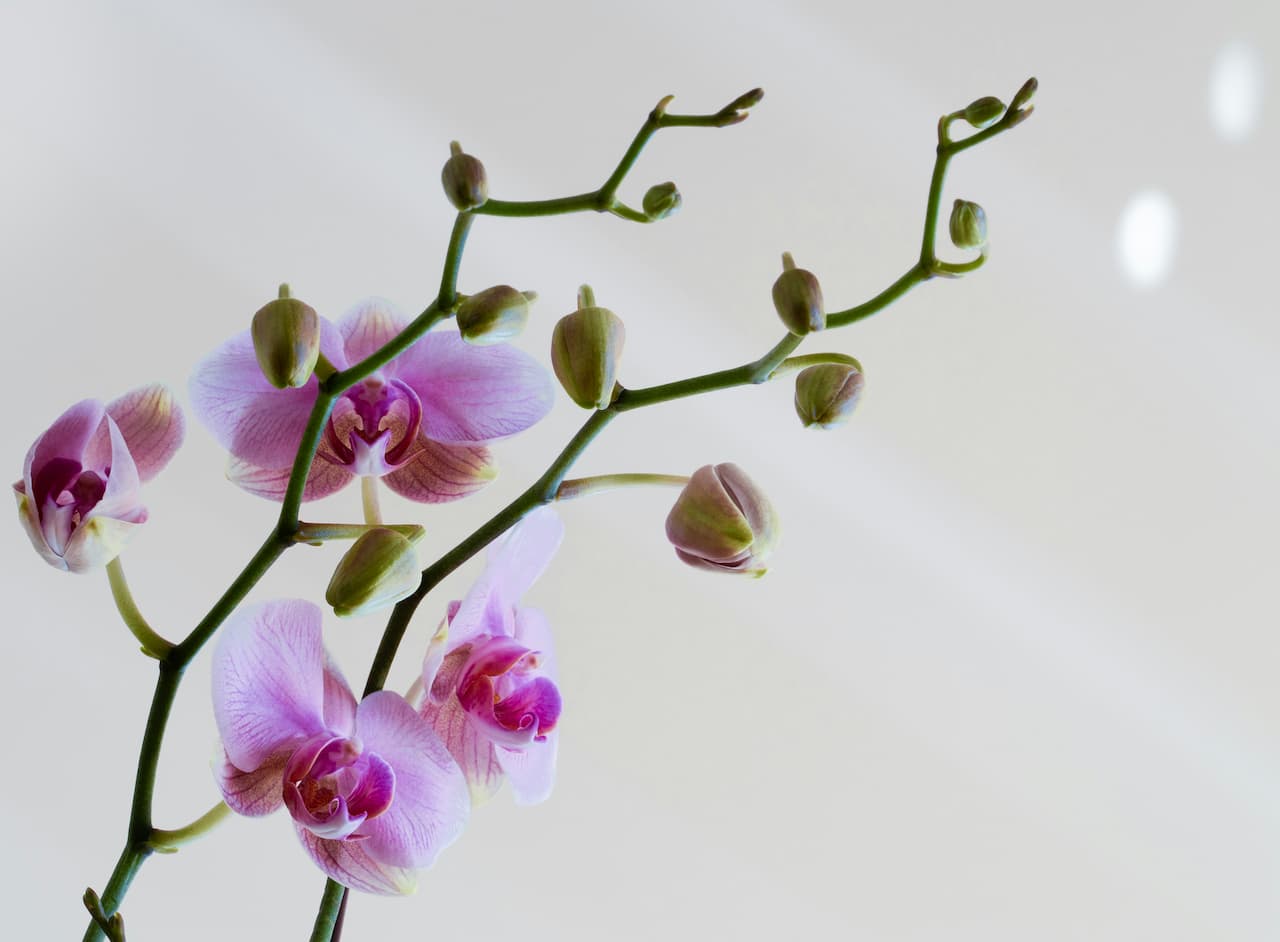
The Phalaenopsis orchid – the moth orchid – is the UK’s most popular houseplant by a significant margin. It is available in supermarkets, garden centres and florists year-round at accessible prices, flowers for months at a time in a wide range of colours, and with the right care reflowers reliably year after year. The majority of Phalaenopsis orchids that die in UK homes do not die from neglect. They die from overwatering. Understanding this single fact is the foundation of everything else in orchid care.
Like cacti and succulents, the Phalaenopsis has evolved to survive periods of drought and genuinely suffers from too much water far more than too little. In its native habitat – the humid forests of South-East Asia – it grows as an epiphyte, clinging to tree bark with its roots exposed to air and only receiving water from rainfall and dew. This is why the care requirements differ so dramatically from most other houseplants, and why the instinct to water on a schedule is the wrong approach. This guide covers every aspect of Phalaenopsis care in UK conditions, from watering by root colour through to triggering reliable reflowering year after year.
Watering – the critical skill
The correct method for watering a Phalaenopsis is to look at the roots, not to follow a fixed schedule. Orchid roots are visible through the transparent or semi-transparent plastic nursery pot they are sold in. When the roots are bright green, the plant has abundant moisture. When they turn grey or silvery-white, the plant needs watering. This visual cue is more reliable than any calendar-based schedule because it adjusts automatically to seasonal changes in temperature, light level and growth rate – watering frequency in a UK home typically ranges from every 7 to 10 days in summer to every 14 to 21 days in winter.
When the roots are grey and watering is needed, take the plastic nursery pot to the sink and water thoroughly until water runs freely from all drainage holes. Allow the pot to drain completely for five to ten minutes before returning it to its outer decorative pot or saucer. Never leave the plastic pot sitting in water – standing water in the outer pot causes root rot within days even on a plant that was otherwise healthy. If water collects in a decorative outer pot, tip it out after every watering.
Never use ice cubes to water orchids. The popular ice cube watering method seen on packaging and social media causes cold damage to the roots. Phalaenopsis roots are adapted to tropical temperatures and sustained contact with ice or very cold water shocks the root tissue. Use room-temperature water and water thoroughly from above, allowing it to drain completely.
Light, position and conditions
Phalaenopsis orchids need bright indirect light. A windowsill that receives good natural light but avoids direct midday sun is the classic position. East or west-facing windowsills are ideal – morning or evening light without the intensity of south-facing noon sun. South-facing positions work well if the plant is set back from the glass, or shielded from direct sun by a sheer curtain in summer. North-facing is too dark for reliable flowering in UK conditions.
Temperature stability matters as much as the actual temperature range. Phalaenopsis cope well with typical UK centrally-heated homes sitting between 18 and 24°C during the day. The critical thing to avoid is draughts – the combination of dry radiator air and cold draughts from windows, which is common in UK homes through winter, causes bud drop in a flowering plant. If the plant is in flower and buds fall before opening, eliminating draughts is almost always the fix. Moving the plant a few centimetres away from a gap in a window frame, or away from a door that is frequently opened, often solves the problem immediately.
Never rotate an orchid in flower. Flower spikes orient toward the light source during development. Once the spike is in flower, rotating the plant causes the flowers to turn awkwardly away from the window. The time to turn the pot for even growth is during the non-flowering period. Once flowers are open, leave the plant exactly where it is until the last flower drops.
Feeding and repotting
Orchid feeding is about maintaining root health and supporting the flowering cycle rather than driving rapid vegetative growth. The correct approach is little and often during the growing season, with complete rest through winter. Overfeeding is a more common problem than underfeeding – excess fertiliser salts build up in the bark and damage the roots over time.
Repotting is needed every two to three years, or when the roots are visibly circling and escaping the pot in all directions. Use specialist orchid bark rather than standard potting compost – the chunky bark structure allows air to reach the roots, which is essential for the plant’s health. Standard compost stays too wet and suffocates orchid roots within weeks. Repot in spring, choosing a pot only slightly larger than the previous one – a pot that is too large holds excess moisture and causes root rot.
After flowering – what to do
When the last flower drops the spike will be bare and brown at the tip. At this point cut the flower spike back to the base, as close to the main stem as possible. Some guides suggest cutting to a node lower on the spike to encourage a secondary flower spike to emerge – this works occasionally but the secondary spike produces fewer, smaller flowers and significantly delays the main flowering cycle of a full new spike the following season. Cutting to the base is the more reliable approach for long-term performance.
After cutting, continue the same care regime. Water when roots turn grey, feed lightly through the growing season, and let the plant do what it does – which is grow new leaves slowly through summer while building the energy reserves for the next flowering. Do not be alarmed if visible progress seems slow. Phalaenopsis are not fast growers and months between visible new leaf growth is normal. The plant is not dead – it is resting and recharging.
Triggering reflowering
The single most reliable way to trigger a new flower spike on a Phalaenopsis that has been through the rest phase is to expose it to cooler temperatures in autumn. Move the plant to a cooler room – around 15 to 17°C at night – for four to six weeks in September and October. This temperature differential between day and night mimics the seasonal shift in the plant’s native habitat that signals to the plant that conditions are right for flowering. After this cool period, return the plant to normal room temperature and a new flower spike should emerge within six to twelve weeks.
Common problems and fixes
Almost every Phalaenopsis problem traces back to one of three root causes: too much water, insufficient light, or draughts and temperature instability. The plant is robust when its basic requirements are met and surprisingly intolerant when they are not. The table below covers every symptom likely to be encountered in UK home conditions.
A well-cared-for Phalaenopsis will flower once or twice a year for many years – the complete opposite of the disposable plant many people treat it as after its first flowering ends. Water only when the roots turn grey, give it good indirect light year-round, provide a cool autumn period and it will reward you reliably season after season.
Share on socials: