At a glance
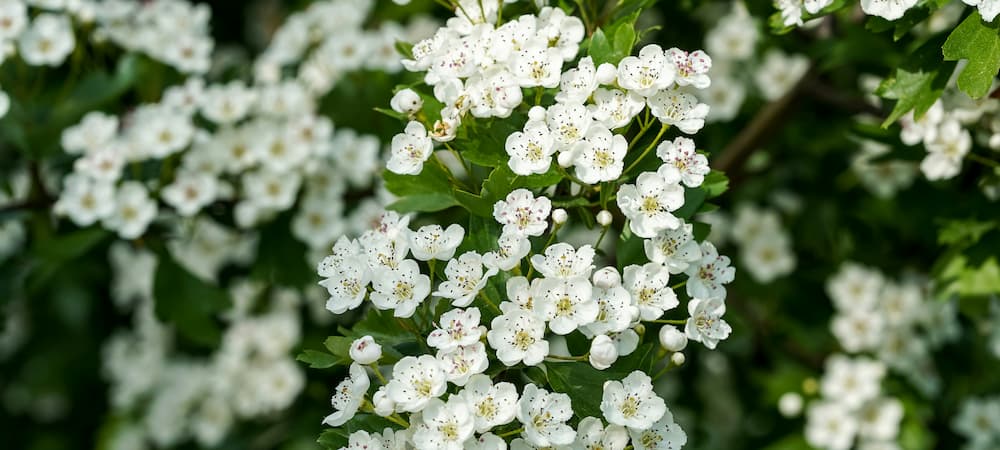
The hedge running along the bottom of my plot was already there when I took it on, thick and gnarly and full of gaps where the previous holder had let it go, and it took me a couple of seasons to work out it was mostly hawthorn underneath all that mess. I’ve since planted a proper stretch of it from scratch along one side, and it’s turned into one of those plants I’d recommend to anyone without much hesitation.
It’s a British native, Crataegus monogyna if you want the full name, and it’ll do a job as either a hedge or a small tree depending what you need. Worth deciding which one you’re after before you buy anything, since that one choice shapes most of what comes after it.
Hedge or tree, and which hawthorn you’re buying
As a hedge, common hawthorn will reach up to 3m left to its own devices, though keeping it trimmed brings that down to somewhere between 1.4 and 2.5m without much bother. The looser you keep the trimming, the looser and less formal it looks, and I’ve found leaving longer gaps between cuts genuinely improves the spring blossom too, so there’s a real tradeoff between tidy and floriferous rather than one being simply better than the other.
If you’re after more than a single species hedge for the sake of wildlife, hazel and elder both pair well alongside it. Bear in mind hawthorn drops its leaves in winter though, so if you want green all year round you’re better off with something like yew, cherry laurel, or western red cedar instead.
As a tree it suits a small garden nicely, flowering and fruiting reliably with berries that hang on well into winter. It’s in the rose family, Rosaceae, which I only worked out after noticing my hawthorn picking up the same fungal spots my roses get most summers. A standard tree will usually settle somewhere between 5 and 10m given the years, though if that sounds like more than your garden can take, there’s a dwarf form that stays much smaller and works better as a big border shrub than a proper tree. There’s also a related species, Midland hawthorn, Crataegus laevigata, slightly smaller with fewer thorns and rounder leaves, its haws carry two or three stones rather than the single stone you get in common hawthorn, and it’s not stocked in the quantity common hawthorn is if you’re after a long run of hedging.
Buying it, and getting the timing right
Hedging plants are usually sold bare root over winter while dormant, bundles of rooted hardwood cuttings that come by mail order or from a nursery, and they’re a fair bit cheaper than anything container grown. Container grown versions do turn up between March and September if you’re planting outside the dormant window, but you’ll pay more for the privilege. Trees can be bought either way too, bare root or as a container grown specimen, and a specialist tree nursery will usually have a better range than a general garden centre.
It copes with more or less any soil, sun or part shade, and shrugs off exposed sites and wet ground better than most things I grow. The one thing it won’t tolerate is ground that’s waterlogged on a regular basis, the roots will rot given enough of that. Before you commit a tree to a spot, check how big it’ll get and give it the room, since a hawthorn squeezed into too small a gap never looks quite right.
Getting it in the ground
For a hedge, space the plants 45 to 60cm apart in a single row, or run a double row if you want something wider and denser, which also makes for better nesting cover for birds and a bit more privacy besides. Small hedging plants don’t need staking, though I’d keep an eye out for rabbits and deer having a go at them while they’re young, a bit of guard or fencing round new plants saves a lot of heartache later.
A specimen tree, especially in an exposed spot, wants staking for somewhere between 18 months and 3 years until the roots have taken hold. Don’t rush taking the stake away just because the tree looks settled, the time frame’s there for a reason.
Mulching, watering and feeding once it’s in
Get a layer of mulch down once you’ve planted, bark, composted bark or leaf mould all work, and it cuts down how much moisture the ground loses round the roots. Leave a gap of about 10cm round the base of the trunk or stem itself though, mulch piled right up against the bark holds damp against it and that’s how rot gets started.
Keep the immediate area weed free, since anything growing too close is competing for the same water and nutrients your hawthorn needs to settle in. Watering matters more than I expected when I first planted mine, particularly through a dry spell, soak the base well rather than a quick splash on the surface, and keep that up through the first three growing seasons rather than assuming one good summer means it’s sorted.
It’s not a hungry plant once established, but a general fertiliser like Growmore, or blood, fish and bone, given in early spring around February gives newly planted hedges and trees a decent boost while they’re finding their feet. Once it’s clearly thriving on its own, I’d stop feeding it, there’s no need to keep going indefinitely.
Pruning, and the time of year you can’t ignore
Once it’s established, a formal hedge wants cutting twice or more between late spring and summer, with a final tidy in early autumn to see it through winter looking neat. I aim for a flat topped A shape on mine, roughly a metre wide at the base, tapering up from there. If you’d rather have more blossom and more berries for the wildlife, cut it only once a year, or even every other year, it’ll look scruffier but it’ll do more good.
Hedge laying is the older, more traditional fix for a sparse or leggy hedge, partially cutting the stems near the base then laying and pegging them over horizontally, you see it most in the countryside but it’ll work in a larger garden too.
Trees need next to nothing by comparison, just take off anything broken, crossing or obviously diseased, and have a proper look round after any bad storm in case something’s come loose. Watch for two main shoots fighting for the lead too, twin leaders as the trade calls it, and just pick one to keep and take the other off before they get any bigger. Once a tree’s well established you can take the lower branches off as well, lifts the canopy nicely, lets more light down to anything you’ve got growing underneath, and makes mowing round the base a lot easier into the bargain. Do any of this while it’s dormant in midwinter, and for anything more serious than a tidy up, get an arborist in rather than chancing it yourself.
Mind the nesting season. Cutting a hedge or tree between March and August risks damaging an active bird’s nest, which is a real offence under the Wildlife and Countryside Act 1981. Leave it well alone through those months if you possibly can.
Growing your own from seed, and why cuttings won’t work
Growing from seed is the cheap route if you need a long run of hedging, and it’s worth doing if you’ve got the patience. Collect the haws while they’re still green in late summer, soak them in warm water for a few days to soften the flesh, then squash them against a sieve to get the seed out. Sow into seed pans of John Innes seed compost, or half multipurpose mixed with grit or perlite, somewhere sheltered like a cold frame or up against an outside wall, you can also drill them straight into open soil if you’d rather. Cold winter temperatures are what break the seed’s dormancy, but germination the first year can be patchy, so I leave mine in place for a second winter too, more usually comes up the second time round. Cuttings are a non starter with this one, I’ve tried and got nowhere, hawthorn just doesn’t strike well that way at all.
What can go wrong, and why it rarely matters once it’s settled
Once it’s properly established, hawthorn’s about as reliable a plant as you’ll find, mine’s needed almost nothing from me in years. That said, a few things are worth knowing before they catch you out.
The roots are the real giveaway with honey fungus specifically, and that’s the only one on this list I’d actually take seriously on a mature plant. Powdery mildew and fireblight both want a bit of attention but neither’s the end of the world if you catch them. Aphids, the leaf margin mite and ordinary leaf spot have never once made me reach for anything in years of growing it.
Why so much hedgerow in Britain is this one plant
I didn’t appreciate how much history was wrapped up in this thing until I started reading round it properly. A chap called William Turner was the first to write it down formally, back in 1562, and it crops up again in old Culpeper’s herbal not long after. Culpeper barely bothered describing it, reckoned the whole kingdom already knew the tree by sight, though he did think the distilled flower water was good for drawing out splinters and thorns. It’s had well over two dozen local names across the country too, and another sixty or so just for the berries themselves, a few of which I’ve come across myself talking to other plot holders:
There’s a fair bit of superstition attached too, plenty of people still won’t bring the blossom indoors on account of its slightly unpleasant smell, though in Ireland the same blossom brought in on May Day was supposed to keep evil out of the house, which I’ve always found a funny contradiction for the exact same plant.
The young leaves get called bread and cheese and can go straight into a salad, the haws make a decent addition to homemade brandy in much the same way sloes go into gin, and there’s a long tradition of using hawthorn for circulation and calming nerves as a tea or tincture, though that’s a different topic to growing the thing. It was also the main plant used to mark out field boundaries during the enclosures of the eighteenth and nineteenth centuries, which is most of the reason there’s so much of it still running across the British countryside in long straight lines today. Left to its own devices it’s a proper pioneer species too, one of the first things to move into a patch of waste ground or abandoned field, scrambling up alongside bramble and blackthorn before anything else gets a foothold.
What sold me on planting more of it is the wildlife it brings in, more than two hundred species of invertebrate are tied to hawthorn specifically, somewhere around 125 of those being moths alone.
For one plant that asks so little once it’s settled in, that’s a genuinely good return.
Share on socials: