At a glance
The Christmas cactus is one of the more misunderstood houseplants in the UK, and it gets misunderstood in a specific direction: people treat it like a desert cactus. They put it in the sunniest window, water it infrequently, and then wonder why it shrivels, drops its buds, and never flowers again the following year. The word “cactus” is doing a lot of damage here. This plant comes from rainforests in Brazil, where it grows in dappled shade and high humidity on the sides of trees. It has more in common, care-wise, with a fern than with a saguaro.
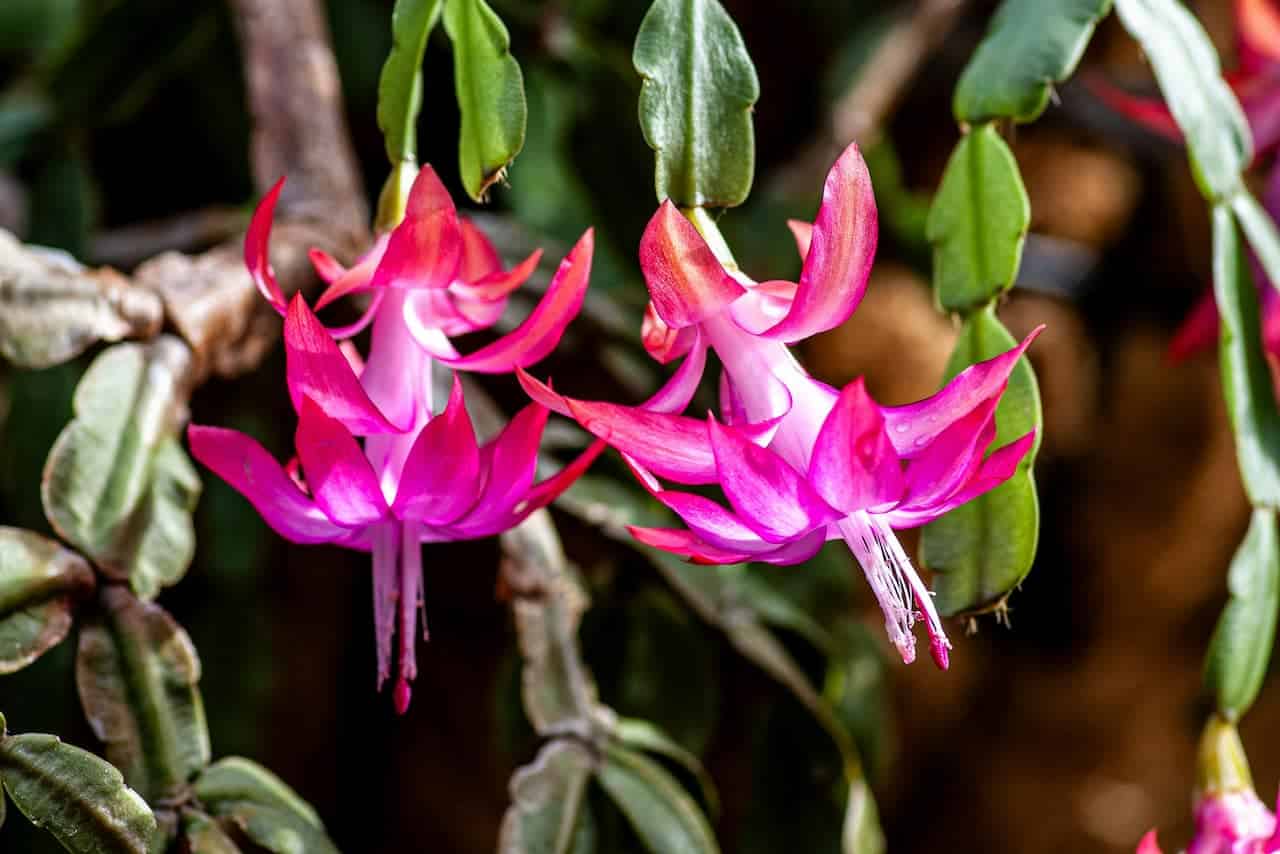
The name causes a second problem. Most plants sold in the UK as Christmas cacti are actually the Thanksgiving cactus, Schlumbergera truncata, which flowers a month earlier than the true Christmas cactus, Schlumbergera buckleyi. You can tell them apart by looking at the stem segments: the Thanksgiving cactus has pointed, claw-like projections at the tips, while the true Christmas cactus has smooth, scalloped edges. For most purposes the distinction does not matter because the care is essentially identical. What it does explain is why your “Christmas cactus” is flowering in November.
What the plant is and how to choose a good one
Christmas cacti are plants worth committing to. Well-kept specimens pass between generations: this is not hyperbole. The more stems they develop over the years, the more flowers they produce, because the flowers only form at the tips of stems. An old, bushy plant with dozens of cascading chains of flat, leaf-like segments is working toward its best flowering every year. There is something satisfying about that.
When buying, choose a plant that still has plenty of closed buds rather than one in full flower. The display on a fully open plant is close to its peak, while a plant covered in buds has weeks of flowering ahead of it. Also check where the plant was being displayed. Cold draughts and low temperatures cause bud drop within days. A plant that spent the morning sitting near the entrance of a cold garden centre on a December morning may look fine when you buy it, but by the time you get it home the damage is already in motion. Buy from indoor displays, wrap it well for the journey, and do not leave it in a cold car.
The colour range runs from red through pink and mauve to white, with yellow and orange turning up occasionally. Most plants in UK shops are sold by colour rather than variety name, which means you pick the one that looks right rather than hunting for a specific cultivar. Schlumbergera buckleyi holds an Award of Garden Merit and is a reliable, well-tested performer for UK homes.
The two plants most commonly sold as Christmas cacti in UK shops:
Everyday care: light, water, humidity, and where to put it
The right spot for a Christmas cactus is bright but not sunny. An east-facing windowsill, where the plant gets some direct morning light but is sheltered from harsh midday sun, is close to ideal. Direct summer sun scorches the flat stem segments, turning them red or brown. But deep shade is not the answer either: too little light produces poor growth and very few flowers. You want the level of brightness that comes through a window that does not get direct sun most of the day.
From April to September the plant is in active growth and needs regular watering. Let the top two centimetres of compost dry out between waterings, then water thoroughly and let it drain fully. These plants are not true succulents that can go weeks without water, but they will rot quickly if the compost stays soggy. Empty any water that collects in the saucer after watering, and never leave the pot sitting in standing water. Outside the growing season, during the two rest periods described below, you water less: let the top few centimetres dry out rather than just the top two, but never let the compost dry out completely.
Humidity matters more than most people expect. These are plants from a humid tropical environment, and a centrally heated UK living room in January is closer to a desert than a rainforest. Misting the stems several times a week helps. Placing the pot on a tray filled with pebbles and water, with the pot sitting above the water line rather than in it, provides a more consistent source of humidity around the plant. Kitchens and bathrooms work naturally well because the air is more humid. Radiators are the enemy: keep the plant well away from them, because the dry heat they produce causes the stems to shrivel and the plant to drop buds or flowers.
In summer, once the risk of frost has gone, you can move the pot outside to a sheltered spot in partial shade. This is one of the best things you can do for the plant: outdoor light levels are considerably stronger than indoor windowsill conditions, and the combination of natural light and fresh air produces noticeably better growth. Bring it back indoors before the end of summer, well before temperatures start dropping, and before the first rest period begins in mid-September.
During the growing season, feed every two weeks with a high-potash liquid feed. Tomato fertiliser does this job well and is usually cheaper than dedicated houseplant feeds. Stop feeding at the end of September when the rest period begins, and do not start again until April.
The compost needs to drain freely. Cactus compost works well, as does John Innes No. 2 with added grit or sharp sand to improve drainage. General multipurpose houseplant compost holds too much moisture and increases the risk of root rot. The pot should be snug: Christmas cacti like their roots to be somewhat confined, and a pot that is too large for the root ball leads to excess moisture sitting around the roots and poor growth. When you do repot, go only one size up, and do it in early spring at the start of the growing season.
The key care rules and why they matter:
The rest periods: why the plant only flowers in a specific window and how to keep it there
The reason Christmas cacti flower in December rather than March has to do with how they read autumn. In the wild, the combination of cooler nights and shortening days as the Brazilian winter approaches triggers flower bud formation. In our homes we replicate that signal through two deliberate rest periods each year. Without them, the display will be thin or absent.
The first rest period runs from mid-September until flower buds appear, usually in October or November depending on the variety. During this period, move the plant to a cooler location, somewhere around 12 to 15 degrees, and reduce watering. A temperature drop of around five degrees from its summer growing temperature is sufficient: you do not need a cold room, just a noticeably cooler one. A spare bedroom, a cool hallway, or a windowsill well away from the radiator all work. At the same time, the shorter days help. If the plant is in a room where lights are on for several hours after dark, bud formation can be disrupted or delayed. It does not need to be in complete darkness, but avoiding rooms with heavy evening lighting helps.
Once you can see the first buds forming, move the plant back to its usual warm spot and resume normal watering. This is the moment to stop moving it. Bud drop is one of the most frustrating things that happens to this plant, and it is almost always caused by one of two things: temperature fluctuation, particularly cold draughts or going from a warm room to a cold one, and being moved when in bud. Once buds are showing, put the plant where you want it for the display and leave it there. Even a relatively small move can trigger drop.
The second rest period runs from late January to late March, once the flowers have finished. The plant needs to rest again before going into active growth in spring. Cooler conditions and reduced watering apply as before. This second rest period sets the plant up for good summer growth, which in turn sets it up for good flowering the following winter. People who skip it and keep the plant in warm, well-watered conditions all year tend to find that the flowering gradually diminishes over successive years.
The annual care cycle at a glance:
The single most common rebloom failure. The autumn rest period starts mid-September and the temperature must drop noticeably, to around 12 to 15 degrees. If the plant stays in a warm room, or if it is near artificial lighting after dark, the bud-formation signal does not trigger. A spare bedroom away from the heating is often all it takes.
Pruning, propagating, and keeping it for the long term
Christmas cacti do not need regular pruning to stay healthy, but they do benefit from it occasionally. Left completely unpruned, the stems get longer and the plant starts to look straggly over time. More practically, flowers only form at stem tips. A plant with fewer, longer stems has fewer flowering points. Pruning encourages the stems to branch, which over time produces more tips, more flower buds, and a better display.
The right time to prune is in spring, after the post-flowering rest period is over and before the growing season gets going properly, so roughly February to early April. Remove a few segments from the end of each leggy stem by snapping them off at the joint or cutting cleanly between segments. Do not cut through the middle of a segment. On an old, crowded plant you can also remove the oldest and most damaged stems entirely, cutting at any joint. What you are aiming for is a plant with a reasonable number of stems that have clear growing tips, not a tangle of old and new growth going in all directions.
The segments you remove make easy cuttings. Let the cut end dry for 24 to 48 hours before inserting it about one centimetre deep into a mix of 50:50 cactus compost and sharp sand. Keep the compost barely moist and the cutting in a bright spot out of direct sun at around 18 to 24 degrees. Roots take between three and twelve weeks to develop. Once well rooted, pot the cutting on normally. It may take two or three years before a cutting-grown plant blooms reliably, but it gets there.
Taking cuttings step by step:
Christmas cacti like to be pot-bound. When you do repot, which should be every one to two years once the roots have filled the pot, do it in early spring and go only one size up. Use cactus compost or John Innes No. 2 with added grit. Do not repot more frequently than the roots demand, and do not put the plant into a much larger pot than it needs: excess compost around the roots holds moisture the plant cannot use, which leads to rot.
The things that go wrong and what they usually mean
Bud drop is the most common and most disheartening problem. The buds form over weeks and then fall off before opening, often within a day or two of being moved to a warmer spot or shifted to a different window. The causes are: temperature fluctuation from cold draughts or moving the plant, overwatering at the bud stage, or buying a plant that was already stressed by cold before it left the shop. Once you can see buds, stop moving the plant, water carefully, and keep it away from draughts.
Shrivelled or limp stems usually mean a watering problem. Check the compost: soggy compost and black roots point to overwatering and the beginning of root rot; dry compost with crispy stem edges points to underwatering. Overwatering is far more common. If the roots are going black, remove them, let the compost dry out a little, and adjust the watering regime. A plant with early-stage root rot can recover if you catch it in time and stop the conditions that caused it.
No flowers, or a very poor display, usually comes down to the rest period not happening properly. The temperature may not have dropped enough in autumn, or the plant may have been near artificial lighting after dark which disrupted bud formation, or the post-flowering rest was skipped so the plant went straight from flowering back into warm, well-watered conditions without a recovery period. Work through those three possibilities and address whichever applies before the following autumn.
Red or brown discolouration on the stems is direct sun damage. Move the plant away from any window where it is getting strong direct light, especially between late spring and early autumn when sunlight is strongest. The damaged segments will not recover, but new growth will be healthy if the conditions improve.
Late flowering, where the plant does not come into flower until January or February rather than November or December, is usually caused by temperatures staying too high into autumn. If the plant does not get the cooler conditions it needs from mid-September, bud formation is delayed accordingly. A cooler location from September onwards will sort this out over the following year.
Mealybugs occasionally appear, most visibly as white fluffy patches where the stem segments meet. Check the undersides of segments and the joints when you water. Catch them early and they are easily dealt with: wipe off visible insects with a cotton swab dipped in rubbing alcohol, or treat with a suitable houseplant insecticide. Left to establish, they weaken the plant and are harder to clear.
A quick diagnostic reference:
Share on socials: