At a glance
Most poinsettias in the UK are dead by February. Not because they are difficult plants, but because of two things that happen long before they get home: cold exposure on the journey, and then sitting in foil wrapping on a warm windowsill next to a radiator for the next three weeks. Both are easily avoided. And if you get through the display period with the plant still healthy, there is a full year of care between January and the following Christmas that is entirely learnable, ending with a plant that turns red again on schedule. It is repetitive and requires commitment, but none of it is complicated once you know the logic behind it.
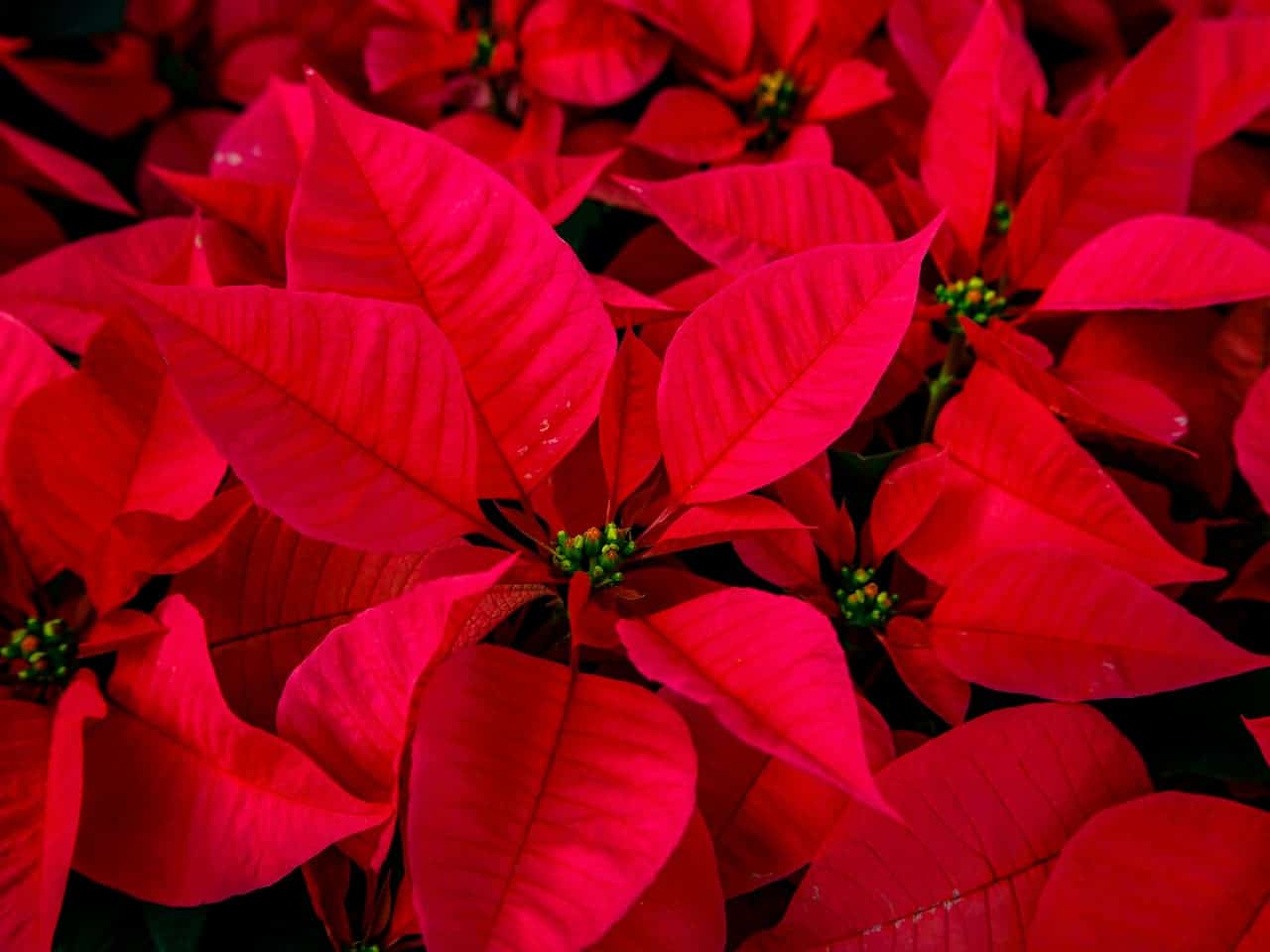
The red parts are not petals. They are bracts, which are modified leaves that change colour in response to the length of the night. The actual flowers are the small yellow-green clusters in the centre of the display. When you are buying a poinsettia and the central flowers are still closed tight, that plant is at the beginning of its display rather than the end of it, and it will last noticeably longer. A plant with open central flowers that are already starting to drop has peaked. It will still look decent for a few weeks, but you are buying it on the way down.
Buying one worth keeping: what to look for and how to get it home
The first thing that kills most poinsettias in the UK is the cold, and it gets them before they even arrive in the house. Below about 10 degrees Celsius, the leaves start to drop within days. Many shops display them near the entrance, or outside on a rack, or on a supermarket forecourt. If the plant has been sitting in the cold, the damage is already done by the time you buy it. Buy from an indoor display, well away from the door, and check that the leaves look firm and the bracts have no wilting or discolouration at the edges.
Getting it home safely matters more than most people think. Wrap it properly before going outside. A large carrier bag over the whole plant, or the paper wrapping the shop uses, provides enough insulation for a short journey. Do not leave it in a cold car while you finish shopping. The window from purchase to warmth should be as short as possible.
Once home, take the foil off immediately. The foil wrapping that nearly every poinsettia is sold in is decorative, not functional, and it traps water around the roots. Any water that drains through the compost has nowhere to go and pools around the base of the pot. A week of that and you are looking at root rot. Put the pot on a saucer instead and you can manage drainage properly.
Pick a spot that is consistently warm, 15 to 20 degrees, away from radiators, fireplaces, and cold draughts. The worst position in most UK living rooms is right on the windowsill, which looks good in the daytime but drops in temperature significantly overnight, especially against single-glazed glass. The plant will cope, but the drop stresses it and shortens the display. A few centimetres back from the glass makes a difference.
What to do and what to avoid when buying and placing:
Keeping it through the Christmas display: light, temperature, water
Bright indirect light for at least six hours a day is what the plant needs to hold its colour well. A position near a window where direct sun is filtered, or a bright room without a south-facing window, both work. In deep shade the lower green leaves will start to yellow and drop, which looks bad and weakens the plant for later in the year.
Water when the top of the compost feels dry to the touch at about a centimetre below the surface. Use lukewarm water, not cold straight from the tap. Cold water shocks the roots in the same way cold air shocks the leaves. Let it drain fully, then empty the saucer. The plant should never be sitting in water. Over and underwatering look similar at a glance but feel different: soggy compost and soft collapsed stems say too much; dry compost and crispy leaf edges say too little. The fix for each is the opposite of the other, which is why it is worth checking the compost before reaching for the watering can.
No feeding during the display period. The plant is not growing; it is spending what it has stored, and extra fertiliser at this stage does nothing useful.
Poinsettias drop some of their older green leaves through the year: they are semi-deciduous, and in December this surprises people who are not expecting it. A handful of lower leaves falling is normal and not a sign that anything is wrong. Rapid wholesale loss across the whole plant is different. That is cold shock, draught, overwatering, or a combination, and it needs diagnosing.
What to do and what not to do during the display:
After Christmas: the dormancy that most people skip
Once the bracts start to fade, usually mid-January, cut or pinch them off. This is not about tidiness. Removing the spent bracts signals to the plant that display is over and pushes it toward the dormancy period it needs. Leave them on and the plant continues investing in them rather than resting.
Now the plant needs cooler conditions and significantly less water. Around 12 to 13 degrees is right for dormancy: a cool spare room, an unheated conservatory that does not freeze, or a cool windowsill away from radiators. Reduce watering to once roughly every ten days, letting about half the compost dry out between. The plant is not growing. It should not be wet. This cooler, drier rest from January through to mid-spring is the foundation of everything that follows. Skip it, keep the plant warm and well-watered all winter, and the following Christmas display will be weaker or absent. The darkness treatment in autumn will not compensate for a poor dormancy in January.
Still provide bright indirect light during dormancy. A little morning or late afternoon sun is fine. No feeding. Let it sit.
In spring, around April, the plant is ready to come back. Increase watering gradually as the temperature rises. This is also the time to cut it back hard: trim the stems to about 10 to 15 centimetres above the compost. This feels drastic, but it is what produces the bushy, well-branched plant that gives you multiple bract-bearing stems in December. A plant that is never pruned grows lanky and produces a thin display on a few long stems. Repot at the same time into a slightly larger pot with fresh compost, watering the plant thoroughly 24 hours before to reduce transplant shock. Start >feeding with a liquid houseplant fertiliser, diluted to half strength, every two weeks.
The full post-Christmas to spring sequence:
Spring, summer, and the darkness trick that turns it red again
From late May, if overnight temperatures are reliably above 10 degrees, the pot can go outside in a sheltered spot with some shade from direct midday sun. This is not essential, but outdoor light is considerably stronger than anything coming through a UK window in summer, and the plant puts on noticeably more growth. Harden it off gradually over a week rather than moving it straight from windowsill to full exposure. Keep watering and feeding through June and July.
In July, trim back the growing tips by about two centimetres on each stem. This promotes side branching. Do the same again in early September, this time cutting back two to three inches (five to seven centimetres) on each stem, leaving three or four leaves on each shoot. Do not prune after early September. Any cutting after that point removes the developing bracts before they have had a chance to colour, and you will have spent a year getting to that point for nothing.
Bring the plant back inside in August before there is any risk of cold nights. In most UK gardens this means mid-August is the safe end date for outdoor growing.
The darkness treatment starts in mid-September. This is the part that requires the most daily commitment and also the part that matters most for reblooming. Poinsettias produce red bracts in response to long nights: they need at least 13 to 15 hours of complete darkness every day, without interruption. The darkness has to be total. A light turning on in the room for a moment, car headlights through a gap in the curtain, light under the door: any of these can disrupt the process and delay or prevent colouring. From mid-September until mid-to-late November, the plant needs to go into a completely dark location every single evening and come back out into daylight every morning. A cardboard box over the plant, a dark cupboard, or a room where no light enters at night all work. A single missed night sets things back.
The temperature during this period should sit around 15 degrees. This is not always achievable in a UK September but try to avoid anything much above 20 degrees during the dark period, which encourages leafy growth at the expense of colour development.
By mid-to-late November the bracts should be colouring up. Stop the darkness treatment. Move the plant back to a bright window, reduce watering slightly, and stop feeding. The plant is entering display mode again.
Month-by-month tasks from May to December:
The darkness must be total. Any light during the 13 to 15 hour dark period can disrupt bract colouring. Car headlights through a curtain gap, light under a door, a phone screen: any of it counts. If the bracts are not colouring by late October, examine the darkness location carefully and seal every light source before continuing.
What goes wrong and why
Sudden leaf drop is almost always cold. Either the plant was bought from a cold display, got chilled on the way home, or it is sitting somewhere with a draught or a cold windowsill at night. Move it somewhere stable and warm and do not expect the dropped leaves to come back, but the remaining foliage will stabilise.
Yellow leaves with soft, collapsed stems mean overwatering. Let the compost dry out more between waterings, check that the pot is draining properly, and make sure there is no water sitting in the saucer. If there is root rot at the base, that plant is very difficult to save. Prevention is the approach.
Crispy brown leaf edges mean underwatering, or the plant is too close to a radiator. Both look similar. If the compost is dry when you check, water more. If it is moist and the edges are still browning, the radiator is the problem. Move it.
Failure to rebloom the following Christmas is almost always one of three things: the dormancy in January was skipped or too warm; the darkness treatment in autumn was not started early enough, or artificial light disrupted it on too many nights; or the late-summer pruning was done after September. Usually it is the darkness treatment. People start it late, or find that the cupboard they are using has a light slipping in from somewhere. If there is no colouring by the end of October, examine every possible source of light in the darkness location and seal it off.
Whitefly and mealybug are the most common pests on poinsettias. Whitefly will be visible as small white flies that scatter when the leaves are disturbed. Mealybugs show as white fluffy patches in the leaf joints and under leaves. Both can be treated with an appropriate houseplant insecticide or neem oil. Spider mite is less common but shows as fine webbing and pale stippling on the upper leaf surface, usually when the air is dry and the plant is close to a heat source.
One thing worth being clear about: the toxicity of poinsettias is consistently overstated. They are mildly toxic if eaten in quantity by pets or children, and the white latex sap can irritate skin and eyes when pruning, so gloves are a good idea. But the level of danger is nowhere near as serious as the warnings sometimes suggest. Keep them out of reach of small children and cats out of common sense, but there is no need to refuse to have them in the house.
A quick reference for the common problems:
Share on socials: