At a glance
The peperomia genus contains over a thousand species, and the range of shapes, textures and colours available in UK houseplant shops reflects that extraordinary diversity – from the thick, succulent-like leaves of Peperomia obtusifolia to the deeply ridged, watermelon-striped foliage of P. argyreia and the trailing, button-leaved stems of P. rotundifolia. What unites this diverse group is a broadly similar set of care requirements: moderate indirect light, careful watering that allows the compost to partially dry between waterings, reasonable warmth, and very little feeding. Most peperomias stay compact their entire lives, rarely outgrowing a 12-15cm pot, which makes them ideal for windowsills, shelves and desks where larger plants are impractical.
Peperomias are sometimes grouped with succulents in terms of care, and while this is not botanically accurate, the comparison is useful in one important respect: they store water in their thick leaves and stems and are far more tolerant of underwatering than overwatering. The single most common cause of peperomia failure in UK homes is watering too frequently – the fleshy stems rot at the base with remarkable speed in persistently wet compost, and a plant that appears healthy can collapse within a week of its roots being waterlogged. Understanding this fundamental characteristic and resisting the urge to water on a fixed schedule is the key to keeping peperomias thriving. Like the Chinese money plant, peperomia rewards a relaxed watering approach more than almost anything else you can do for it.
Popular varieties to grow
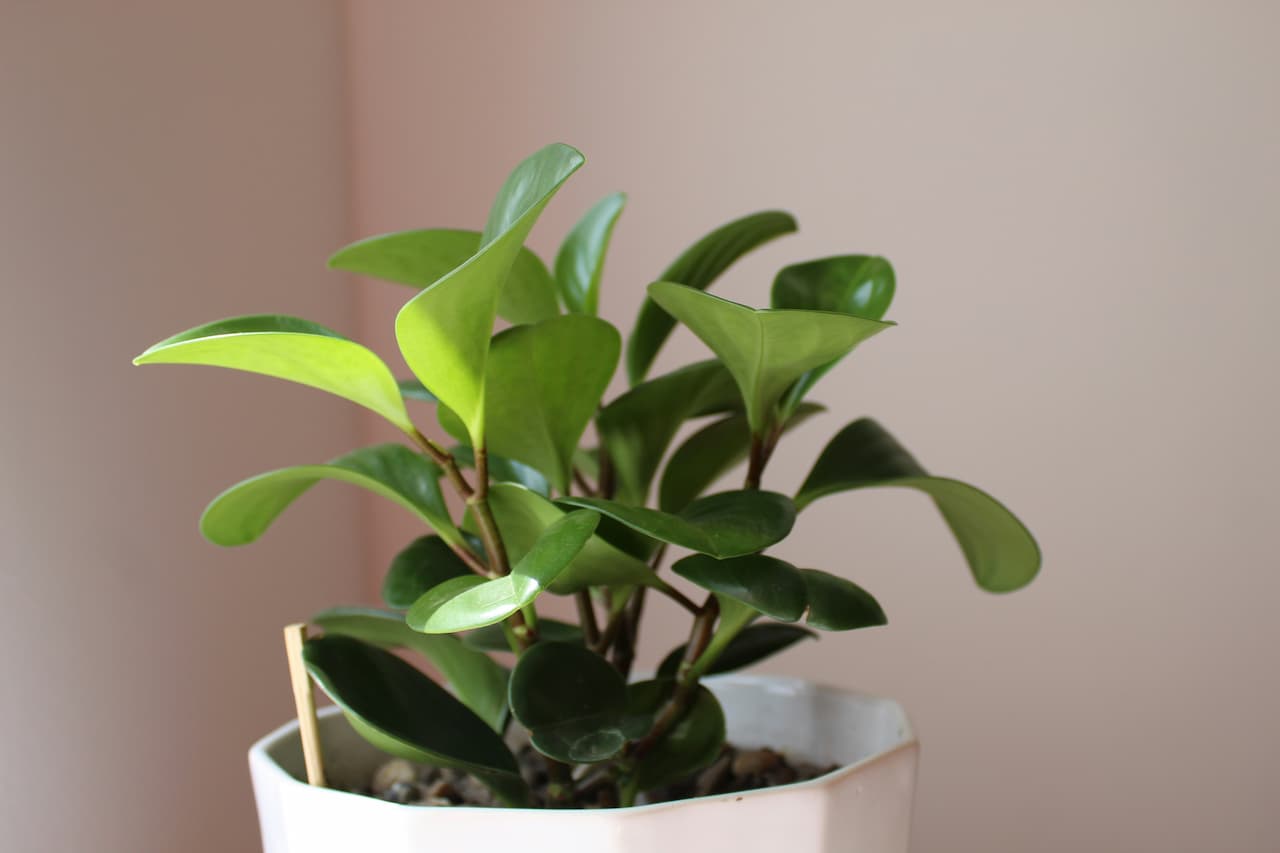
Watermelon peperomia is the most widely sold variety in the UK – its striped silver-and-dark-green leaves genuinely do resemble watermelon rind and make it one of the most visually distinctive small houseplants available. It is compact, staying well under 30cm, and grows well on a desk or shelf with moderate indirect light. Ripple peperomia (P. caperata) has deeply corrugated, dark green or burgundy-tinged leaves with a velvety texture – slightly more demanding about humidity than other types but very ornamental. Baby rubber plant (P. obtusifolia) is the most forgiving of all peperomias – a robust, glossy-leaved variety that tolerates the widest range of conditions and is the best choice for anyone new to the genus. Trailing varieties including P. rotundifolia and P. Hope are well suited to hanging baskets or high shelves where the delicate trailing stems can cascade – similar in placement to the string of hearts, though considerably less demanding about light.
Light, temperature and position
Most peperomias perform best in bright, indirect light – within a metre or two of a window that receives good natural light but not direct sun. Direct summer sunlight bleaches and scorches the leaves of most varieties, particularly the watermelon and ripple types whose decorative patterning fades in strong light. However, peperomias are more tolerant of lower light than many houseplants – P. obtusifolia in particular grows adequately in positions that would cause other plants to decline, making it a useful option for a slightly dim corner or north-facing room. Variegated varieties need somewhat more light than solid green types to maintain their colouring.
Peperomias are comfortable between 15°C and 26°C – the typical range of a UK living room or office throughout the year. They dislike temperatures below 10°C and must be kept away from cold draughts, cold windowsills in winter, and any position where the temperature drops significantly at night. They do not require high humidity – unlike ferns or calatheas, most peperomias are reasonably tolerant of the relatively dry air of centrally heated UK homes in winter, though they appreciate a position away from direct radiator heat which can cause the leaf edges to dry and curl.
Watering and feeding
Allow the top half of the compost to dry out between waterings throughout the growing season. For a peperomia in a 10-12cm pot in a typical UK home, this means watering roughly once a week in summer and every ten to fourteen days in spring and autumn. In winter, when growth slows considerably, reduce watering to once every two to three weeks or when the compost has dried to within a centimetre of the bottom of the pot. The surest way to check is to lift the pot – a peperomia pot that feels light is ready for watering; one that still feels heavy has adequate moisture.
Always water thoroughly – pour water slowly onto the compost surface until it runs from the drainage holes, allow the pot to drain completely and never leave it sitting in water. This deep-then-dry cycle encourages roots to grow downward into the compost rather than remaining near the surface. Peperomias are light feeders – apply a balanced liquid houseplant fertiliser at half the recommended strength once a month from April to September. Do not feed in autumn and winter. Overfeeding encourages soft, sappy growth that is more prone to rot and less ornamental than growth produced under restrained nutrition.
Seasonal care calendar
Repotting and propagation
Peperomias are slow-growing and genuinely prefer being slightly root-bound – they rarely need repotting more than once every two to three years. Signs that repotting is due are roots appearing through drainage holes, the compost drying out very quickly after watering, or the plant clearly having outgrown its pot. Repot in spring into a pot one size up – a 9cm to a 12cm, for example – using a free-draining compost. A standard houseplant compost mixed with 20-30% perlite improves drainage and reduces the risk of the waterlogging that peperomias are most vulnerable to. Never repot into an oversized pot – the excess compost stays wet for far too long and promotes root rot.
Propagation is straightforward and rewarding. Stem cuttings 8-10cm long taken in spring or summer root readily in moist compost or water – remove the lower leaves, insert into a small pot of moist perlite or compost and place in a warm bright position. Roots typically appear within three to four weeks. Leaf cuttings also work for most rosette-forming types like watermelon and ripple peperomia – cut a healthy leaf with its petiole (leaf stalk) intact and insert into moist compost. New plantlets develop at the base of the petiole over four to six weeks. This is one of the most satisfying propagation methods in the indoor plant world and produces new plants with no cost beyond a pot of compost. Like the nerve plant, peperomia propagates most reliably in warm conditions with high humidity around the cutting – covering with a clear plastic bag or placing in a propagator speeds rooting considerably.
Peperomias make excellent terrarium plants. Their compact size, tolerance of moderate light and appreciation of higher humidity make most small-leaved peperomia varieties ideal candidates for closed or open terrariums. P. rotundifolia, P. argyreia and P. caperata all work particularly well alongside other humidity-loving compact plants. In a terrarium, the naturally elevated humidity reduces watering frequency even further, making peperomias one of the lower-maintenance inhabitants of a planted container.
Common problems and solutions
Share on socials: