At a glance
If you’ve ever had a tree or shrub die suddenly in late summer or autumn, pulled the plant and found white fan-shaped sheets of tissue under the bark at the base, and then noticed bootlace-like black strands running through the soil around the roots, you’ve had honey fungus. It is the most destructive fungal pathogen in UK gardens, and it’s worth understanding properly because the decisions you make after you find it will determine whether it stays contained or spreads through your entire planting.
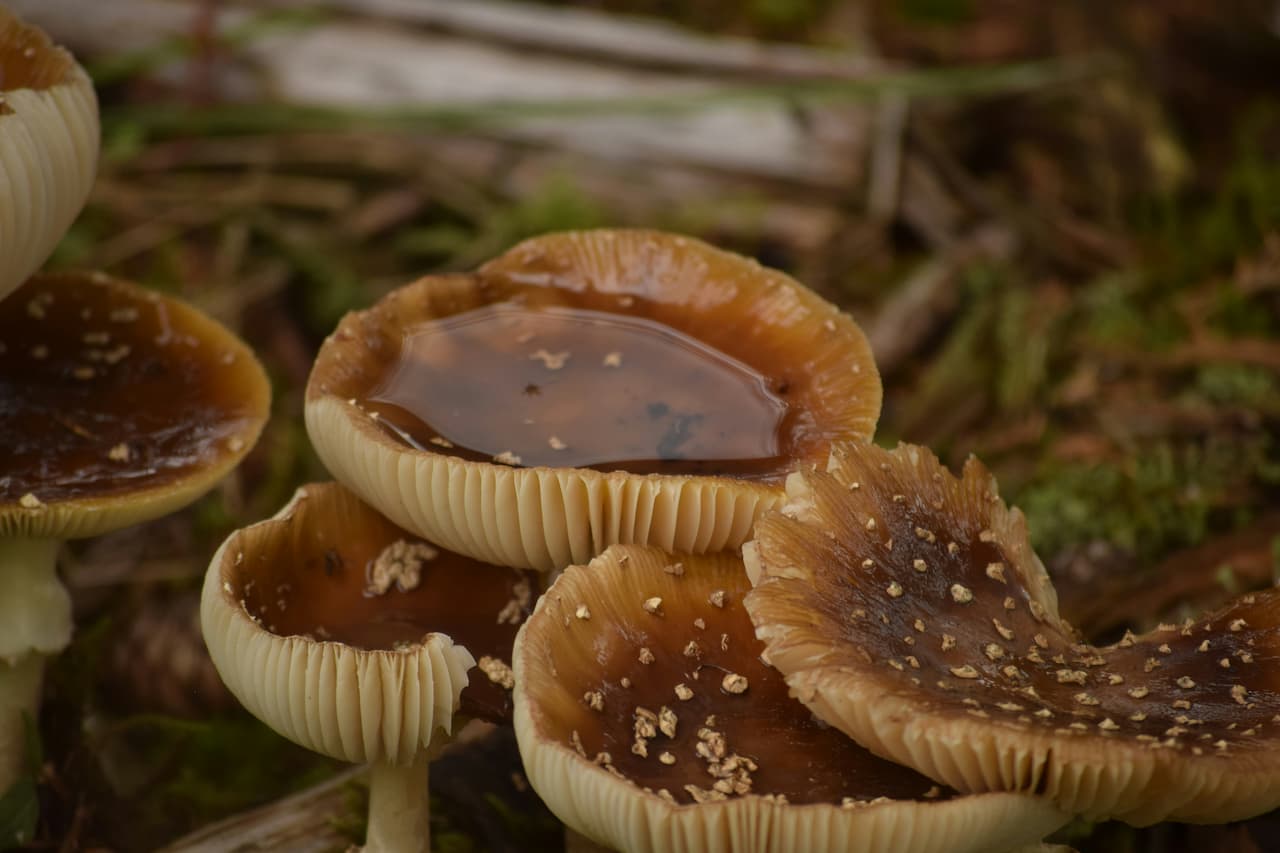
The name comes from the honey-coloured toadstools it produces in autumn, clustered around the base of infected plants or from the soil nearby. These toadstools are visible for only a few weeks of the year and many gardeners never see them. The more reliable signs are the ones underground.
Identifying honey fungus
There are several fungi that produce honey-coloured toadstools in UK gardens, and not all of them are Armillaria. Misidentifying a harmless fungus as honey fungus has caused gardeners to dig up healthy plants unnecessarily. Get the identification right before doing anything else.
The definitive sign is the white mycelial sheets under the bark at the base of an affected plant or recently dead tree stump. Peel back the bark at ground level and the sheets should be clearly visible, white to cream-coloured, with a mushroomy smell. This is not the same as the white fungal threads you sometimes find in compost or leaf litter, which are various saprophytic fungi causing no harm. The honey fungus sheets are dense, flat and fan-shaped, sitting between the bark and the wood.
The black bootlace strands, called rhizomorphs, are how honey fungus spreads from plant to plant through the soil. They look like thick black shoelaces and can travel many metres from an infected plant, spreading at up to a metre per year and reaching plants 30m or more from the original source. Finding rhizomorphs in the soil is strong supporting evidence. They are dark brown to black on the outside and white inside. Break one open to check.
The autumn toadstools appear in clusters at the base of infected plants or emerging from soil above infected roots. They are honey-yellow to tan-brown, with a ring around the stem and scales on the cap, though these features vary between the different Armillaria species present in the UK. The toadstools alone are not sufficient for identification. They are supporting evidence, not proof.
A plant dying for no obvious reason, particularly if established trees or shrubs around it have died previously, is a warning sign. Honey fungus often kills several plants in a garden over successive years, working outward from a central infected source, which is almost always a dead or dying tree stump or old root system.
If you cannot find the white mycelial sheets clearly, do not start removing plants on the basis of toadstools alone. Collect a sample of bark with any suspected mycelium still attached, seal it in a plastic bag, and send it to a plant disease diagnostic service. Most professional horticultural labs offer identification from samples. A confirmed result protects you from digging out plants unnecessarily, and equally confirms the problem if the signs are present but you are uncertain.
Which plants are vulnerable
Honey fungus attacks a very wide range of woody plants. Roses, rhododendrons, wisteria, privet, forsythia, hydrangeas, fruit trees and many conifers are all highly susceptible. Lilac is particularly vulnerable and appears consistently at the top of recorded case lists. In ornamental gardens, the plants that die most often are established shrubs and trees that have been growing in one place for years, because the fungus has had time to build up a substantial underground presence before attacking them.
Some plants have genuine resistance. Box, bamboo, phormium and most grasses are rarely affected. Cistus has some tolerance. A planting strategy that includes resistant species is one of the practical ways of managing a garden where honey fungus is present. The resistant list is long enough to make a garden full of good-looking plants entirely feasible without relying on susceptible ones.
It is worth knowing that not all Armillaria species are equally aggressive. Of the seven Armillaria species found in the UK, three occur commonly in gardens. A. mellea accounts for over 80% of garden cases and is the most pathogenic. A. gallica is also common but generally less damaging. A. ostoyae is rare in gardens but aggressive when present. Without laboratory analysis you cannot tell them apart from symptoms, but it is worth knowing that some honey fungus infestations cause repeated losses over years while others, particularly where the original source stump has been removed, may not spread as extensively.
What to do when you find it
The first priority is removing the source. In most garden situations, honey fungus is living on a dead or dying tree stump or major root system. The fungus feeds on dead wood and uses it as a base from which to send rhizomorphs in search of living plants to attack. Removing the stump and as much of the root system as possible removes the food source and limits its ability to spread.
Stump removal is hard physical work. Grinding the stump to below ground level is better than nothing but leaves the roots in place. Digging out the stump and the major lateral roots is more effective but rarely achievable completely in an established garden. The aim is to remove as much dead woody material as possible, because dead wood is the fuel.
Remove any infected plants promptly. A plant showing honey fungus symptoms is already dying or dead. Leaving it in the ground extends the period during which the fungus can draw on it and spread. Dig out the whole root ball, getting as much of the root system as you can. Burn or bin the material. Do not compost infected wood or roots.
There is no chemical treatment for honey fungus in UK gardens. There used to be, but the compounds that worked were withdrawn on safety grounds decades ago. Nothing currently available to UK gardeners reliably kills Armillaria in the soil. Anyone selling a product that claims to eliminate honey fungus from soil is wrong. The management approach is physical removal, barriers where feasible, and replacing susceptible plants with resistant ones.
Physical barriers
A physical barrier installed in the soil can prevent rhizomorphs from spreading from an infected area into a planting bed or border. The barrier needs to be impermeable, with 450 micron heavy-gauge polythene sheeting working well. It must go vertically from the surface to at least 45cm depth, ideally 60cm, and must be continuous with no gaps. Where honey fungus is spreading from a neighbour’s garden or from a nearby infected tree, installing a buried barrier along the boundary can meaningfully reduce spread.
This is only practical in certain situations. The barrier stops rhizomorphs from passing through the soil laterally, but it cannot prevent spread via root contact between adjacent plants above or at the barrier depth. It works best as a preventive measure when the source is known and localised, and as a way of protecting a specific planting area. It is not a solution across an entire infected garden.
No product eliminates honey fungus from soil. Armillatox was used as a soil drench for this purpose but is no longer approved. Nothing currently on the market works. Do not spend money on products claiming to treat or sterilise infected soil. Physical removal and resistant planting are the only effective approaches.
Replanting after honey fungus
Before replanting any area where honey fungus has killed plants, remove as much infected material as possible. Any dead wood or roots left in the soil can continue supporting the fungus for years. Work through the area carefully with a fork, removing every root fragment you can find.
Replacing with resistant species is the most reliable long-term strategy. In a garden where honey fungus is established and the source cannot be fully removed, planting susceptible species in the same area is likely to result in repeated losses. The resistant plant list is long enough that there is no shortage of good choices.
Resistant plants include box, bamboo, phormium and New Zealand flax, most ornamental grasses, cistus, Pittosporum, Cordyline, Cotinus (smoke bush), yew, Pieris, Tamarix and most bulbs. Salvias, both hardy and tender, have proven resistant. Among conifers, yew performs better than most but is not reliably immune under severe pressure.
The resistant list should inform your replanting choices, but it does not mean immune. Under severe infection pressure, rhizomorphs contacting the roots of normally resistant plants can still cause damage, particularly on young specimens. Planting vigorous, established plants rather than young specimens reduces risk, as does improving soil drainage, since Armillaria is more aggressive in wet, poorly drained conditions.
Honey fungus and stumps
The most common source of honey fungus in UK suburban gardens is a tree stump, either in the same garden or in a neighbouring one. Old stumps from trees removed without stump grinding, or large root systems left after development clearance, can harbour Armillaria for decades. The fungus breaks down dead wood very slowly, which means a large stump can support it for twenty or thirty years.
If you are having a tree removed and honey fungus is present in the garden or nearby, insist on stump grinding or, better still, full root excavation. The cost of proper stump removal is small compared to the ongoing losses from leaving infected wood in the ground. A grinding service reduces the stump to chips below soil level, which is a significant improvement over leaving the stump in place, though the lateral roots remain. Full excavation with a mini-digger is the most thorough option where access allows.
The chips produced by stump grinding from an infected stump should not be used as mulch. They keep the wood in the garden and can continue supporting the fungus. Remove and bin or burn them.
Common questions
Share on socials: