At a glance
The lily beetle (Lilioceris lilii) is one of the most damaging garden pests in the UK and has spread widely across England and Wales since its arrival in the 1940s. A single pair of adults can produce enough larvae to strip a lily plant to bare stems within a few days. The adults are deceptively attractive – bright scarlet and unmistakable – but the larvae are the real destroyers, disguising themselves under a thick covering of their own black excrement that makes them almost invisible on stems and leaf undersides until serious damage has already been done. Missing even a week during the peak larval feeding period in June and July can mean complete defoliation of a plant that was healthy two weeks earlier.
Effective control requires consistency from the moment lily shoots emerge in spring through to when the plants die back in autumn. There is no single treatment that eliminates lily beetles permanently – adults overwinter anywhere in the garden, not just beneath the host plant, and will fly back to lilies each spring regardless of what was done the previous season. The combination that works is regular hand-picking, close attention to the larval stage where the real damage happens, and neem oil spray to deter adults and interrupt the laying of further egg batches. This guide covers every stage of the lifecycle and what to do at each one.
Identifying lily beetles and larvae
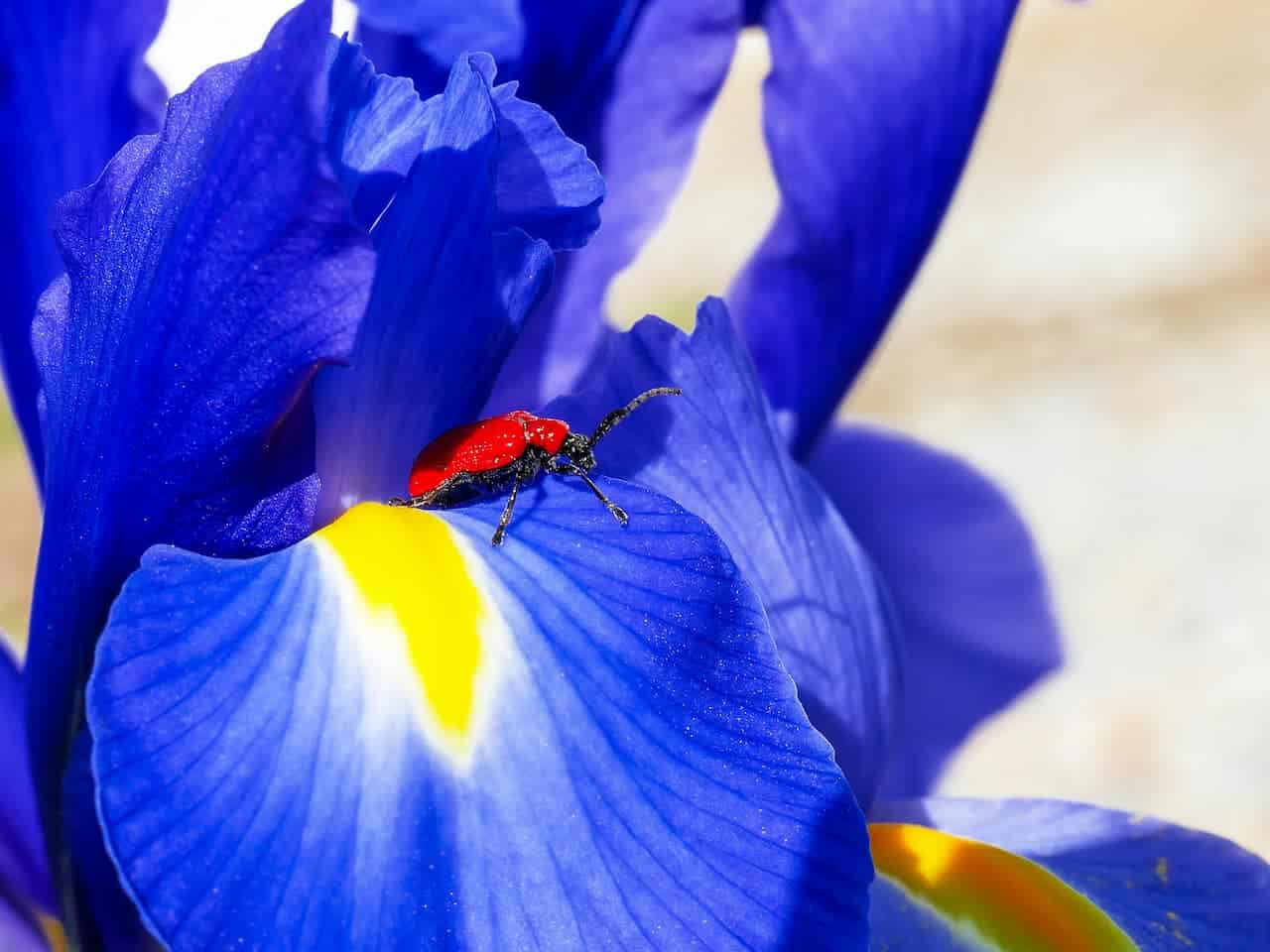
The adult lily beetle is one of the few garden beetles that is genuinely impossible to confuse with anything else. The bright scarlet body, approximately 6-8mm long, is vivid even from a distance, and is paired with a black head, black legs and a black underside. That black underside is the beetle’s main survival trick: when disturbed, it immediately drops from the plant and lands upside down, making it almost invisible against bare soil. Handling a beetle between gloved fingers will often produce a faint squeaking sound, which is the beetle stridulating – rubbing parts of its body together as a defensive response.
The larvae are the stage that does the most damage and the most difficult to find. Running a gloved finger firmly along every stem and leaf underside is the only reliable method of detection – any dark smear that moves or reveals an orange grub beneath it is a larva that needs removing. The sheer quantity of black excrement covering on older larvae can make a single plant look as though a large insect has deposited a streak of dark matter along its stems. Do not assume dark marks are soil or bird droppings without checking them physically.
Eggs are laid in batches of up to 12 on leaf undersides, often in a slightly irregular curved line. They are orange-red when freshly laid and easy to distinguish from the leaf surface, but can be partly covered in debris as they age. Removing eggs when they are found prevents the next generation entirely – this is the highest-value action per minute of inspection time, as each batch of removed eggs represents up to 12 larvae that will never need dealing with.
Check fritillaries as well as lilies. Lily beetles also attack fritillaries (Fritillaria species) including crown imperials, snake’s head fritillaries and other Fritillaria species grown in the garden. Any bed containing both lilies and fritillaries should treat both as host plants and inspect both regularly from late March onwards. The beetle finds hosts partly by volatile chemicals given off by the leaves, and adults arriving from elsewhere in the neighbourhood can locate either plant type.
Seasonal activity calendar
There is one generation of lily beetles per year. Adult beetles overwinter in soil and plant debris anywhere in the garden – not necessarily near lilies – and emerge from late March as temperatures rise, flying to lilies and fritillaries to feed and begin egg laying almost immediately. A single female can lay up to 450 eggs over the season. The larvae hatch and pass through four feeding instars before dropping to the soil to pupate, with new adults emerging later in the summer before overwintering again. This annual cycle means the season’s management effort must start at the very beginning of spring – by the time significant damage is visible, the larvae responsible are already well advanced.
The consequences of defoliation are worth understanding because they explain why the June and July period is genuinely critical, not just inconvenient. A lily that is completely stripped of foliage before flowering loses the photosynthetic capacity to refuel its bulb after blooming. A bulb that enters dormancy with insufficient energy reserves will produce a weaker plant the following year, and may not flower at all. Two or three seasons of severe defoliation can effectively exhaust a bulb entirely. Consistent management is therefore a direct investment in the long-term performance of the planting.
Control methods compared
There is no single method that eliminates lily beetles permanently, and no biological control currently approved or practically effective for UK garden use – adult beetles overwinter well away from lily plants and fly back in spring, making soil treatment around the host plant an ineffective approach. The strategy that works is combining regular physical removal with neem oil spray to deter adults and disrupt larval development, supported by good winter soil management. Chemical pesticides are not recommended: contact sprays kill adults on contact but do not penetrate the excrement covering that larvae use as camouflage, and they cause significant harm to bees, hoverflies and other beneficial insects visiting lily flowers.
The white tray technique transforms hand-picking from frustrating to effective. The beetle’s drop-and-hide behaviour evolved specifically to defeat detection against natural backgrounds. A white plastic tray or upturned frisbee held directly beneath the stem before any disturbance gives the beetle nowhere to hide when it falls. Work slowly from the side of the plant rather than reaching from above – the vibration of an approach from above triggers the drop reflex before you are close enough to catch the beetle.
Common problems and solutions
Prevention and long-term management
There is no way to prevent lily beetles finding lilies in a UK garden – adults are mobile fliers and will arrive each spring from overwintering locations anywhere in the surrounding area. The realistic goal is consistent population suppression rather than elimination. Vigilance that begins at the first sight of lily shoots in March and continues through to September, combined with thorough winter soil management, will keep most established gardens at a level where plants grow and flower successfully year on year despite the annual beetle pressure.
Forking over the soil around lily bulbs and through the wider garden in October and November exposes overwintering pupae and adults to cold and to foraging birds – robins in particular will work through freshly turned soil looking for grubs. Forking the whole border rather than just the area immediately around the bulbs is worth the extra effort because adults can overwinter anywhere in the garden, not only close to their host plants. The soil disturbance also disrupts any pupae that completed their development earlier in the autumn.
Remove and bin all dead lily foliage in autumn rather than composting it. Composting dead foliage can provide shelter for overwintering adults that then emerge directly into the same garden the following spring. A clean cut-down and disposal of stems and leaves in October is preferable. Avoid heavy mulching directly around lily plantings from late May through to late August – larvae that drop from the plant to pupate find thick organic mulch an ideal environment in which to complete their development undisturbed. A clear soil surface or a fine grit mulch around lily plantings during summer is preferable to bark chippings or thick organic material that creates a protected layer.
Growing lilies in containers rather than borders offers one practical benefit for management: easier inspection. Container lilies can be turned and examined from all angles, which makes it quicker to check every stem and leaf underside thoroughly. However, a container does not make the plant any less attractive to beetles – adults find their host plants partly by the volatile chemicals given off by lily foliage, and a lily in a pot is as visible to a searching beetle as one in a border. The same inspection routine applies regardless of where the plant is grown.
Physical exclusion using fine mesh netting placed over plants in early spring, before adults emerge, is worth considering for a small number of particularly valued or show lilies. The mesh must be fine enough to exclude the beetle but must allow air circulation to prevent problems with mould under the cover. This approach is labour-intensive to set up and remove and is not practical at scale, but for one or two specimen plants in containers it can dramatically reduce initial adult colonisation in March and April.
Share on socials: