At a glance
Borage is one of those plants that does several things at once and does all of them well. The electric blue star-shaped flowers are among the most striking produced by any annual plant in a UK garden – a genuine, unambiguous cobalt blue that glows with particular intensity in early morning and evening light and looks spectacular frozen into ice cubes for summer drinks. The flowers attract bumblebees, honeybees and solitary bees in remarkable quantities from June right through to October, making borage one of the most effective pollinator support plants available. And the plant is so easy to grow, so tolerant of neglect, and so reliable in its self-seeding habit, that once you have established it in a garden you will almost certainly never need to buy seed again.
That combination – visual impact, pollinator value, culinary use, and effortless self-perpetuation – is unusual in a single plant. Most herbs make you choose between the ornamental and the useful. Borage manages both. It belongs in the herb garden and in the vegetable bed. It is a trap plant for aphids, a companion that draws pollinators to nearby crops, an edible garnish, and a genuinely beautiful flowering annual. The only management challenge it presents is controlling where it decides to grow – and even that is a minor inconvenience in a plant that earns its space so comprehensively.
What borage is and why it belongs in your garden
Borage (Borago officinalis) is a hardy annual herb native to the Mediterranean region, now naturalised widely across Europe. It belongs to the Boraginaceae family – the same botanical family as forget-me-nots, comfrey and lungwort, which explains the characteristic rough, bristly leaves and the vivid blue flower colour the family is known for. The plant has been cultivated in British gardens since at least the Roman period, when it was used medicinally, added to wine, and valued for the cucumber-scented flowers that made it a cooling herb for summer drinks and salads.
The plant grows rapidly from seed into a large, branching, slightly sprawling annual typically reaching 50-70cm tall and nearly as wide, sometimes taller in rich moist conditions. Every stem and leaf surface is covered in stiff white bristles that catch the light and give the plant a silvery appearance from a distance. These hairs can cause mild skin irritation in people with sensitive skin – similar to the effect of nettles but considerably less severe – so wearing long sleeves when handling large quantities of foliage is worth doing. The flowers themselves are perfectly smooth and safe to handle barehanded.
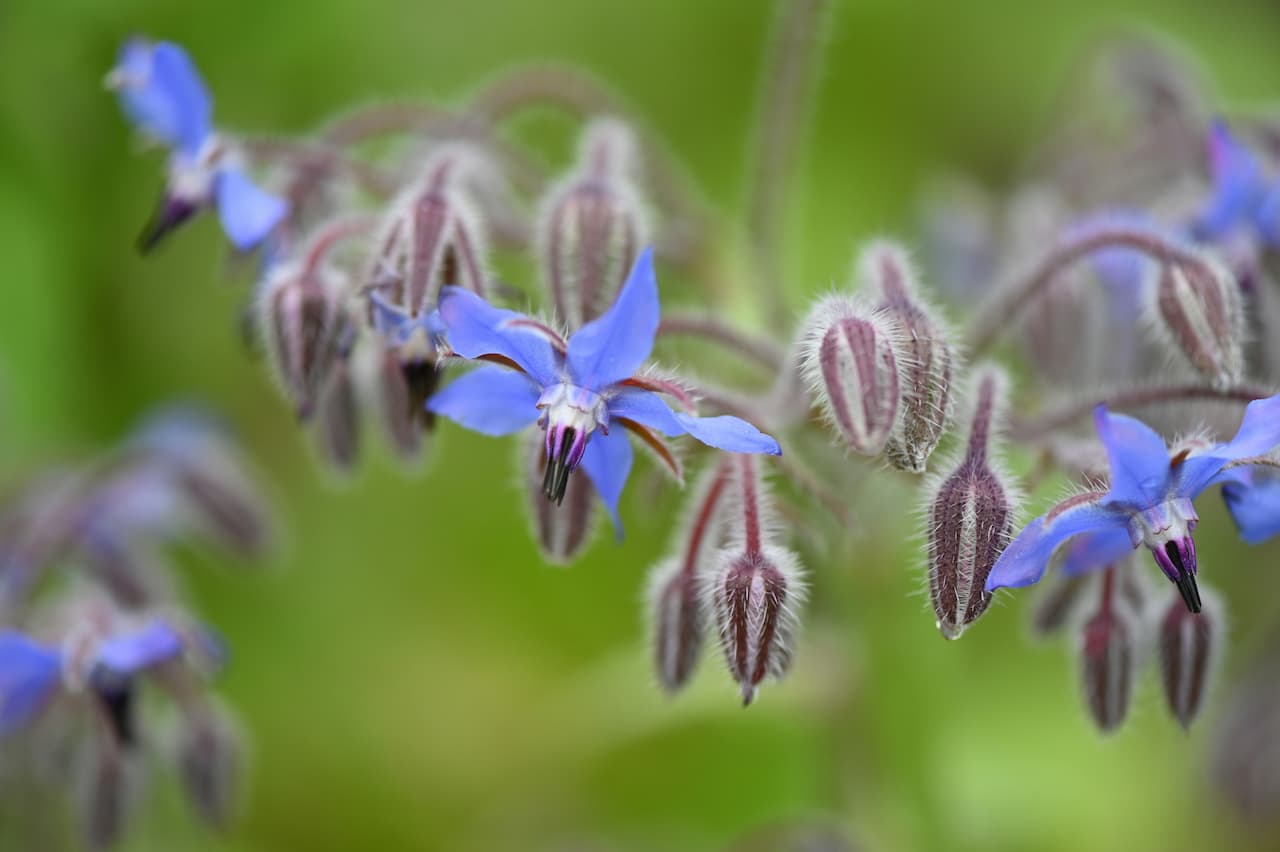
The flowers are the reason most gardeners grow borage. True blue is genuinely rare in the flowering world. Many plants described as “blue” are in reality violet, lavender, purple, mauve or blue-grey. Borage flowers are none of those things – they are a saturated, vivid cobalt blue that has no purple undertone at all. The five-petalled star shape, each petal reflexed backward to reveal the prominent black and white anthers at the centre, is immediately recognisable and structurally unlike most other garden flowers. The white-flowered form ‘Alba’ exists and is attractive in its own right, but it lacks the particular quality that makes standard borage genuinely special. When bees are working a large borage plant in full sun, the combination of the blue flowers, white anthers and amber pollen is something worth watching for a few minutes.
The pollinator value is exceptional and well-documented. Borage is rated among the most valuable pollinator support plants available for UK gardens, and the reason is straightforward: the flowers refill their nectar reservoirs extremely rapidly – reportedly every two to five minutes – providing a continuous, reliable food source that keeps bees returning throughout the day. On a warm summer afternoon a well-established borage plant can host dozens of bees simultaneously across its hundreds of open flowers. No other common garden annual sustains this level of pollinator traffic for such an extended season, from June through to the first frosts of autumn.
Varieties worth growing
Three types of borage are worth knowing about before you plant, though the standard species is the one most gardeners should grow.
The standard species (Borago officinalis) is the one to grow for maximum pollinator value, edible use and visual impact. Borago officinalis ‘Alba’ produces pure white flowers and is attractive in a planting scheme where the blue of the standard species would clash, but it lacks the particular electric quality of the true blue form and is marginally less striking as a garden plant. Borago pygmaea is a low-growing, creeping perennial species that reaches only about 30cm tall, produces smaller pale blue flowers from June to October, and is found in the perennials rather than herbs section of most garden centres. It is well suited to growing at the front of borders or in containers where the standard borage would be far too large, but it is a different plant in character and habit – slower, less prolific, and without the culinary usefulness of the annual species. Standard borage is the one to start with unless you specifically need a smaller or perennial option.
Sowing and establishing borage
Borage is always sown direct where it is to grow. This is not optional advice or a preference – it is a fundamental characteristic of the plant that has a practical consequence. Borage develops a long, deep taproot very quickly after germination, and this taproot is extremely sensitive to disturbance. Transplanted borage usually wilts, stalls, and either dies or grows on weakly without ever achieving its full potential. Any seedling raised in a pot or module tray and moved to its final position is at high risk of failure unless moved at the cotyledon stage, before the root has become substantial. The simplest, most reliable and cheapest approach is direct sowing, and there is no benefit to doing anything else.
Sow from April onwards once the soil has warmed. Seeds can be sown earlier – from March – under a cloche or fleece, which brings flowering forward by a few weeks. The large black seeds are easy to handle individually and sow one per station rather than scattering them. Push each seed 1-1.5cm deep, firm lightly, water in, and mark the spot. Germination is rapid and reliable in warmth – seven to fourteen days is typical in April and May, slightly longer in cooler conditions. Thin seedlings to 45-50cm apart; borage plants spread considerably and crowded plants compete for light and become leggy. For a continuous supply of young leaves and fresh flowers through summer, make two sowings three to four weeks apart – one in late April and one in late May.
An autumn sowing is also possible – September is the right month for this – which produces plants that overwinter as small rosettes and flower significantly earlier the following year than spring-sown plants. This approach works well in mild gardens with free-draining soil but carries a small risk of losses in wet winters. In practice, most established borage gardens make autumn sowing unnecessary because the plants self-seed so prolifically that the spring seedlings are already in place before the gardener thinks about sowing.
The self-seeding habit of borage is one of its most useful characteristics and the source of its only genuine management challenge. A single borage plant produces large quantities of seed. In a good site – sunny, well-drained, reasonably undisturbed – the seedlings that appear the following spring will be dense enough to require significant thinning. This is not a problem if you want borage in that spot. It becomes an issue if the original plant grew somewhere inconvenient, because borage seedlings will appear prolifically in that location year after year unless you remove every plant before it sets seed. The practical solution is to position your initial sowing carefully, allow the plants to self-seed freely in their first few years, and use the resulting colony as a permanent feature that needs thinning annually rather than sowing fresh.
Growing conditions and ongoing care
Borage is fundamentally a plant from dry, rocky Mediterranean terrain – poor soil, good drainage, plenty of sun – and its ease of cultivation in UK gardens reflects how well those basic conditions translate to most garden situations. Unlike many herbs that reward careful nurturing with better flavour or more abundant harvest, borage actively produces better results in lean conditions. In rich, heavily fertilised soil it makes excessive leafy growth with fewer flowers, a scraggier habit and less concentrated nectar. The less you do for it, the better it tends to perform.
Beyond initial watering while seedlings establish, borage requires almost no active care through the growing season. There is no pruning to do, no feeding schedule to follow, and no deadheading needed since spent flowers simply drop and the plant continues producing new blooms continuously. The one physical task that may be required is staking. Older borage plants in full flower become significantly top-heavy – the weight of the flowering stems can cause them to flop outward and collapse. Insert a short cane and loose string loop around the main stem before this happens, particularly in exposed positions or when heavy rain is expected. Collapsed plants usually continue growing but become untidy and take up far more space than upright ones.
The question of managing self-seeding is the main ongoing decision with borage. If you want to prevent it spreading into areas where it is not wanted, remove plants before the seed fully ripens – before the seed cases turn black and begin to fall. This is harder to time perfectly than it sounds, since a borage plant typically has flowers, half-ripe seeds and ripe seeds simultaneously at any point in the season. Regular checking and removal of plants in unwanted areas is more reliable than trying to deadhead a plant producing hundreds of flowers simultaneously. Conversely, if you want to establish a permanent self-seeding colony, simply leave plants to set seed freely in a chosen area for two or three seasons and the colony will develop and sustain itself indefinitely from that point.
Harvesting flowers and leaves
Both the flowers and the young leaves of borage are edible, and both repay attention to how and when you harvest them. The flowers are the more frequently used and arguably more rewarding – they are genuinely beautiful as a garnish and have a mild, clean, fresh flavour that works in a wide range of culinary contexts. The leaves are useful but require more care in selection since older leaves become increasingly hairy and are unpleasant to eat raw.
To harvest flowers, pick them individually when fully open – they detach cleanly from the calyx with a gentle tug or a twist. Pick in the morning after any dew has dried. Use them the same day – borage flowers wilt within a few hours of picking and cannot be stored fresh in any useful way. The most common culinary uses are as a garnish floated in Pimm’s, gin and tonic, or elderflower cordial, and frozen into ice cubes. To freeze, place individual flowers face-down in an ice cube tray, pour over a thin layer of water, and freeze before topping up the cube with more water to seal. The electric blue colour is preserved beautifully in the ice and slowly reveals itself as the cube melts in a glass. For salads, scatter flowers across the finished dish immediately before serving – they add visual impact far beyond their size.
Young borage leaves – those from the growing tips or the smallest leaves on the plant, picked before they become large and fully developed – have a genuine mild cucumber flavour and work well in green salads, particularly with cucumber and mint. Once leaves are more than a few centimetres long the surface hairs become coarse enough to be unpleasant raw, and those larger leaves are better blanched briefly before use, which softens both the flavour and the texture. Cooked, borage leaves behave much like spinach and can be used anywhere spinach is called for. They reduce substantially in cooking, so pick more than you think you need. The whole plant is also rich in minerals and has a long history of medicinal use, though its primary value in the modern kitchen garden is culinary and ornamental rather than medicinal.
Companion planting and wildlife value
Borage’s value in the kitchen garden extends far beyond its own harvest. The relationship between borage and the crops it grows near is one of the most well-established and genuinely useful examples of companion planting available to UK gardeners, and it works through a mechanism that is straightforward and not merely traditional folklore: borage flowers attract bees in extraordinary numbers over an extended season, and bees working the borage also visit and pollinate the surrounding crops. The practical improvement in fruit set on tomatoes, strawberries, courgettes, beans and cucumbers growing near a large borage plant in full flower is measurable and consistent.
The mechanism behind the tomato-borage relationship is worth understanding because it affects how you position the plants. The benefit is not transmitted through root chemistry or soil improvement, though borage decomposing into the soil at the end of the season does add organic matter and some minerals. The primary benefit is aerial – bees attracted by borage flowers visit nearby tomato flowers in the same foraging trip, improving pollination rates. This means borage needs to be physically near the crops it is supporting, not on the other side of the garden. Plant it at the edges of vegetable beds where it can grow to full size without shading low crops, within two to three metres of the plants it is intended to support.
The blackfly trap plant relationship with broad beans is different in mechanism and equally well established. Blackfly colonise the growing tips of broad beans in spring and early summer and can devastate the crop. Borage planted near broad beans attracts enough of the blackfly colony away from the beans to reduce the population pressure on them significantly. The blackfly on the borage can then be dealt with there – by leaving them for natural predators such as ladybirds and hoverflies, or by removing them manually – rather than needing to protect the more valuable bean crop. Position borage close enough to the beans to intercept early blackfly scouts – ideally within a metre of the bean rows.
The wildlife value extends beyond bees. Borage flowers also attract hoverflies, whose larvae are significant aphid predators, and various solitary bee species in addition to bumblebees and honeybees. The sustained flowering season from June to October means borage provides a food source during the late summer and early autumn period when many other flowering plants have finished – a gap in the nectar calendar when bees particularly need reliable foraging. A single large borage plant in a small garden or allotment plot provides meaningfully more pollinator support than many other choices, and its value compounds when multiple plants are established in a self-seeding colony.
Common problems
Borage has a relatively short list of problems and most of them are minor. The more significant ones are related to its vigour and self-seeding habit rather than disease or pest pressure, and they are all manageable with simple interventions.
Blackfly on young borage shoots is both the most common pest problem and, in the context of companion planting, one of the most useful things that can happen. The aphids on the borage are a food source for ladybird larvae, hoverfly larvae and other predatory insects whose populations build up as the season progresses. If borage is being used as a trap plant near broad beans, the intention is to leave the blackfly colony on the borage and let natural predators deal with it, while protecting the beans from the same infestation. If you do need to remove blackfly from borage – because the infestation is heavy and the plant is clearly weakened – a jet of water from a hosepipe removes the majority without needing any pesticide on a plant you may be eating from.
Powdery mildew appears on borage leaves in late summer, particularly in dry conditions with poor air circulation. By the time it typically appears, the main flowering and harvesting season is largely over anyway, and the affected foliage is older and no longer useful for eating raw. The mildew does not kill the plant and rarely affects flower production significantly. Remove the worst-affected leaves if the appearance bothers you, ensure the area has reasonable air circulation, and accept that late-season mildew on borage is a cosmetic issue rather than a threat. Leaf miners create winding pale tunnels in the leaves but similarly rarely cause serious damage – remove and dispose of heavily affected leaves and the plant grows on without further treatment needed.
Share on socials: