At a glance
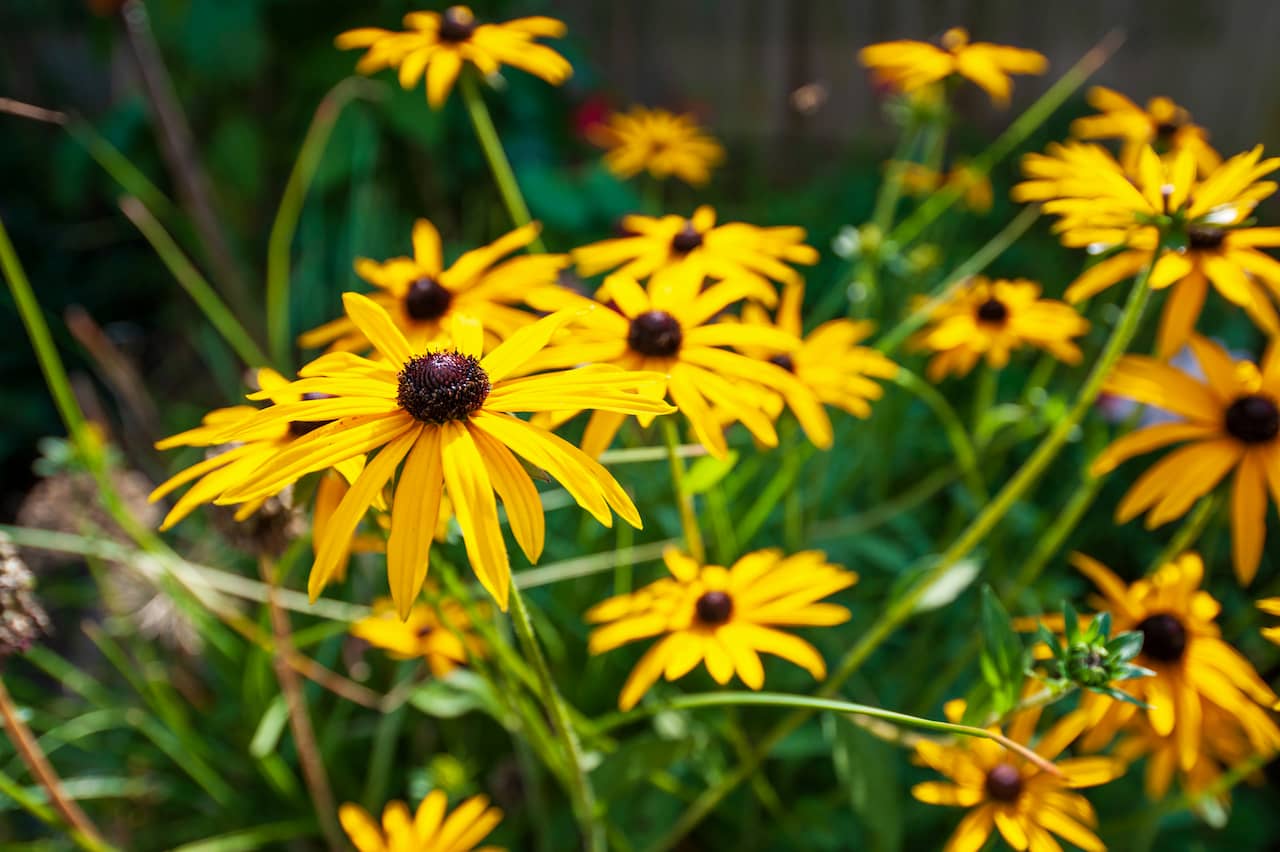
Rudbeckias are among the most reliable late-summer and autumn-flowering plants for UK gardens. The bold yellow to orange daisy flowers with their distinctive dark centres – giving rise to the common name black-eyed Susan – brighten borders from July onwards at exactly the point when many early-summer perennials are fading. They are unfussy about soil, reasonably drought-tolerant once established, and produce flowers in such quantity that even a modest clump transforms a tired late-summer border into something worth looking at well into October.
The genus is more varied than most gardeners realise. It includes both annual and perennial species with very different habits, and choosing the right type for your purpose is important. The annuals (principally Rudbeckia hirta cultivars) give an enormous first-year display but require repeat sowing. The perennials (R. fulgida and R. laciniata types) take a season to establish but then reliably return and spread year after year. Understanding which is which prevents the frustration of expecting a perennial performance from an annual, or vice versa.
Varieties – annual, biennial and perennial
The confusion between annual and perennial rudbeckias is the most common source of disappointment with this plant. Both types are sold without clear labelling in many garden centres, and the distinction matters significantly for long-term border planning.
Among the perennial types, Rudbeckia fulgida var. sullivantii ‘Goldsturm’ is the benchmark variety for UK gardens. At 60-70cm with near-perfect golden-yellow flowers from late July to October, it has earned its place as one of the most planted late-summer perennials in the UK for good reason. It is robust, self-supporting, and spreads steadily to form a substantial clump without becoming invasive. R. laciniata ‘Herbstsonne’ is the choice for height – reaching 180cm in good conditions with slightly looser, reflexed petals that give a more naturalistic character suited to prairie-style plantings.
Growing conditions and planting
Rudbeckias are notably tolerant of a wide range of soil conditions – one of their most practical virtues for UK gardeners dealing with clay, sand or anything in between. They perform best in moisture-retentive but free-draining soil in full sun, but adapt reasonably well to partial shade and heavier soils. In consistently waterlogged conditions they will struggle, but they are far more forgiving of occasional winter wet than many other border perennials.
Plant container-grown perennial rudbeckias in spring or early autumn. Spring planting gives the root system time to establish before its first winter, though both timings work well in most UK gardens. Space R. fulgida cultivars 45cm apart – they spread steadily and clumps reaching 60cm across in their second or third year are typical. In borders, plant in groups of three or five for impact rather than as individual specimens. A single rudbeckia plant is easily lost in a busy late-summer border; a group of five creates a bold block of colour that holds the space.
Plant rudbeckia where it can spread slightly. R. fulgida spreads by short stolons and self-seeds modestly. Planting where neighbouring plants can be gradually displaced allows the clump to develop naturally and produce more flower stems each year. In a tight, formal border, divide every three years instead to maintain the planting footprint.
Care, deadheading and feeding
Rudbeckias are low-maintenance plants that need little day-to-day attention once established. They do not require staking in most situations – R. fulgida and most of the shorter hirta types are self-supporting. Only the tall R. laciniata cultivars over 150cm benefit from light support in exposed positions. Feeding requirements are modest – a balanced slow-release fertiliser worked into the soil at planting is usually sufficient for the season, with a light top-dressing of balanced fertiliser the following spring.
Propagation and overwintering
Perennial rudbeckias are straightforward to propagate by division. The method is identical to dividing any clump-forming herbaceous perennial – lift the whole clump in spring, separate into sections with a sharp spade or back-to-back forks, and replant the outer sections. Named cultivars do not come reliably true from seed, so division is the only method for maintaining a specific variety. Seed-grown plants from open-pollinated rudbeckia seed will vary in flower size and form but are typically still attractive and perfectly garden-worthy.
Using rudbeckia in the border
Rudbeckias fill the gap in the border calendar that presents the biggest challenge for most UK gardeners – the late July to October period when early summer perennials are over and autumn is not yet established. Their warm yellow and orange tones work particularly well paired with purple and blue late-season flowers, and the combination of rudbeckia with grasses, sedums and late-flowering asters creates the naturalistic late-summer planting style that has become increasingly popular in UK garden design.
For companion planting, the most effective pairings combine rudbeckia’s warm yellow with cool contrasts. Salvia nemorosa and veronicastrum provide the purple-blue vertical contrast that sets off rudbeckia’s horizontal, daisy-form flowers most effectively. Ornamental grasses like Pennisetum and Molinia weave between rudbeckia clumps and catch the low autumn light in a way that extends the visual season beyond the last flowers. Sedum ‘Autumn Joy’ and asters complete the late-season palette, and all of these plants share rudbeckia’s tolerance of average UK soils and minimal maintenance requirements. If you are building a new late-summer border from scratch, a combination of R. fulgida ‘Goldsturm’, Veronicastrum virginicum, ornamental grasses and sedums planted in generous drifts will deliver four months of interest from July through to the first hard frosts with almost no intervention required.
Share on socials: