At a glance
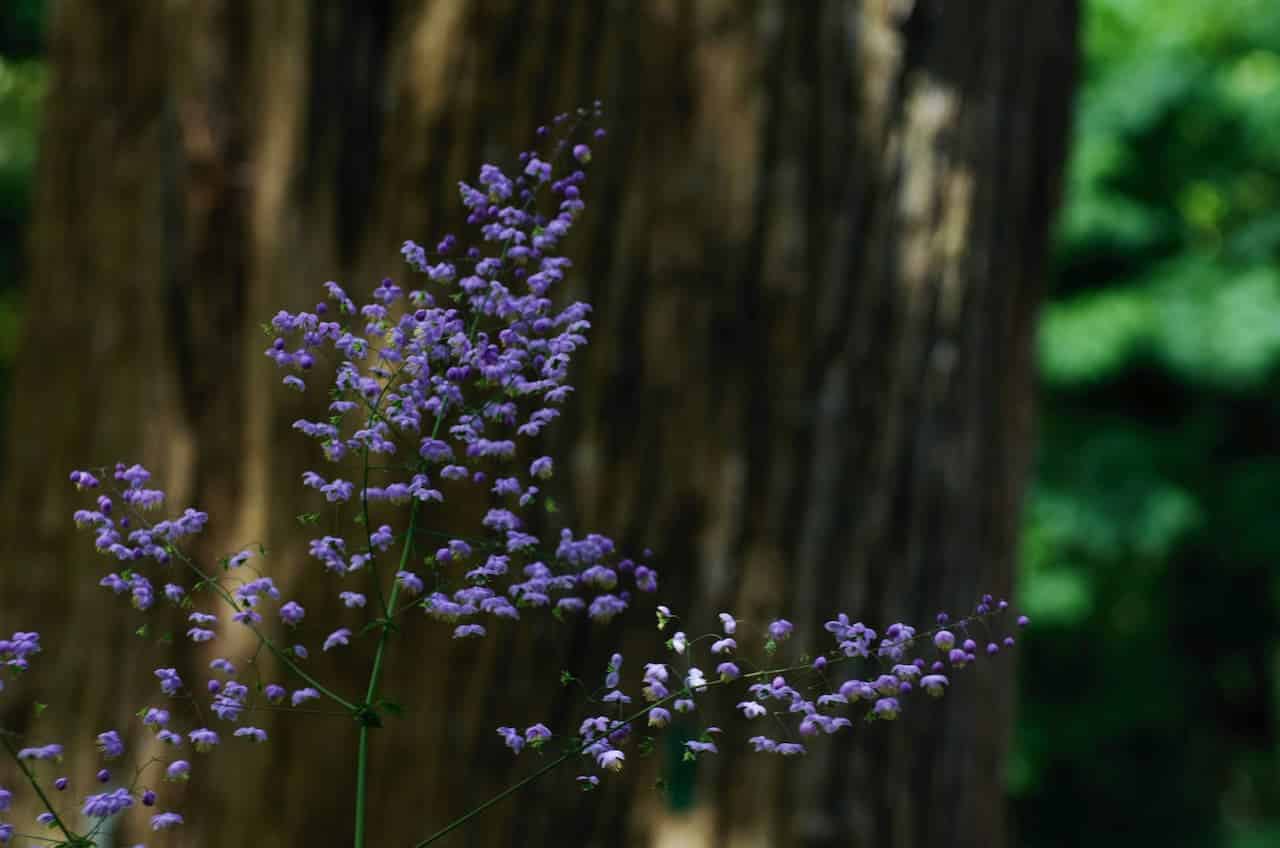
Thalictrum – commonly known as meadow rue – is one of the most elegant groups of perennials available to UK gardeners, yet it remains less widely grown than it deserves. The flowers are tiny individually, but they are produced in such abundance on branching stems that the overall effect is a cloud of colour floating above the foliage – mauve, lilac, cream or pale yellow depending on the species. The foliage is equally ornamental: delicate, columbine-like leaves in soft grey-green that look attractive even before the flowers open, and which remain presentable long after the blooms have faded. No other tall perennial produces quite this combination of airy lightness and visual substance.
The genus covers a wide range of habits and habitats, from compact front-of-border species at 60cm to towering back-of-border giants reaching well over 2 metres. Most are fully hardy in UK conditions and reliably perennial, returning each year with minimal attention. The preference for moisture-retentive soil and tolerance of partial shade makes thalictrum one of the few tall, dramatic perennials that performs genuinely well in the shadier parts of a garden where many other plants simply sulk. Understanding which species suits which position is the key to getting the best from this genus.
Best varieties for UK gardens
The species most commonly grown in UK gardens fall into three broad groups: the tall summer-flowering types suited to mid and back of border, the compact front-of-border types, and the autumn-flowering species that extend the season. The tall group is dominated by Thalictrum delavayi and its cultivars, which represent the best starting point for most UK gardens.
Growing conditions and planting
Thalictrum is one of the more adaptable tall perennials, tolerating a range of conditions that would challenge many plants of similar stature. The key requirements are moisture-retentive soil that does not dry out completely in summer, and some protection from strong winds that can snap the taller varieties. Within those parameters, thalictrum performs across a surprisingly wide range of light conditions.
Plant thalictrum in spring or early autumn, incorporating plenty of organic matter into the planting hole to improve moisture retention. Spacing depends on species: compact types like T. aquilegiifolium can go at 40-45cm centres, while the tall T. delavayi cultivars need 60-70cm to allow air circulation around the stems. The taller species benefit from a sheltered position, or from neighbouring plants that provide physical support – thalictrum self-supports reasonably well but a late gust of wind during a heavy summer rainstorm is the most common cause of stem damage.
Mulch in autumn, not spring. A layer of organic mulch applied in autumn around thalictrum crowns serves two important purposes: it insulates the crowns through winter cold and it slowly improves the moisture-retentive quality of the soil as it breaks down. Applying mulch in spring after growth has started risks burying emerging shoots. Autumn application is consistently the better timing for this genus.
Care through the seasons
Thalictrum is not a demanding plant once established. The main tasks through the year are supporting emerging stems in spring, deadheading or cutting back after flowering, and dividing overcrowded clumps every three to four years to maintain vigour. Established plants are drought-tolerant in the sense that they will survive dry spells, but they will not flower as freely or as long without consistent soil moisture during the growing season.
Propagation and division
Thalictrum can be propagated by seed, division or basal cuttings in spring. Each method has different strengths depending on the cultivar and the volume of plants required. Division is the most reliable approach for most gardeners – it is quick, carries no risk of losing cultivar characteristics, and the resulting divisions establish and flower in the same season in most cases.
Using thalictrum in the garden
The greatest design strength of thalictrum is its transparency and visual lightness in a border. Unlike a solid-stemmed plant that blocks the view, thalictrum’s wiry branching stems and delicate foliage create a semi-transparent curtain through which other plants can be glimpsed. This quality makes it particularly useful for placing at the front of a tall plant grouping where it screens without concealing – a characteristic that the best naturalistic planting designers exploit extensively.
Thalictrum is also a first-rate cut flower. The stems are long, the flowers last well in water if cut in bud, and the distinctive foliage adds texture to arrangements where most cutting garden flowers would add nothing. Cutting for the vase doubles as deadheading, keeping the plant tidy while providing material for the house. For anyone growing a cottage garden or a cutting patch, thalictrum deserves a permanent place. The foliage also resembles maidenhair fern in texture and delicacy, making it a useful bridging plant between the border and shadier corners planted with ferns and woodland perennials.
In naturalistic and prairie-style plantings, tall thalictrum species like T. rochebrunianum and T. flavum glaucum are especially effective. The pale yellow of T. flavum and the pewter-blue foliage beneath it creates a quietly spectacular combination that is effective from a distance in a way that shorter, bolder plants are not. These tall species are also excellent for attracting bees – the pollen-rich flowers are worked heavily by bumblebees and solitary bees throughout July and August. For a garden combining visual elegance with genuine wildlife value, few perennials match thalictrum’s dual contribution. Pairing with astilbe in damp, partially shaded spots exploits both plants’ preference for moist soil and creates a layered planting with contrasting flower forms – astilbe’s dense feathery spikes beneath thalictrum’s open airy clouds – that performs reliably from June right through the end of August without requiring any attention once established.
Share on socials: