At a glance
Turnips are one of the most underrated vegetables in the UK kitchen garden. They mature faster than almost any other root vegetable – some varieties are ready in as little as six weeks from sowing – and they can be grown across a remarkably long season from early spring right through to late autumn. Young turnips harvested at golf-ball size are tender, mild and sweet; left to grow larger they become the storable winter root that most people associate with the crop, with a firmer texture and a more robust flavour suited to long-cooked dishes.
Despite their humble reputation, turnips are genuinely versatile in the kitchen and reward fresh harvesting in a way that the supermarket versions rarely suggest. Small young roots eaten raw or quickly roasted bear almost no resemblance to the large, overgrown specimens that put generations of UK gardeners off the crop. The green tops are also edible – young turnip greens are a useful bonus harvest, particularly in spring and autumn when other leafy greens may be scarce. For any gardener looking to keep a raised bed producing right through the year, turnips offer one of the longest and most flexible harvesting windows available.
About turnips
Turnip (Brassica rapa subsp. rapa) is a member of the brassica family, closely related to cabbage, kale and swede. Like all brassicas it prefers a firm, neutral to slightly alkaline soil and grows best in cool conditions. It tends to bolt and develop a pithy, hot-tasting root in very hot, dry weather, which makes it an excellent choice for spring and autumn growing when temperatures are moderate, and a reliable crop for autumn and winter harvest when sown in late summer.
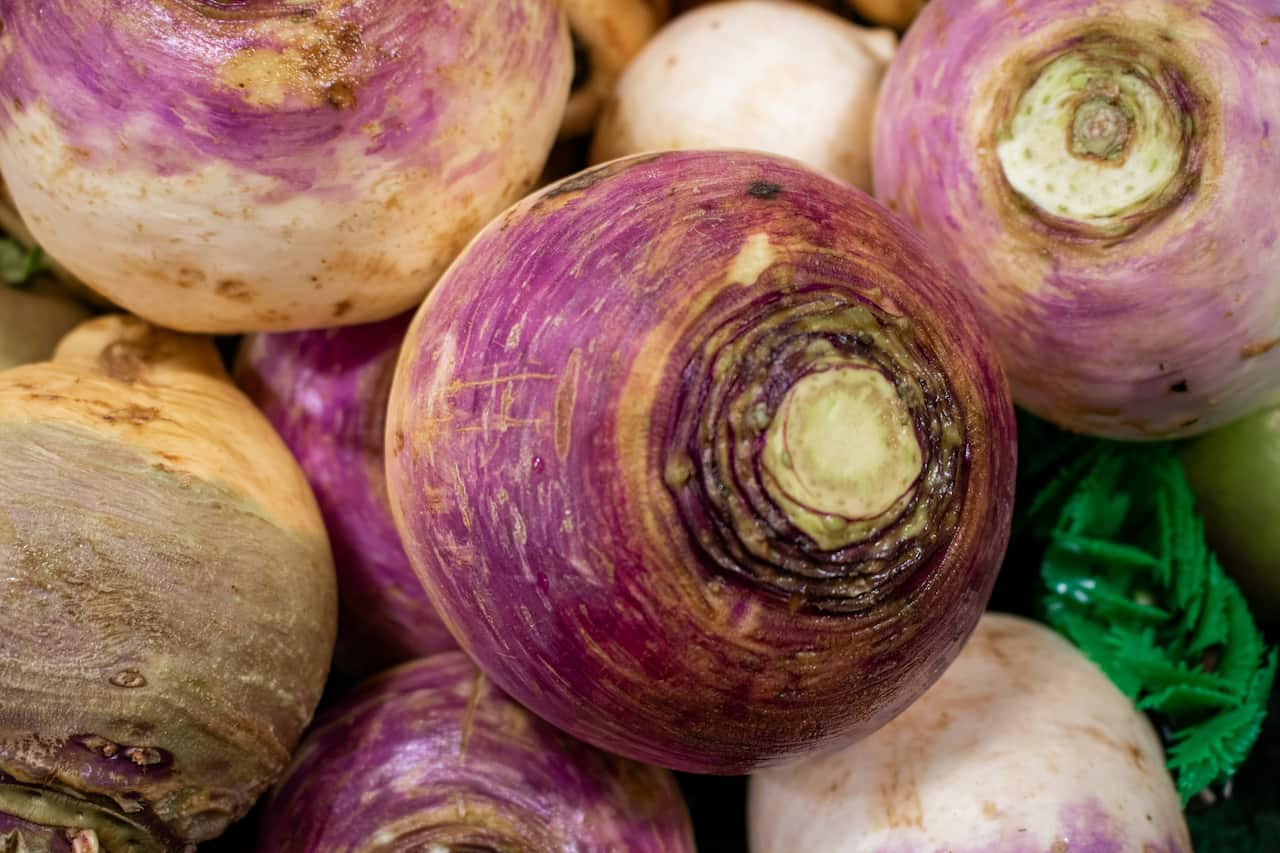
The turnip root is technically a swollen stem base rather than a true root – the same botanical structure as kohlrabi, though turnips develop primarily underground while kohlrabi sits largely above it. The root develops partly above and partly below the soil surface, with the upper portion often showing colour – white, purple, red or yellow depending on the variety. The coloured portion is always above ground; the white lower portion develops below it. Turnips are biennial plants but are always grown as annuals in UK gardens, harvested well before they would attempt to flower in their second year – if left unharvested, plants bolt and the root becomes completely inedible. Companion planting alongside beetroot works well in a raised bed – both crops are direct-sown, prefer similar cool growing conditions, and neither shades the other significantly at the spacings used for each.
Sowing turnips
Turnips are always sown directly where they are to grow – they develop a taproot early and do not transplant without a significant setback. Sow thinly in rows 30cm apart, pressing seeds into the growing medium at roughly 1cm depth. Thin the seedlings progressively once they are a few centimetres tall, first to 7-8cm, then to a final spacing of 15cm for early crops or 20-23cm for larger maincrop types. The thinnings are edible and the young tops are particularly good in salads or briefly wilted.
Succession sowing every three to four weeks keeps the harvest coming steadily throughout the season. Each sowing matures in six to ten weeks, so staggering the sowings across spring, early summer and late summer gives a continuous supply rather than a single glut. A single sowing of twenty or thirty plants will all be ready within the same two-week window, which is more than most households can eat before the roots begin to deteriorate in quality. Smaller, more frequent sowings of ten to fifteen plants are far more practical and produce better-quality roots at every harvest. In a raised bed this is particularly easy to manage – sow into the space left by an earlier crop as it is cleared and the rotation works itself out naturally.
Turnip tops as a bonus harvest. When thinning seedlings, collect the small green tops and use them like mustard greens – they have a peppery, slightly bitter flavour that works well in stir-fries and soups. In late winter, turnip plants left in the ground will also produce a flush of young green shoots that can be cut and eaten like spring greens, making them one of the few crops that offers two distinct harvests from a single sowing.
Ongoing care
Turnips are low maintenance once established but the quality of the final roots is directly determined by two things: consistent moisture and good weed control in the early weeks. Get those right and the crop largely looks after itself through to harvest.
Harvesting and storing
Early turnips sown in spring are best harvested young – at golf-ball to tennis-ball size, around 5-8cm in diameter. At this size the skin is thin enough that peeling is barely necessary, and the flesh is crisp, mild and sweet. Pull them by hand or lever gently with a hand fork, taking care not to snap the root. Do not leave them in the ground in summer – once turnips exceed 8-10cm in diameter in warm conditions, the flesh becomes pithy, fibrous and increasingly hot-tasting within days.
Maincrop turnips sown in late summer for autumn and winter use can be left in the ground until needed, provided the soil does not freeze solid. The ground acts as a natural store – the roots stay in good condition right through autumn and into early winter in most UK locations. When hard frosts threaten, lift the whole crop in November, twist off the tops (do not cut them – a small stub left attached seals the wound against rot better than a clean cut), and store in boxes of slightly damp sand in a cool shed. Check occasionally and remove any that start to soften before they infect neighbours. Stored this way they keep well for two to three months. Unlike carrots, which store for many months under the right conditions, turnips are best used within a few months of harvest rather than kept indefinitely.
Using turnips in the kitchen
Home-grown turnips harvested young have a flavour that bears almost no resemblance to the large, mature specimens sold in supermarkets. At golf-ball size the flesh is crisp and mildly sweet – good enough to eat raw, sliced thinly into salads or cut into batons for dipping. The raw turnip has a clean, slightly peppery note that works well with sharp dressings. As they grow larger the flavour becomes more robust and the texture denser, which makes them better suited to roasting, mashing or adding to slow-cooked stews and soups where they absorb other flavours well.
Roasting is one of the simplest and most transformative ways to use turnips. Peel and cut into wedges, toss in oil, season well and roast at 200C for 35-40 minutes until the edges caramelise. The natural sugars concentrate during roasting in a way that makes even a mid-sized turnip genuinely delicious. They pair particularly well with other root vegetables – a mixed tray of turnip, carrot and parsnip at 200C makes one of the most satisfying autumn side dishes available from a UK kitchen garden. The greens should not be overlooked – young turnip tops wilted in a hot pan with butter and garlic are a genuinely good vegetable in their own right, worth growing the crop for alone.
Common problems
Turnips share the standard brassica pest concerns, but the majority of problems are either preventable from the outset with a single intervention (insect mesh) or are growing-technique issues that come down to harvest timing and watering consistency. In a well-managed raised bed where the mesh goes on at sowing time and the crop is checked regularly, most UK growers have trouble-free seasons. Understanding the frequency of each issue helps set the right priorities from the start.
Flea beetle is by far the most common issue – tiny holes appear across the leaves of seedlings, created by small jumping beetles. Insect mesh applied immediately after sowing prevents this entirely. Pithy roots and splitting are both growing-technique problems rather than pest or disease issues: the first is caused by leaving roots too long before harvest, and the second by irregular watering. Bolting in summer sowings is prevented by keeping the soil moist and avoiding the hottest two to three weeks of July for sowing. Cabbage root fly can also attack – the larvae eat the roots underground, causing wilting and sudden collapse. Mesh or brassica collars at thinning time provide good protection.
Best varieties
‘Purple Top Milan’ is the most widely grown turnip in UK gardens – fast, reliable and with a characteristically flat, disc-shaped root topped with deep purple above the soil line and white below. It is ready in as little as six weeks and is the standard recommendation for spring and summer sowings where speed matters.
A mixed planting of Purple Top Milan for early harvest, Golden Ball for autumn storage and Atlantic for a reliable mid-season crop gives the best coverage across the season from a single raised bed. All three varieties can be grown simultaneously if space allows, using succession sowing to spread the harvest across several months.
Turnips grow well alongside leeks in a raised bed rotation – both are cool-season crops that tolerate autumn and winter conditions, neither shades the other significantly, and their different root depths mean they draw on different soil layers in a well-prepared growing medium. Succession sowings of turnips from a cleared leek bed in late summer is one of the most productive ways to use raised bed space in the final months of the growing season.
Share on socials: