At a glance
Violas and pansies are among the most reliable sources of colour in the UK garden from October through to late spring. They flower through frosts, survive temperatures down to minus 10 degrees Celsius, and produce blooms at a time when almost nothing else does. A well-maintained container of winter pansies by the front door will look good from September to May with relatively little effort, making them one of the best value flowering plants in the entire garden calendar.
The two plants are often grouped together and for good reason. Their growing requirements are identical and they serve the same purpose in the garden. The main difference is in flower size, flowering habit and how long they last, all of which affect which to choose for a given situation.
What violas and pansies are
Violas and pansies are both members of the genus Viola and belong to the Violaceae family. Pansies, botanically Viola x wittrockiana, are hybrid plants bred for large, showy blooms measuring 5 to 8cm across, with the characteristic face markings in the centre. Violas, primarily Viola cornuta and its hybrids, produce smaller flowers of 2 to 4cm but in far greater numbers per plant and over a longer period. Violas are generally hardier and more weather-resistant than pansies and tend to recover more quickly after frost damage.
The distinction between the two is not always clearly drawn by retailers. For practical growing purposes the care requirements are identical. The choice between them comes down to whether you want large showy flowers in smaller numbers (pansies) or a mass of smaller flowers over a longer season (violas).
Choosing the right type
Winter-flowering pansies are bred specifically for cold tolerance and are planted in autumn to flower from October through to late spring. Varieties in the Universal, Matrix and Inspire series are widely available and reliably hardy. These are the right choice for winter containers, hanging baskets and bedding schemes where a large-flowered impact is wanted through the cold months.
Summer-flowering pansies are larger-flowered types used for spring and early summer colour. They are planted in spring and tend to stop flowering as temperatures rise above 25 degrees Celsius in June and July. Many gardeners use winter pansies in containers through the cold months then switch to summer types for late spring display.
Violas are smaller-flowered and very free-blooming over a longer overall season. They tolerate both heat and cold better than pansies. Viola cornuta types are perennial and reliably return year after year without replanting. Trailing violas are grown specifically for hanging baskets and window boxes, producing long cascading stems covered in flowers from October through spring.
Sowing from seed
Both violas and pansies are straightforward to grow from seed. Winter-flowering types should be sown from June to August for autumn planting. Summer-flowering pansies are sown from November to February for spring planting. Violas for spring flowering are sown from January to March.
Sow into seed trays or modules using a fine seed compost. Cover lightly with vermiculite or fine compost to around 3mm depth. Unlike many flower seeds, pansies germinate best in darkness or low light, so covering them lightly is correct. Germination temperature should be between 15 and 18 degrees Celsius. At higher temperatures germination becomes erratic and patchy, which is a common cause of failure. Germination takes ten to twenty days. Prick out seedlings into individual 7cm pots when they have two true leaves and grow on in a cold frame or cool greenhouse. Harden off over ten to fourteen days before planting out.
Buying plants
Most gardeners buy violas and pansies as plug plants or small pots in autumn or spring. For winter planting, buy in September and October while plants are still compact and in early bud rather than in heavy flower. Plants already in full flower at purchase have used up considerable energy and perform less well than younger, more compact plants with multiple stems and vivid, dark green foliage without yellowing. Avoid plants showing powdery mildew on the leaves.
Planting and spacing
Violas and pansies perform best in a sunny or lightly shaded position. They tolerate partial shade but produce fewer flowers. In containers, use a good quality multipurpose or peat-free compost and add slow-release fertiliser granules at planting time to sustain the plants through a long season. For bedding schemes, space winter pansies 15 to 20cm apart. Closer spacing gives a more immediate impact but can lead to poor air circulation and increased disease.
Soil in borders should be well-drained and reasonably fertile. Work in some garden compost or well-rotted manure before planting to improve moisture retention. Violas and pansies do not tolerate waterlogged conditions, which causes root rot particularly in winter. Plant at the same depth as they were growing in their pot, firm in well and water immediately. Allow the surface of the compost to dry slightly between waterings in wet weather rather than watering on a fixed schedule.
Ongoing care
Deadheading is the single most important maintenance task. Regular removal of spent flowers prevents energy going into seed production and dramatically extends the flowering period. For pansies, snap off each spent bloom individually. For violas, which produce many smaller flowers, trimming the whole plant back by one third with scissors every few weeks is more practical and keeps plants compact and floriferous. Aim to deadhead every two to three days during active flowering periods.
Feed every one to two weeks with a balanced liquid fertiliser to maintain vigour. In winter, reduce feeding frequency as plants grow slowly, but do not stop entirely. Resume regular feeding from February as days lengthen. A potassium-rich feed such as tomato fertiliser encourages flower production in spring. Watering in winter requires care. Water only when the compost feels dry an inch below the surface. In cold wet weather, containers may not need watering for weeks. Overwatering in winter is a more common cause of plant death than underwatering.
Overwintering
Winter pansies and violas are hardy to approximately minus 10 degrees Celsius in their dormant state. They may suffer in prolonged hard frosts, particularly in containers where the root system is exposed to cold on all sides rather than insulated by the ground. If severe frost is forecast for more than a few days, move containers to a sheltered position against a wall or wrap them with horticultural fleece.
Plants may look battered after a hard frost, with collapsed foliage and wilted stems, but most will recover as temperatures rise. Do not pull out apparently dead plants after frost until you have given them two to three weeks to show new growth from the base. In borders, established plants are more cold-tolerant than those in pots and generally look after themselves through the winter without intervention.
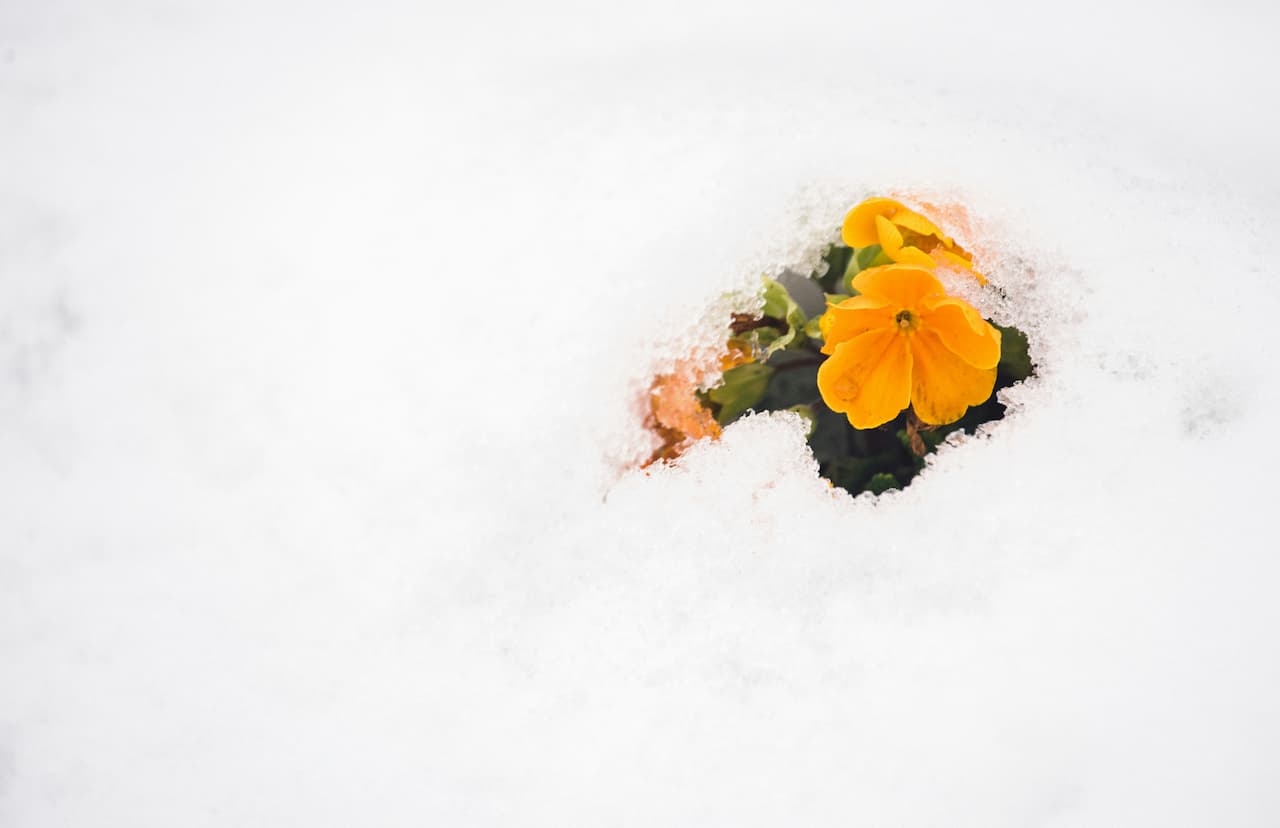
Snow actually protects pansies. A layer of snow insulates the plants and prevents the deeper cold that damages roots. The flowers may be crushed but the plant itself is protected. Brush snow off gently if it is very heavy, but a light cover does more good than harm.
Pests and diseases
Violas and pansies have a handful of specific problems that are worth knowing about. Slugs and snails are the most significant pest in autumn and spring. Aphids and powdery mildew are the main issues in drier conditions. Two diseases are specific to this plant family.
Slugs and snails eat large, irregular holes in leaves and petals, particularly in autumn and spring when conditions are moist. Use biological control with nematodes when soil temperatures are above 5 degrees Celsius, or apply slug pellets around newly planted plugs. Aphids colonise soft new growth in spring, causing distorted leaves and stunted shoots. Squash by hand or spray with insecticidal soap. Powdery mildew appears as a white dusty coating on leaves, usually in dry conditions or when plants are stressed from underwatering or overcrowding. Improve air circulation, ensure adequate watering and remove badly affected leaves.
Violet gall midge causes the leaves to roll and thicken with a characteristic distortion that will not recover. Remove and destroy affected growth. There is no effective chemical treatment. Good air circulation and avoiding overcrowding reduce incidence. Crown rot causes the base of the plant to go soft and dark, usually caused by waterlogging or by planting too deep. Improve drainage and plant at the correct depth. Affected plants cannot be saved. Pansy sickness is a root disease caused by soil-borne pathogens that causes wilting and death, particularly where pansies have been grown in the same ground repeatedly. Rotate bedding in borders each year and use fresh compost in containers. There is no treatment once plants are affected.
Toxicity
Viola plants are generally safe for humans and animals. All parts are edible and viola flowers are commonly used in salads and as a cake decoration. There is no significant toxicity risk from accidental contact or ingestion of small quantities.
Long-term management
Winter pansies are typically treated as biennials or short-lived perennials. After their spring flush they tend to become leggy and stop flowering reliably as summer temperatures rise. Most gardeners replace them in early summer with summer bedding plants and start fresh with autumn pansies again in September. Violas, particularly Viola cornuta types, are more reliably perennial and can remain in the border. Cut them back hard by half to two thirds after the spring flush to prevent them becoming woody. They will reshoot and flower again from summer through autumn. Every two to three years, divide congested clumps in spring to maintain vigour.
The key to a good display year-round is planning the succession. Winter pansies planted in September, replaced by summer bedding in June, with perennial violas providing a continuous ground-level presence throughout and bridging any gaps in the annual rotation.
Share on socials: