At a glance
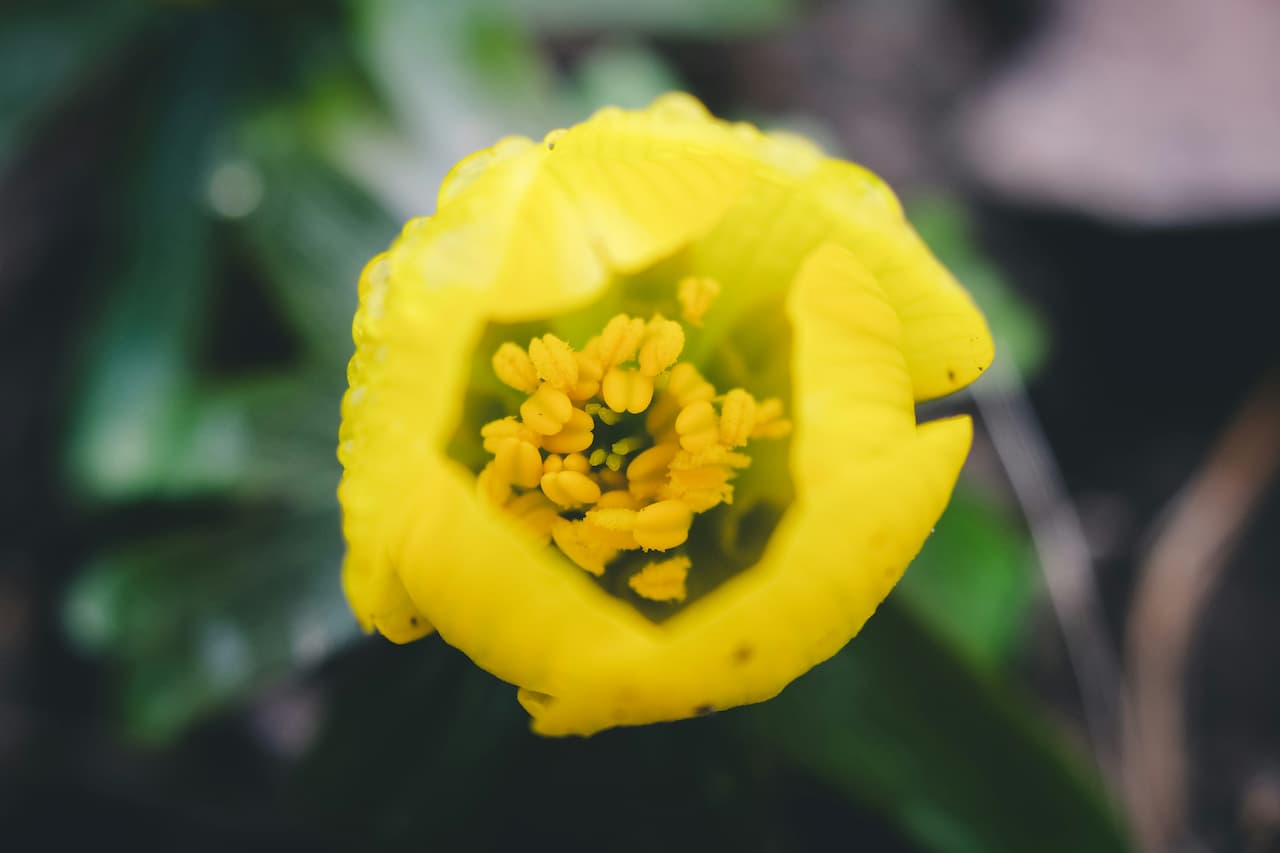
Winter aconite is a small tuberous perennial that produces bright yellow cup-shaped flowers from January to March, often while snow is still on the ground. It is one of the first garden plants to flower each year, sometimes appearing before snowdrops depending on the season and site. Each flower sits above a ruff of deeply cut bright green leaves that act as a collar below the petals, giving the plant a distinctive and instantly recognisable appearance. The plant grows to around 5 to 10 centimetres tall and spreads slowly over years to form golden carpets when established under deciduous trees.
After flowering the foliage persists for several weeks, then the plant disappears completely below ground and goes dormant from late spring through to the following winter. The dormant period is long and the plant is invisible for most of the year. Understanding this lifecycle, and protecting the planting area during dormancy, is the key to success with this plant.
What winter aconite is and what it does
The botanical name is Eranthis hyemalis, a member of the Ranunculaceae family alongside buttercups and hellebores. Despite sharing the word “aconite” with the toxic monkshood (Aconitum), it is a completely unrelated plant. Winter aconite is itself mildly toxic: all parts of the plant contain compounds that cause digestive irritation and mouth soreness if eaten, affecting children, dogs, cats and rabbits. Sap contact can cause skin irritation in sensitive individuals, so gloves are sensible when handling corms. It holds the Award of Garden Merit.
The flowers open when daytime temperatures reach around 10 degrees Celsius and close again on colder days. This means the display extends over weeks of cold weather rather than rushing over in a few days. After flowering, the foliage manufactures and stores energy in the corms before dying back completely in late spring, leaving no trace above ground until the following January.
Choosing the right site
Winter aconite originates from woodland margins and scrubby habitats in southern Europe and western Asia, and it has naturalised in many parts of Britain and Ireland. In gardens it performs best in conditions that replicate its native habitat. The ideal position is under a deciduous tree or large deciduous shrub where the canopy is bare in winter and spring. The bare canopy allows light through during flowering and foliage growth, then provides shade during summer dormancy. This combination suits winter aconite perfectly.
It does not perform well under evergreens because the canopy blocks winter light exactly when the plant needs it. Under conifers or dense evergreens, flowering is poor and establishment slow. Winter aconite tolerates full sun in winter, but the flowers last longer in dappled or partial shade because direct sun accelerates them and they go over quickly. In deep shade the plant grows poorly. Dappled light through a deciduous canopy is the ideal. Any aspect works provided these conditions are met.
Soil requirements
Winter aconite grows in most soil types but has preferences and limitations worth understanding. It prefers moist but well-drained soils with good organic matter content. Heavy clay that sits wet through the dormant summer months will cause the corms to rot. If your soil is clay-dominant, improve drainage before planting by working in grit and garden compost, or choose a slightly raised position where water drains away naturally. Very light sandy soils that dry out completely in summer can also cause problems: incorporate plenty of leaf mould or garden compost before planting.
On pH, winter aconite is more tolerant than many bulbs. It grows in neutral to slightly alkaline soils and does particularly well on chalk and limestone. It also grows in mildly acid soils. The best preparation for any new planting site is to work leaf mould or well-rotted garden compost into the top 15 centimetres of soil before planting, which improves moisture retention, drainage and fertility in one operation.
The dry corm problem and how to solve it
The most important fact to understand before buying is that dry corms, which are the form most commonly sold at garden centres and by mail order in autumn, have a notoriously poor establishment rate. Many gardeners plant them correctly and see nothing the following January, or see sporadic weak shoots that dwindle over the following seasons. The reason is that the corms dehydrate easily after lifting and often arrive depleted after months in commercial storage.
The solution is to plant in the green. This means buying or obtaining plants that are already in leaf and flower, or just finished flowering, typically in February and March, and transplanting them while still actively growing. Established plants divide and transplant extremely well in this state, and in-the-green divisions establish at a far higher rate than dry corms ever manage. If you can only access dry corms in autumn, soak them in cool water for 24 hours before planting to rehydrate the tissue. Even after soaking, a dry corm may sit dormant for one or two full seasons before producing visible growth. This is not failure. If the corm is firm when checked in autumn it is alive.
Source in the green wherever possible. Specialist bulb suppliers and nurseries offer winter aconite in the green in February and March. Some will also lift and send clumps from their own established colonies. This method costs slightly more but produces colonies that establish quickly and flower reliably from the first or second season.
How to plant
Dry corms are planted in autumn, ideally September to October. Plant at a depth of 5 centimetres with the flattened side facing down. If orientation is unclear, plant on the side and the corm will orientate itself. Space corms 7 to 10 centimetres apart and plant in groups of at least 25 to 50 for any meaningful visual impact. For in-the-green planting in February and March, lower the plant into a hole large enough to take the root system at the same depth it was growing, firm around the roots and water in well. Space divisions 5 to 7 centimetres apart. Never let roots dry out between lifting and replanting.
Whether planting dry corms or in-the-green divisions, prepare the soil first by removing perennial weed roots, working in organic matter and raking level. A natural scattering pattern looks better than a regimented grid: plant irregularly, with denser concentrations in some areas and sparser planting in others, as a colony would naturally establish.
The annual lifecycle
Understanding the year-round lifecycle is essential because mistakes made during dormancy are the commonest cause of declining colonies. The table below shows what happens in each period and what action is needed.
From May to December the corms sit just 5 centimetres below the soil surface, invisible and dormant. This is the danger period. Digging, cultivating, hoeing or planting aggressively in the area during these months will destroy corms. Mark the area clearly with canes at planting time and treat the entire zone as a no-dig area from late spring through to the following January. During the flowering and foliage period from January to May, leave the plant completely alone. Do not cut the foliage before it has yellowed and collapsed on its own: the leaves are manufacturing energy for the following year’s flowers, and removing them early reduces or eliminates the following season’s display.
Self-seeding and naturalising
Winter aconite naturalises by two mechanisms: gradual clump expansion and self-seeding. Self-seeding is the principal means by which large carpets develop over time. Seeds ripen and are shed in April and May, dropping close to the parent plant. The seeds are not dispersed far by natural means, so spread is slow and localised, but over many years an established colony expands steadily outward from the original planting. To encourage naturalising, stop all tidying of the planting area until the seed heads have fully ripened and opened. If the area is cleared for appearance in April before seeds are shed, the plant cannot spread. Self-sown seedlings are tiny in their first year and easily missed or accidentally removed. If you find dense clumps of small Eranthis seedlings in spring, leave them undisturbed.
Propagation by division
Division is the most reliable active propagation method. Divide established clumps immediately after flowering while in the green, in February or early March. Use a hand fork to lift the clump, gently tease it apart into individual or small groups of corms, and replant at the original depth in the new position. Water in and keep moist until the foliage dies back. Do not attempt to divide dry corms in summer: the corms are nearly impossible to locate without excavating the whole planting area, and when found are in a desiccated dormant state that does not divide or replant well. Seeds can also be collected and sown immediately after ripening in April and May into pots of gritty compost. Germination occurs the following winter. Seedlings take several years to reach flowering size, making division of existing plants the faster practical route to new plants.
Watering
Established winter aconite requires no supplementary watering in normal years. The combination of cool winter weather, rainfall, and the moist root zone under deciduous trees provides all the moisture the plant needs during its active growing period. The table below shows when watering is needed and when it should be avoided.
Do not water during the dormant summer period. The corms benefit from a relatively dry dormancy and excessive summer moisture, particularly in clay soils, encourages the corm rots that are one of the main causes of colony decline. In dry autumns, water newly planted corms and recent divisions weekly from September to October to help them form root systems before the cold weather arrives.
Feeding
Winter aconite requires minimal feeding. The leaf litter and organic matter that accumulates naturally under deciduous trees is effectively the plant’s feed in its native habitat, and replicating this is the best approach in gardens. Apply a thin layer of well-rotted leaf mould or garden compost over the planting area each October or November, spreading it across the surface without digging it in. The worms will incorporate it over winter. This top dressing feeds the soil, maintains moisture retention, and suppresses winter annual weeds. Do not apply general fertilisers high in nitrogen: nitrogen promotes leafy growth at the expense of flowering in bulbs and tubers. High-potash feeds designed for flowering bulbs can be used sparingly in genuinely impoverished soils, but in normal garden conditions with annual organic mulching no additional feed is needed.
Pests
Winter aconite has relatively few pest problems, but three are worth knowing about. Each has a distinct symptom pattern that makes identification straightforward.
Diseases
Winter aconite is largely disease-resistant, but two diseases are worth knowing: one specific to Eranthis, and one general fungal condition that occasionally appears in wet conditions.
Common problems and how to diagnose them
Most problems with winter aconite trace back to one of a small number of causes. The table below covers the symptoms most frequently encountered and the action to take.
Toxicity
All parts of winter aconite are toxic if ingested. The plant contains cardiac glycosides (bufadienolide compounds including Eranthin A and Eranthin B) which in quantity can affect the heart. Symptoms include burning or irritation of the mouth and throat, salivation, nausea, digestive upset and, in serious cases, cardiac effects. Effects can be more pronounced in children, dogs, cats and rabbits. Keep children away from plants when corms are being handled and clear up any corm fragments. Wash hands thoroughly after handling. Wear gloves if skin irritation is a concern, as sap contact can cause irritation in sensitive individuals.
Companion plants
Winter aconite naturalises well alongside snowdrops, which flower at the same time and share identical growing requirements. The combination of yellow aconite and white snowdrop flowers under bare tree branches in January and February is one of the classic winter garden effects. Both can be moved and divided in the green at the same time, making the practical management of combined plantings straightforward. Early species crocuses, particularly Crocus tommasinianus which flowers from February and spreads readily, extend the flowering season in the same area from January through to March. Cyclamen coum provides winter and spring interest with its marbled foliage and pink flowers from December to March, tolerating the same deciduous shade and dry summer conditions as winter aconite.
Share on socials: