At a glance
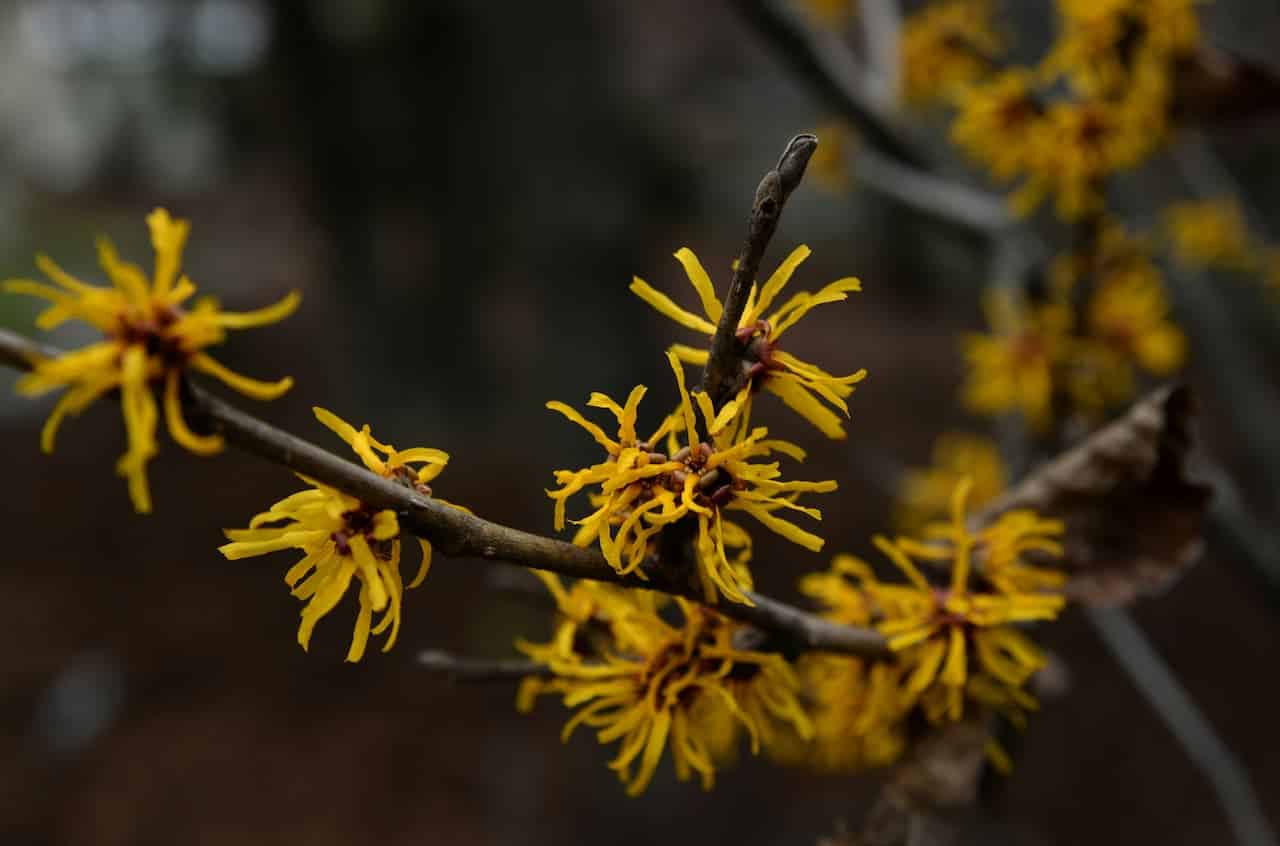
Witch hazel is a deciduous shrub or small tree that flowers in winter, producing spidery, ribbon-like blooms directly on bare stems while the rest of the garden is dormant. The flowers appear from November through to March depending on the variety, and their fragrance on a cold winter morning is one of the most distinctive and welcome scents in any garden. The common name derives from the Old English word “wych”, meaning pliable or bendable, referring to the flexible young branches.
The most widely grown witch hazels in UK gardens are the hybrid Hamamelis x intermedia cultivars, crosses between the Japanese witch hazel and the Chinese witch hazel. They combine the large flowers and strong fragrance of the Chinese parent with the vigour and reliability of the Japanese. Witch hazel is not toxic to dogs, cats or people and all parts of the ornamental garden hybrids are safe around children and pets.
What witch hazel is
Hamamelis x intermedia is a long-lived, slow-growing shrub that eventually reaches 2.5 to 4 metres in both height and spread, developing over many years into a broad, vase-shaped or spreading form with attractive tiered branching. It is hardy throughout the UK and needs no winter protection once established. The flowers are frost-tolerant and will curl up during hard freezes to protect themselves, then unfurl again when temperatures rise, a mechanism that allows them to last for weeks or even months on the stems.
Hamamelis mollis, the Chinese witch hazel, is also widely grown and is considered to have the finest fragrance of all. It is slower-growing than the hybrid forms but produces large, intensely scented yellow flowers in January and February. The hybrid forms generally offer a wider colour range and tend to establish more readily in garden conditions.
Choosing a variety
The choice of variety affects flower colour, fragrance strength, autumn leaf colour and to some degree flowering time. The table below profiles the most widely available and reliable cultivars for UK gardens.
If fragrance is the priority, Pallida and Hamamelis mollis are the strongest performers. If autumn colour matters as much as winter flowers, Jelena is the standout choice. Diane is the best option for red flowers, though its blooms are less visible at distance than yellow or orange forms.
Choosing a site
Witch hazel is not a difficult plant but it has strong preferences, and getting the site right is the most important factor in long-term success. The table below sets out what it needs and what to avoid for each key condition.
Alkaline soil is the most common reason witch hazel fails in UK gardens, and it is the factor most worth checking before buying. If your soil is chalk-based or strongly alkaline, witch hazel is not a realistic choice unless grown in a large container with ericaceous compost. Choose a position where the plant can be appreciated at close range. The flowers are not spectacular from a distance but extraordinary up close, and the fragrance only becomes apparent within a metre or two of the blooms.
Planting
Plant in autumn or early spring when the soil is workable and the plant is dormant or just coming into growth. Container-grown plants can technically go in at any time, but autumn and spring reduce the watering demand on the plant as it establishes.
Dig a hole at least twice the diameter of the root ball and to the same depth. Work in a generous amount of well-rotted compost or leaf mould into the base and sides. Do not add lime or any alkaline material. Plant at the same depth the plant was in its pot. Planting too deep can cause basal rot and eventual death. Firm gently to remove air pockets and water in thoroughly. Apply a 7 to 10 centimetre mulch of composted bark or chipped wood over the root zone, keeping it away from the stem. This mulch is particularly important through the first summer.
Witch hazels are sold as grafted plants, with the named variety grafted onto a rootstock of a common species. Any shoots emerging from below the graft union must be removed immediately. These are the rootstock variety growing strongly and will eventually outcompete and replace the ornamental top if left unchecked. The graft union is usually visible as a slight swelling near the base of the main stem. Any shoots from below this point should be cut flush to the point of origin.
Remove rootstock shoots the moment they appear. Vigorous straight-stemmed shoots from below the graft union will be the understock variety, not the ornamental cultivar. Left even for one season they can take over the plant entirely. Check around the base each spring and cut any such growth flush with the stem.
Watering and feeding
Established witch hazels are reasonably drought-tolerant once their root system has developed, but they should not be allowed to dry out completely in summer. Water deeply during prolonged dry spells from June to September, allowing the water to penetrate the full root zone rather than applying small amounts frequently. Newly planted specimens need more consistent watering through their first two growing seasons. Check the soil at root depth weekly during dry weather and water when it is dry but not parched. Do not water in winter, when the plant is dormant and waterlogged soil in cold weather causes far more harm than drought.
Witch hazel is a light feeder and does not need regular fertilising once established. On poor soils, an annual top-dress of well-rotted compost or leaf mould applied around the root zone in spring is sufficient to maintain healthy growth. Do not use high-nitrogen feeds, which drive leafy growth at the expense of flowers and can cause a witch hazel to produce lush dark-green foliage while flowering reluctantly. Avoid feeding after July, as late feeding stimulates soft growth vulnerable to early autumn frosts.
Pruning
Witch hazel needs very little pruning and is best left to develop its natural vase-shaped or spreading habit without regular cutting. The plant grows slowly and unnecessary pruning reduces the following year’s flowering. The only situations requiring pruning are: removing dead, diseased or crossing branches, removing rootstock growth from below the graft union, and very occasionally shaping a plant that has grown unevenly or too large for its position.
Any pruning should be done immediately after flowering in late winter or early spring, before the new leaf buds open. Pruning in summer or autumn removes the flower buds already set for the following winter and results in one season with greatly reduced flowers. Hard pruning back into old wood is possible but should only be done when absolutely necessary, as witch hazel regenerates slowly and the plant may take several years to flower well again. If a witch hazel must be reduced in size, take out individual stems back to a strong lateral rather than clipping the whole plant.
Autumn colour and year-round character
Witch hazel offers more than winter flowers. The broad, slightly crinkled leaves turn in autumn to shades of yellow, orange, amber and occasionally deep red, depending on the cultivar. Jelena and Diane are particularly noted for strong autumn colour. The display lasts for two to three weeks in most autumns, provided the weather is not too wet and windy. The bare branching structure through winter has its own architectural quality, particularly when the plant is mature and has developed its spreading, tiered form. Choosing a position where the winter silhouette is visible against sky or a pale wall makes the most of this.
Propagation
Witch hazel is propagated by grafting in commercial horticulture, which is beyond most home gardeners. Layering is the most practical method available at home. In late summer, select a long, flexible stem near the base of the plant. Wound the stem slightly where it will contact the ground by making a shallow cut or removing a thin sliver of bark. Peg the wounded section into a shallow trench filled with gritty, humus-rich compost and keep the area moist. Roots form slowly and the layer may not be ready to separate for twelve to eighteen months. Once a good root system has developed, sever the new plant from the parent and grow on for a further season before moving to its permanent position.
Seed is very slow and unreliable, and seedlings of hybrid cultivars will not come true to type. Seed-raised plants may take ten or more years to flower and the resulting flowers will not match the parent’s colour or fragrance characteristics. Layering is strongly preferred for anyone wanting to increase stock of a named variety.
Pests and diseases
Witch hazel is largely trouble-free but four problems are worth being aware of. The table below gives the key facts for each.
Common problems
The most common complaints from gardeners growing witch hazel all have identifiable causes and straightforward solutions.
Place witch hazel near a path or gate you use in winter. The flowers are not spectacular at distance but extraordinary close up, and the fragrance only carries a metre or two. A plant at the back of a large border where nobody walks in January is a missed opportunity.
Share on socials: