At a glance
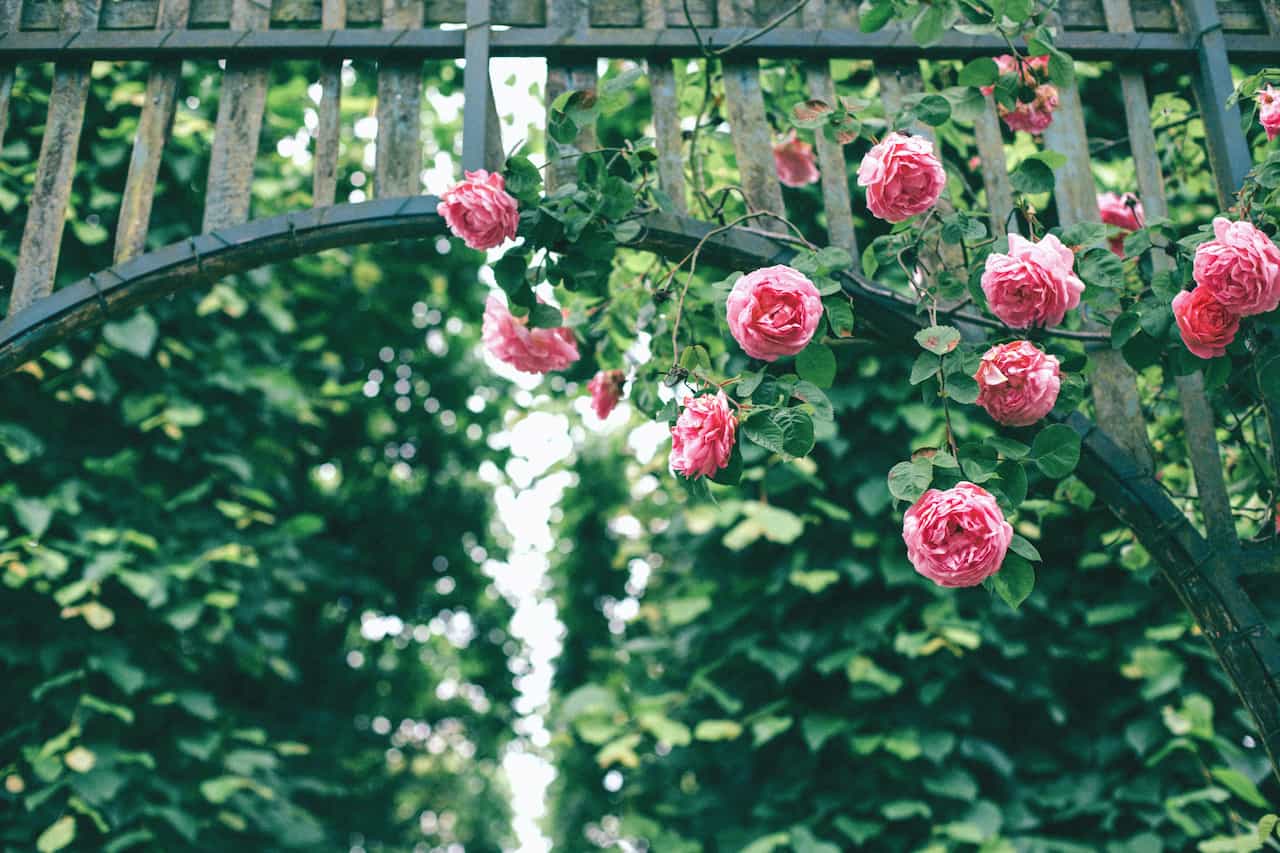
Climbing roses are one of the most impactful plants a UK gardener can grow. A well-established climbing rose on a sunny wall or over a garden arch produces hundreds of flowers across a long season and can cover a structure completely within three or four years. They are not the low-maintenance plant some beginners expect – they need feeding, training and annual pruning to perform well – but none of these tasks are complicated once the basic principles are understood.
The distinction between climbing roses and rambling roses matters before buying. Climbers are repeat-flowering, producing blooms from June through to the first frosts, and most reach 2.5-4 metres. Ramblers flower once, usually in June and July, but can reach 6-10 metres and are better suited to covering large structures or growing through trees. For walls, fences and arches in most UK gardens, a repeat-flowering climber is usually the better choice. If you are also growing other wall-trained plants, the training principles that apply to climbing roses work equally well for wisteria and clematis, both of which make excellent companions on large structures.
Choosing the right variety
Variety choice determines how much disease resistance, repeat-flowering and fragrance you will get. Modern climbing roses bred in the last 30 years are significantly more disease resistant than older varieties and require much less intervention to look presentable.
Planting climbing roses
Bare-root climbing roses should be planted between October and March when they are dormant. Container-grown roses can be planted at any time the ground is not frozen or waterlogged, but autumn and early spring planting gives the best establishment results. The key planting rule is to position the rose at least 45cm away from the base of the wall or fence it will grow against – the soil immediately adjacent to walls is often dry and poor, and a rose planted too close will struggle from the start.
Dig a planting hole at least twice the width of the rootball and incorporate a generous amount of well-rotted garden compost or a rose-specific planting mix into the backfill. For bare-root roses, the graft union (the swollen knuckle where the named variety is joined to the rootstock) should sit just below soil level. Water in thoroughly and mulch the surrounding soil with a 7-10cm layer of compost or bark to retain moisture and suppress weeds.
Never plant a new rose where a rose has grown before. Rose replant disease – caused by a complex of soil pathogens and nematodes that build up around rose roots – will significantly weaken or kill a replacement rose planted in the same soil. If you must replant in the same spot, excavate the soil to at least 60cm depth and 60cm width and replace entirely with fresh soil from a different part of the garden.
Training and support
Climbing roses do not self-cling – they must be tied in to their support as they grow. On walls, horizontal wires fixed at 45cm intervals with vine eyes and tensioned with a straining bolt provide the most practical and long-lasting support. The wires should run from approximately 45cm above soil level to the top of the wall.
The key training principle is to train the main structural stems as horizontally as possible rather than allowing them to grow straight up. A stem trained horizontally produces flowering sideshoots along its entire length. A stem allowed to grow straight up produces flowers only at the tip. Fan the main stems outwards and tie them in at regular intervals throughout the growing season – new growth is pliable and easy to position, but left to its own devices it will head skyward and become woody and inflexible within a few weeks.
Feeding, watering and ongoing care
Climbing roses are hungry plants that flower repeatedly across a long season and need regular feeding to sustain that output. Apply a balanced granular rose fertiliser in early March as growth begins, and again in mid-June after the first flush of flowers. Do not feed after the end of July – late feeding encourages soft new growth that is vulnerable to frost damage in autumn.
Water established climbing roses deeply during dry spells in their first two seasons. Once established, most climbing roses are reasonably drought-tolerant, though watering during prolonged dry periods significantly extends the flowering season and reduces stress-related disease. Water at the base rather than over the foliage – wet leaves overnight encourages black spot and mildew.
Deadhead repeat-flowering varieties regularly through the season by cutting back spent flowers to the first strong leaf below the flowerhead. This redirects the plant’s energy into producing new flowering shoots rather than setting hips. Leave the final flush of flowers in September to develop hips for autumn interest and wildlife value.
How and when to prune
Climbing roses are pruned in late February or early March, just as the buds begin to swell. The approach differs from bush roses – the aim is to maintain the framework of main structural stems while keeping the plant producing young, flowering wood.
Never prune climbing roses in autumn. Autumn pruning removes the wood that will produce next year’s first flush of flowers and stimulates soft new growth that frost will kill. Wait until late February when the worst frosts are past and the buds are just beginning to move. If long whippy stems are a problem in winter gales, tie them in securely rather than cutting them back.
Common problems
Black spot is the most common problem for climbing roses in the UK – a fungal disease that causes circular black spots on leaves followed by yellowing and premature leaf drop. Good air circulation around the plant reduces severity significantly, as does watering at the base rather than over the foliage. Remove and dispose of all affected fallen leaves rather than composting them. Growing a variety with good disease resistance removes most of the problem before it starts.
A well-trained climbing rose on a sunny wall is one of the most enduring features in a UK garden. The investment in correct planting, horizontal training and annual pruning pays dividends for decades – a neglected climbing rose is a tangle of thorny stems and sparse flowers, a well-managed one is a wall of bloom from June to October.
Share on socials: