At a glance
Tradescantia is one of the most reliably rewarding houseplants available in the UK – fast-growing, tolerant of the imperfect conditions of a typical British home, propagatable from cuttings in a glass of water, and genuinely attractive in the right position. The trailing forms drape beautifully from shelves or hanging planters, producing dense cascades of patterned foliage that hold their colour throughout the year in good light. The main reason tradescantias disappoint is not the plant’s demands but a mismatch between where the owner places it and what it actually needs – almost always a light problem, rarely anything more complicated than that.
Understanding the handful of things tradescantia actually requires – consistently good light, free-draining compost, regular pinching and a watchful eye on the watering frequency in winter – is enough to keep most plants in excellent condition indefinitely. It is also one of the few houseplants where a plant that has gone leggy and bare can be fully refreshed within a few weeks by cutting it back and rooting the cuttings, making long-term maintenance genuinely forgiving even when things have gone wrong.
Popular varieties for UK homes
Several distinct tradescantia species are sold as houseplants in the UK, and they differ enough in habit, light requirements and ornamental quality to be worth distinguishing before buying. The trailing types – T. zebrina, T. fluminensis and T. ‘Nanouk’ – are the most common and the most versatile for typical indoor situations. T. pallida is the outlier: upright rather than trailing, with deep purple foliage that requires the highest available light indoors to maintain its colour.
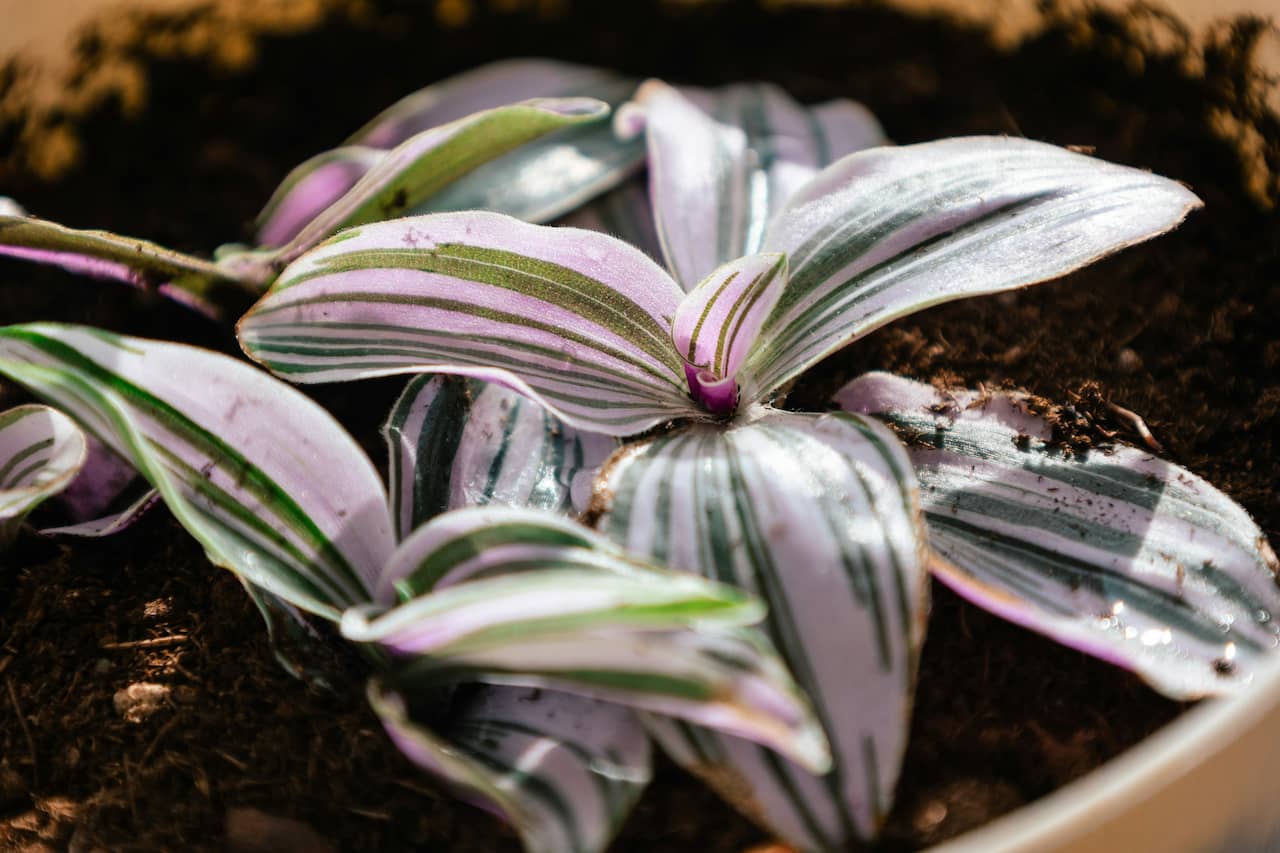
T. zebrina is the most widely available and the most ornamental of the trailing types. The silver-striped, purple-backed leaves catch the light in a way that few other trailing houseplants match, and the plant is content in the typical temperatures and humidity of a UK home without any special treatment. Its one genuine requirement is enough light to maintain the silver striping – in poor light the leaves revert toward plain green and the plant loses much of its appeal. For a high shelf, a hanging planter in a bright room or a bathroom with reasonable light, it is a genuinely excellent choice that needs very little to perform well.
Light and watering
Bright indirect light is the condition tradescantia performs best in, and the coloured varieties are particularly dependent on it. An east or west-facing windowsill works well for T. zebrina and ‘Nanouk’ – they receive direct morning or afternoon sun without the intensity of south-facing midsummer light, which can bleach the foliage of some varieties if the plant sits immediately against the glass. T. pallida is the exception and benefits from the strongest light available indoors, including south-facing sun in the lower-intensity winter months. In low light, the silver variegation of T. zebrina fades progressively to plain green, growth becomes long, thin and sparse as the plant stretches toward the light source, and the plant loses the qualities that make it worth growing. Moving to a brighter position resolves this – the new growth will show correct colouring within a few weeks.
Tradescantia is tolerant of occasional under-watering – the succulent stems hold enough moisture to survive a missed watering without obvious distress. The failure mode to watch for is the opposite: consistent overwatering, particularly in winter, which causes the base of the stems to soften, turn translucent and eventually collapse. Unlike the Pothos, which shows clear wilting when it needs water and recovers quickly when given it, tradescantia gives less visible warning before root rot becomes established – the compost feels dry on the surface even when the lower layers are still wet. Checking at 2-3cm depth rather than surface level avoids this misread.
Tradescantia is one of the easiest plants to propagate from cuttings. Take a 10-15cm tip cutting, remove the lowest leaves to expose a node, and place in a glass of water on a bright windowsill. Roots appear within 7-10 days in warm conditions. Once the roots reach 2-3cm, pot into houseplant compost. A plant that has become leggy and bare can be cut back hard, the tip cuttings rooted and several replanted into the original pot for a full, fresh-looking plant within a few weeks.
Feeding and repotting
Tradescantias grow fast and benefit from regular feeding during the active growing season. A balanced liquid houseplant fertiliser applied at the manufacturer’s recommended dose every two to four weeks from April through to September supports the rapid growth rate without pushing the excessively soft, floppy growth that results from high-nitrogen feeding at too-frequent intervals. Any balanced NPK formula designed for foliage houseplants is suitable – there is no need for a specialist product. Stop feeding entirely in October and do not resume until new growth appears in spring, which in a warm UK home typically occurs in March.
Repotting is needed more frequently with tradescantia than with slower houseplants – most plants in active growth outgrow their pot within a year. The signal is roots emerging from drainage holes, very rapid drying out after watering, or a plant that has visibly stopped growing despite adequate light and feeding. Move up one pot size in spring, using a well-draining peat-free houseplant compost with added perlite if available. Tradescantias do not develop a deep root system – a wide, shallow pot accommodates their surface-spreading roots more naturally than a tall, narrow one. Always ensure the new pot has drainage holes and do not be tempted to pot into a container significantly larger than the root ball, as excess compost around the roots stays wet for too long and increases rot risk.
Pruning and propagation
Pinching is the single most impactful maintenance habit for tradescantia. Left unpinched, each stem extends from the growing tip and produces foliage only at the tip and in the most recent few centimetres of growth – the lower stem becomes bare progressively as the plant extends. The result is a plant with long, increasingly sparse trailing stems that looks full only when very young. Pinching out the growing tip of each stem once it reaches 15-20cm redirects the plant’s energy into producing side shoots from the nodes below the pinch point. Two or three new growing tips develop where there was one, and repeated pinching over the growing season builds a dense, bushy plant rather than a collection of long bare wires with a tuft of leaves at the end.
Propagation is as close to foolproof as any houseplant operation gets. Take a 10-15cm tip cutting, remove the lowest one or two leaves to expose a node, and place in a glass of water in a warm, bright spot. Roots appear within 7-10 days under good conditions. Once the roots reach 2-3cm length, pot into moist houseplant compost and keep in bright indirect light. Several cuttings planted into the same pot produce a fuller result much faster than a single cutting. For a plant that has become leggy and largely bare at the base after a period of neglect, the correct approach is to cut the whole plant back to around 5cm, root the tip sections in water and replant them into the original pot once rooted. The result is a completely refreshed, full-looking plant within three to four weeks.
Remove all-green stems from variegated varieties promptly. On T. zebrina and ‘Nanouk’, occasionally a stem reverts to producing entirely plain green growth without the characteristic striping. These all-green stems are significantly more vigorous than variegated ones – they grow faster, branch more readily and will gradually take over the plant if left in place. Cut them out at their point of origin as soon as they are noticed to preserve the plant’s variegation.
Common problems
Loss of variegation is the most frequently reported problem with tradescantia and the cause is almost always insufficient light. In a dim position, the plant loses the energy investment of producing pigment and reverts to producing plain green chlorophyll-only growth. Moving the plant to a brighter position is the solution – new growth will show correct colouring within a few weeks. Cut back any entirely green stems to where variegated growth resumes. If the whole plant has lost its markings, moving it to a window position and cutting back by half typically produces correctly coloured new growth within a month.
Spider mites are the most common pest on tradescantia and typically appear in warm, dry conditions – a centrally heated UK home in winter with low ambient humidity is ideal for mite infestations. The first sign is usually fine webbing on the underside of leaves and a stippled, faded appearance to the foliage. Moving the plant to a more humid environment, misting the undersides of leaves with water and washing the plant down with a damp cloth disrupts the mite colony and usually resolves a mild infestation. Persistent cases respond well to neem oil solution applied to the undersides of leaves every seven days for three to four weeks. Tradescantia’s rapid growth means any damaged foliage is quickly replaced once the infestation is under control.
Share on socials: