At a glance
Few houseplants generate more frustration in UK homes than the maidenhair fern. The problem is almost never what people assume. It is rarely a mistake with watering or feeding. It is almost always one thing: the humidity in a typical British home – especially in winter with the central heating running – drops to levels the maidenhair fern simply cannot tolerate. The fronds turn brown and crispy, the plant collapses within days of coming home from the garden centre, and the owner concludes the plant is impossible. It is not impossible. It is just very specifically demanding about a single environmental factor.
Understanding what the maidenhair needs, and why, transforms the experience of growing it. This is a plant that evolved growing in cracks in rocks near waterfalls and in the humid floors of tropical forests. Constant atmospheric moisture, stable warmth and filtered light are its natural conditions. Provide those conditions and a maidenhair fern will grow quickly, produce beautiful new growth throughout the season, and live for years. Fail to provide them – particularly the humidity – and no amount of correct watering or feeding will compensate. This guide addresses the humidity challenge directly and practically, with specific strategies that work in UK homes. It also covers the revival method that brings apparently dead maidenhairs back to life, which many growers do not know exists and which works in a surprisingly high proportion of cases.
About maidenhair ferns – species and what makes them tick
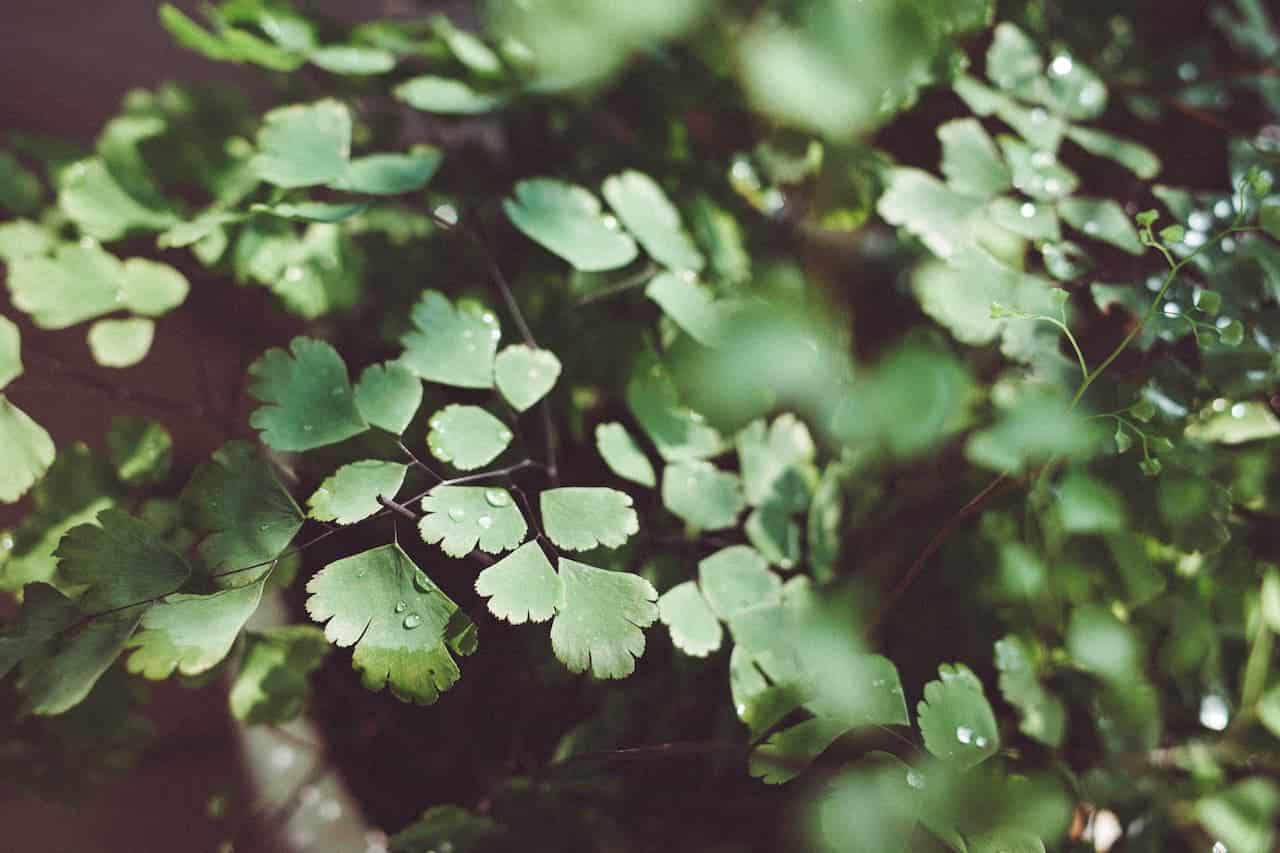
The maidenhair ferns sold as houseplants in the UK are almost always Adiantum raddianum – also known as the delta maidenhair or Venus hair fern – native to tropical South America. The plant is also sometimes sold as Adiantum rubellum or Adiantum cuneatum, which are synonyms for the same species. A related species, Adiantum capillus-veneris, is occasionally available and has very similar care requirements. Both grow in compact clumps of arching fronds on glossy black wiry stems, producing fan-shaped or triangular leaflets called pinnules that tremble in any air movement and create the characteristic delicate, lacy appearance. New growth emerges in shades of pink or copper before maturing to fresh green, which adds considerable visual interest to an established plant in good health.
One practical benefit of the rhizomatous growth habit is that the plant is well-suited to division. A mature maidenhair develops a spreading network of rhizomes just under the compost surface, and these can be separated into sections with minimal disturbance, making propagation by division very simple at repotting time. Each division establishes quickly and produces new fronds within a few weeks in the right conditions.
What makes the maidenhair fern biologically distinctive – and practically challenging – is the combination of a rhizomatous root system that spreads just under the compost surface, and fronds that have no protective waxy coating whatsoever. Most houseplants have at least some leaf surface protection against atmospheric moisture loss. The maidenhair has none. Its leaflets lose moisture directly to the air around them, which is why humidity is so much more critical than for other common houseplants. A spider plant or pothos can tolerate the dry air of a centrally heated UK home without damage because their leaves are protected. A maidenhair fern cannot, and will begin to desiccate within hours of being in air that is too dry.
Light, temperature and position
Bright indirect light is the target – a position that receives good natural light throughout the day but no direct sun at any time. A north-facing windowsill works well, as does a position set back from a south or west-facing window. East-facing windows provide gentle morning light that suits the plant. Direct sunlight at any strength will scorch the delicate fronds, causing brown patches that are permanent and unsightly. The damage appears quickly and the affected fronds do not recover – they can only be cut off. In practical terms this means avoiding windowsills where the sun shines directly through the glass onto the plant, particularly in summer.
Temperature stability matters as much as the temperature itself. The ideal range is 15-21°C. Cold draughts from poorly sealed windows, exterior doors or air conditioning units cause immediate frond drop – the combination of sudden cold and low humidity is more damaging than either alone. In UK homes, the practical implication is that maidenhair ferns should be positioned away from exterior walls in old houses with draughty windows, away from any door that opens to outside, and well clear of any air conditioning unit. The bathroom is consistently the best position in most UK homes: the regular humidity from bathing or showering raises the ambient humidity naturally, and the room tends to stay warm. A bathroom with an east or north-facing frosted window is close to the ideal indoor environment for this plant.
Positioning the plant in a bathroom is the single most reliable way to solve the humidity problem in most UK homes. A bathroom that receives good indirect light through a frosted or east-facing window provides the stable warmth and ambient humidity the plant needs without any additional intervention. If the bathroom has poor light, supplement with a small grow light set on a timer rather than moving the plant to a well-lit but dry room – the humidity the bathroom provides is more critical than perfect natural light levels.
Central heating dries UK homes severely. In winter with central heating running constantly, relative humidity in UK homes routinely drops to 30-40%. Maidenhair ferns require 50% or above. A plant that performs well through summer will begin to decline rapidly in October and November as heating comes on, even if watering is unchanged. This seasonal shift is the most common reason a previously healthy plant suddenly deteriorates. Address it proactively – do not wait for fronds to brown.
Watering and humidity – getting both right
Of all the houseplants available to UK growers, the maidenhair fern asks the most in terms of sustained attention to moisture – both in the compost and in the air. It does not forgive lapses. But the effort required is less about the volume of work and more about the consistency of it. A gardener who checks the compost daily and who has addressed the humidity problem once with a good setup – a humidifier, a bathroom position, or a well-maintained pebble tray – will find the ongoing care quite manageable. The difficulty comes when those systems are not in place and the grower is trying to compensate with sporadic attention.
Watering and humidity are two different needs that are sometimes conflated. Watering addresses the moisture in the compost around the roots. Humidity addresses the moisture in the air around the fronds. Both need to be right, and getting one right does not compensate for failing at the other. A maidenhair fern in perfectly moist compost but dry air will still collapse. A maidenhair in high humidity but dry compost will also fail, just more slowly. Both need to be correct simultaneously.
The compost must never fully dry out – this is more demanding than most houseplants. Check the compost every day during the growing season. The surface should feel consistently just moist to the touch – not wet, not waterlogged, but never parched. Water carefully around the base of the plant when the surface begins to dry, and always use room-temperature water. Cold water from the tap applied directly to the compost or foliage can shock the plant. Water sparingly in winter when growth slows, but do not allow even occasional complete drying – the rhizomes near the surface are vulnerable. Never allow the plant to sit in standing water in a saucer, as the root system will rot. The combination of constantly moist compost and good drainage requires a pot with adequate drainage holes and a saucer that is emptied after watering.
For humidity, there are four practical approaches available to UK houseplant growers. Each has its place depending on the room and the commitment involved.
A small electric humidifier is the single most effective intervention for UK growers who have struggled with maidenhairs. It removes the guesswork entirely – set it to maintain 50-60% relative humidity near the plant and the humidity requirement is met continuously regardless of the heating level or season. For growers committed to keeping this plant in a non-bathroom location in a typical centrally heated UK home, a humidifier is the difference between success and repeated failure. The bathroom alternative works equally well but requires a good light source, which not all UK bathrooms have.
Feeding, repotting and seasonal care
The maidenhair fern grows actively from March through to September in UK conditions, producing new fronds regularly through this period when conditions are right. During active growth, the plant needs water consistently, monthly feeding and maintained humidity. Outside this period – particularly from October to February – growth slows or stops, and care requirements change accordingly. Reducing watering frequency (while never allowing the compost to dry out fully), stopping feeding and if possible reducing temperature slightly in winter mirrors the plant’s natural seasonal rhythm and helps it transition into and out of its rest period without stress.
Feed monthly from mid-April to late September with a half-strength balanced liquid houseplant fertiliser. The half-strength dilution is not cautious over-thinking – it is the correct rate. Maidenhair ferns are sensitive to excess nutrients and full-strength feeds will cause tip and margin burn on the fronds. Do not feed at all in winter. Feeding a dormant or slow-growing plant in cool conditions pushes nutrients into the compost with nowhere to go, and the resulting salt build-up causes root damage. Remove dead or browned fronds by cutting them at the base with clean scissors. This is partly cosmetic and partly practical – dead fronds create surface clutter that can retain moisture around the crown and encourage fungal issues.
Repot every one to two years in spring, moving up one pot size when the roots have filled the current container. Use a peat-free houseplant compost and handle the root ball gently – the rhizomes spreading just under the surface can be disturbed by rough handling. The plant can be divided during repotting by separating sections of the root ball, each with several fronds and a section of rhizome. Pot divisions into individual containers and keep in warm, humid conditions while they establish. Scale insects are the most notable pest issue – look for small brown waxy bumps on the stems. Treat by wiping with a damp cloth and applying a houseplant insecticide appropriate for ferns if the infestation is significant.
Reviving a collapsed maidenhair fern
A maidenhair fern that has turned entirely brown and crispy is not necessarily dead. This is perhaps the most important thing to know about this plant. The rhizomes just below the compost surface can survive even when every visible frond has desiccated, and the plant is capable of regenerating completely from those living roots. Many plants discarded as dead have produced new fronds within weeks of revival treatment being applied. The revival method described below is worth attempting on any collapsed maidenhair before discarding it.
Cut back all dead fronds to compost level
Using clean scissors, cut every brown and crispy frond off at the base. Leave nothing standing above the compost. This looks drastic but removes dead tissue, reduces moisture loss from stumps, and allows you to see new growth clearly when it emerges.
Water thoroughly and check drainage
Water the compost thoroughly with room-temperature water, ensuring it drains freely. If the compost has compacted and is repelling water, poke a few holes with a pencil to allow penetration. Check the drainage holes are clear. The compost should be evenly moist throughout.
Create a humidity tent with a clear plastic bag
Place the pot inside a large clear plastic bag and loosely seal it. This creates a microclimate around the plant with close to 100% relative humidity, giving the roots the best possible conditions to regenerate without the fronds losing moisture to the air. Place in a warm spot with indirect light.
Check weekly – new growth appears in 2-4 weeks
Check every week. New growth will emerge as small pink or green frond tips from the compost surface. Once several fronds have appeared, begin opening the bag for increasing periods each day over the course of a week to acclimatise the plant to normal room humidity before removing the bag entirely.
Address the original cause before removing the bag
Before fully removing the bag, identify and fix whatever caused the collapse in the first place – typically low humidity, a draught or inconsistent watering. Reviving the plant and returning it to exactly the same conditions will produce the same result. A humidifier, a bathroom position or a pebble tray should be in place before the bag comes off.
If no new growth appears after six weeks of the humidity tent treatment, the plant is almost certainly dead and the roots have not survived. At that point, the compost can be checked – living rhizomes are pale or white; dead roots are dark brown or black throughout. A plant with entirely dark roots has not survived. But in most cases where the collapse happened fairly recently, the revival method succeeds.
Common problems and what causes them
The vast majority of maidenhair fern problems trace back to the same handful of environmental causes. Once the pattern is understood, diagnosis becomes straightforward. The key is to check conditions systematically rather than assuming, because different problems produce visually similar symptoms.
The most common scenario for UK growers is buying a maidenhair fern that looks perfect in the garden centre, transporting it home in a cold car in autumn, and finding it collapsed within two to three days. The cause is always the journey: the cold air and reduced humidity of the car trip and a cool room is enough to trigger frond drop even from a perfectly healthy plant. This is not a reflection of the plant’s care requirements in normal conditions – it is a transport shock specific to this species. The revival method in the previous section should be applied immediately. The plant will almost certainly recover if the roots survived, and in autumn purchases the roots are usually intact.
Share on socials: