At a glance
The staghorn fern is one of the most visually dramatic houseplants you can grow in a UK home – and one of the few that looks genuinely better mounted on a wall than sitting in a pot. The antler-shaped fronds of Platycerium bifurcatum, spreading outward from a disc of papery brown shield fronds on a piece of weathered wood or cork bark, creates an effect closer to living sculpture than conventional houseplant display. It is also, once you understand two fundamental things about it, considerably more manageable than its exotic appearance suggests.
Those two things are the frond types and the watering method. The staghorn produces two entirely different types of frond that serve completely different functions, and confusing one for the other – specifically, removing the brown shield fronds thinking they are dead – is the most common and most damaging mistake people make. The watering method is equally distinctive: this plant is watered by soaking, not by pouring into a pot. Get both of these right and a staghorn fern will thrive in a UK home for many years, growing slowly but steadily into an ever more impressive display.
About staghorn ferns – the two frond types explained
Platycerium bifurcatum is the most commonly grown staghorn fern in the UK, also sometimes called the common staghorn or elkhorn fern. It is native to the rainforests of Australia and New Guinea, where it grows as an epiphyte – attached to trees rather than rooted in soil, absorbing moisture and nutrients from rainfall, the air and accumulated organic debris around its root zone. This epiphytic habit is why the plant is traditionally mounted on wood rather than grown in conventional compost, and why its watering requirements are so different from most houseplants.
Staghorn ferns grow slowly but become increasingly impressive over time. A well-established plant with a large shield frond disc and long, well-developed antler fronds projecting outward is a genuinely striking display – the kind of thing that draws comment from every visitor. The slow growth rate means this is not a plant for instant gratification, but it is one of the most durable and long-lived houseplants available in the UK. With good care, a staghorn will still be growing and looking better ten or fifteen years after purchase.
The brown shield fronds at the base of the plant are the element that causes the most confusion. They look dead. They look like they should be removed. In almost any other plant context, brown papery material at the base would be dead leaves to be tidied away. In the staghorn fern, those fronds are still functional – they continue to absorb water that runs over them and protect the root ball even once they are completely brown and papery. Removing them exposes the root ball, reduces the plant’s ability to absorb water, and can cause the whole mounting to become unstable. New shield fronds will be produced in time that eventually cover over the old ones, and this layering process is part of the normal growth cycle of the plant.
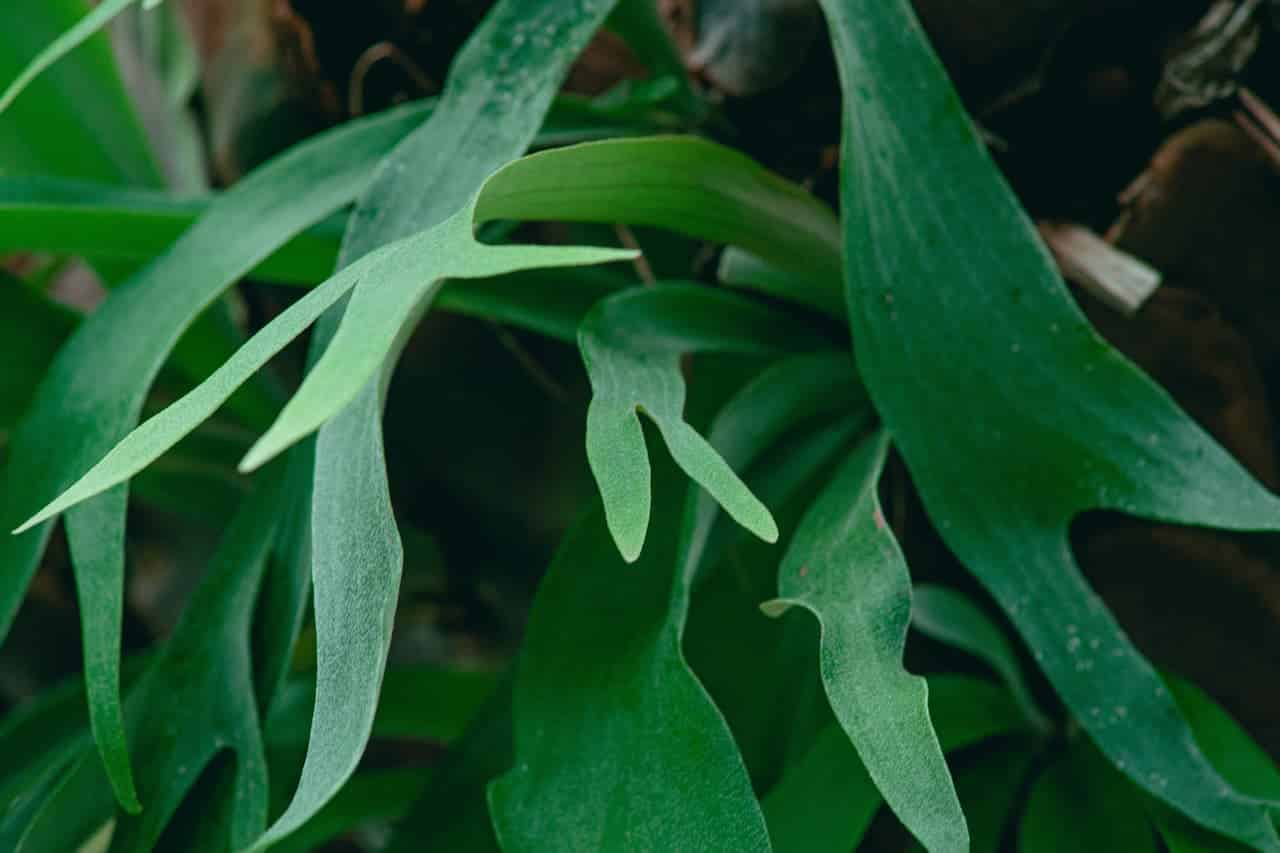
The antler fronds are coated in a fine layer of star-shaped hairs called stellate trichomes, which give them their characteristic silvery-grey appearance and help protect the fronds from water loss in their natural habitat. This coating is normal and must not be wiped off. Brown spores on the underside of mature antler fronds are also completely normal – they are the plant’s reproductive structures and are a sign of a healthy, mature specimen. The plant is non-toxic to cats, dogs and humans.
Mounting, positioning and light
The standard way to display a staghorn fern is mounted on a piece of wood or cork bark. The method involves positioning the plant’s root ball against the wood with a generous pad of damp sphagnum moss between it and the mounting surface, then securing everything firmly with fishing line, wire or natural fibre cord wrapped around the shield fronds and the board. The moss pad is essential – it retains moisture between waterings and provides the organic substrate the roots need. The mount is then hung on a wall like a picture, usually at an angle where the antler fronds can spread and display to best effect.
New mounts can be bought pre-made with the plant already attached, or assembled from scratch using a piece of hardwood, cork bark or a repurposed piece of timber. The choice of mounting material affects both the appearance and the care routine. Cork bark is porous and retains some ambient moisture; dense hardwood dries faster and suits growers who tend to overwater. Either works well. The mount should be large enough to accommodate several years of shield frond growth – they expand outward over time. A mount that feels slightly too large when the plant is first attached will look perfectly proportioned within a few years.
Never remove the brown shield fronds. The brown papery fronds at the base look dead – they are not. They continue to absorb water, protect the root ball and anchor the plant to its mount. Removing them causes significant stress and destabilises the mounting. New green shield fronds will grow over them in time. Leave the brown ones in place permanently.
Watering the right way – the soak method
Watering a mounted staghorn fern is fundamentally different from watering any pot-grown plant. Because the root system is embedded in a sphagnum moss pad rather than compost, and because the plant naturally grows in conditions where it receives periodic rain rather than a constant water supply, the correct method is to soak the whole mount rather than trickle water onto the surface. This mirrors the natural watering cycle of the plant’s tree-growing habitat far more accurately than regular small waterings would.
The weight of the mount is a useful practical indicator of moisture level. A freshly soaked mount is noticeably heavier than a dry one. Over time you will develop a feel for the difference, and the weight test becomes a quicker diagnostic than checking the moss surface. A light mount that was last soaked five days ago needs water; a mount of similar weight that was last soaked two days ago probably does not.
The soak method works as follows: take the mount down from the wall and submerge the root ball and moss pad in a container of room-temperature water. A sink, bucket or large bowl all work. Leave it submerged for ten to twenty minutes – long enough for the moss to absorb water thoroughly. Then remove it and allow it to drain for an equal period before rehanging. The moss pad should feel damp but not dripping when the plant goes back on the wall. In a UK home during the active growing season (spring to early autumn) this needs doing roughly once a week. In winter, when growth slows, every ten to fourteen days is usually sufficient – but check the moss rather than following a strict timetable. If it still feels damp, wait.
Between soakings, lightly misting the antler fronds adds humidity and is particularly useful in winter when central heating dries the air. Never mist in place of soaking – misting alone does not provide enough moisture to the root zone. Use room-temperature rainwater or tap water that has been left to stand if possible, as cold water can cause spotting on the antler fronds. The key diagnostic for correct watering is the moss pad: if it is bone dry when you check it, soaking frequency needs to increase; if it is still wet from the previous soaking when the next one is due, reduce the frequency. The moss tells you.
Feeding, seasonal care and propagation
Feed monthly during the active growing season – March through September in UK conditions. Use a balanced liquid fertiliser diluted to half the recommended strength. The fertiliser can be added directly to the soaking water rather than applied separately, which is both convenient and ensures the nutrients reach the root zone effectively. Do not feed in winter when the plant is resting. Like most ferns, the staghorn is sensitive to over-fertilising: full-strength feeds cause frond tip burn and can damage the root system. Half-strength, once monthly is the correct rate.
The staghorn fern grows slowly but rewards patience. New shield fronds and new antler fronds are produced regularly through the growing season. Young shield fronds emerge green and press flat against the mount and any old shield fronds, gradually turning brown as they mature. Young antler fronds emerge pale and slightly soft – do not touch them at this stage, as the emerging fronds can be permanently marked or deformed by physical contact. Allow them to harden off over two to three weeks before the plant is handled.
Propagation is achieved by separating pups – small offsets that develop at the base of a mature plant – or by division. To separate a pup, wait until it has developed its own shield fronds and is of reasonable size, then use a clean sharp knife to cut it from the main plant with some of the moss and root material attached. Mount the pup immediately onto its own board with fresh sphagnum moss and treat as a new plant, keeping it in higher humidity than usual while it establishes. Propagation by spores is theoretically possible but takes many months and requires specialist conditions that are not practical for most home growers.
Common problems and how to fix them
Most problems with staghorn ferns in UK homes come from one of two causes: overwatering or insufficient humidity. The symptoms overlap in ways that make diagnosis important before deciding on a fix.
Black or brown rot at the base of the antler fronds – at the point where they emerge from the shield fronds – indicates root or crown rot from overwatering. Let the moss pad dry out more thoroughly before the next soaking and reduce frequency. If the rot is significant, take the plant down and allow the mount to dry completely for several days before resuming a reduced watering schedule. Scale insects (small fixed brown or tan bumps on the frond surface) can be removed by wiping with a cotton pad dampened with a solution of water and a small amount of washing-up liquid. Check both surfaces of the antler fronds carefully. The brown spore patches on the underside of healthy mature fronds are NOT scale insects – they are flat, dusty patches forming neat rows, not raised bumps. Do not attempt to remove them.
Display ideas and position options
The wall-mounted display is the staghorn fern’s natural home in a UK interior. A single large specimen on a piece of weathered oak or a slab of cork bark becomes a genuine focal point in a living room, hallway or bedroom. Multiple mounts of different sizes grouped on one wall create a spectacular living gallery effect. The best background colours are pale grey, white or warm terracotta – any neutral tone that does not compete with the grey-green of the antler fronds. The plant looks particularly strong against exposed brick.
Bathrooms are an excellent position where the plant gets the humidity it appreciates from regular bathing or showering. A bathroom with an east or north-facing window that provides good indirect light is close to ideal. Kitchen positions also work well – the plant is in frequent view, which means the moss dryness is checked regularly, and the humidity from cooking provides a natural benefit. Living rooms and hallways work perfectly well provided the light is adequate and the mount is kept well away from radiators.
One underappreciated aspect of wall-mounted staghorn ferns is how well they work with other mounted epiphytes and air plants. A grouping of staghorn ferns at different sizes, some tillandsia air plants and perhaps a piece of driftwood with a small orchid mounted on it creates a genuinely living wall installation. The care requirements are not dramatically different between the plants in such a grouping, and the visual effect – particularly in a bathroom or hallway – can be remarkable.
For growers who prefer not to mount the plant on a wall, staghorn ferns can be grown in hanging baskets lined with sphagnum moss, or in large shallow containers filled with a very open mix of bark, perlite and sphagnum. The basket or pot approach is slightly less visually dramatic but makes the soaking process somewhat easier – the whole basket can be lifted into a sink. The growth habit is identical whichever method is used. Whichever display approach you choose, a staghorn fern that is properly cared for grows larger and more impressive each year, making it one of the most rewarding long-term investments in a UK indoor plant collection.
Share on socials: