At a glance
Outdoor electrical sockets are one of the most useful garden additions a UK homeowner can make – powering garden lighting, tools, outdoor kitchens, hot tubs, irrigation controllers and all the other electrical equipment that makes a garden genuinely functional as an outdoor living space. They are also one of the most regulated DIY projects, with specific legal requirements around who can install them, how they must be wired and what certification is required on completion.
Getting outdoor electrics wrong carries serious risks – electrocution, fire and flood damage – and an uncertified installation can invalidate home insurance and cause problems when selling the property. This guide explains exactly what the regulations require, what you can legally do yourself and what must be done by a qualified electrician.
Regulations and Part P
Outdoor electrical work in the UK is covered by Part P of the Building Regulations, which requires that certain electrical work in and around dwellings is either carried out by a competent person registered with an approved scheme – such as NICEIC, ELECSA or NAPIT – or is notified to and inspected by the local building control authority before the work is carried out.
Adding a new circuit from the consumer unit to garden sockets is notifiable work under Part P regardless of who carries it out. This means it must either be done by a registered electrician who self-certifies on completion, or you must notify building control before starting, pay an inspection fee and have the work inspected. The notification route is legal but rarely used by homeowners – using a registered electrician is simpler, typically faster and the cost difference is modest. When you use a registered electrician, they notify the local authority automatically on your behalf as part of the scheme registration process. You receive the completion certificate and the authority receives confirmation of compliance without any further action from you.
Part P applies in England and Wales. Scotland operates under the Building (Scotland) Regulations 2004 and Northern Ireland under the Building Regulations (Northern Ireland) 2012, but the principle – that significant new electrical work must be carried out by a competent person and properly certified – is consistent across all four nations.
Uncertified electrical work invalidates home insurance. If an outdoor electrical installation causes a fire or injury and cannot be shown to comply with Part P Building Regulations, your home insurance may refuse to pay out. Always get a completion certificate from a registered electrician for any new outdoor circuit – it costs nothing extra and is essential documentation for the property.
What you can and cannot DIY
The boundary between permitted DIY and notifiable electrical work matters practically, because getting it wrong creates either an illegal installation or an unnecessarily expensive electrician’s bill for work a homeowner could legally do themselves. The table below covers the most common tasks – if in any doubt about a specific job, ask a registered electrician before starting rather than after. An informal call to clarify scope costs nothing and can save significant money if it reveals preparatory work you can safely do yourself before they arrive.
Specifications and IP ratings
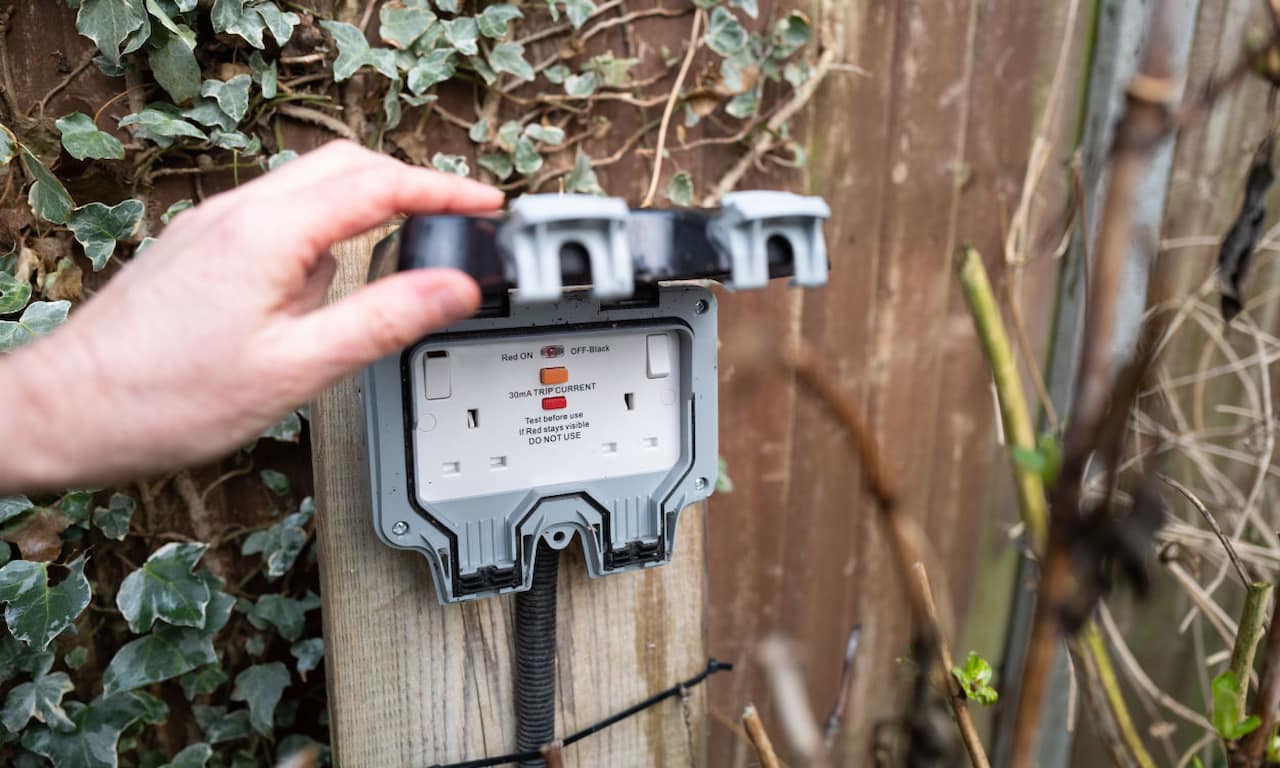
Outdoor sockets in the UK must carry a minimum IP44 weatherproof rating under BS 7671 (the 18th Edition Wiring Regulations). The IP code has two digits: the first indicates protection against solid ingress, and the second indicates protection against water ingress. IP44 means protection against solid objects larger than 1mm and against water splashing from any direction – adequate for a socket mounted under a covered area such as a pergola or porch roof.
For sockets in fully exposed positions where they will be directly rained on, IP65 or IP66 is the practical recommendation. IP65 provides complete dust protection and resistance to low-pressure water jets from any direction; IP66 upgrades this to high-pressure jets. In practice, most quality outdoor socket products sold in the UK are rated IP66 as standard, making the choice straightforward – buy IP66 for any external position and you will not need to think about it further. IP44 products do exist and are compliant for sheltered positions, but the price difference between IP44 and IP66 units is typically minimal and the additional protection is worthwhile. All outdoor circuits must also have RCD protection at 30mA sensitivity, which trips within milliseconds if a fault current develops to earth – a non-negotiable safety requirement for any outdoor electrical installation.
Cable routes and types
Underground cables running across a garden must either be Steel Wire Armoured (SWA) cable buried at a minimum depth of 500mm, or unarmoured cable run inside rigid conduit and buried at the same depth. Under driveways and areas subject to vehicle loads, the burial depth increases to 600mm for additional mechanical protection. SWA armoured cable is the most common choice for garden runs – it is robust, rated for direct burial and handles the damp, acidic conditions of UK soil without deterioration over a long service life. The steel wire armouring also provides a degree of mechanical protection against accidental spade strikes, though cable warning tape laid 100mm above the buried cable is still mandatory to alert anyone digging in the area in future.
Surface-mounted cables on walls or fences within reach must be in rigid conduit. Mark the route of all buried cables on a sketch plan and keep it with the house documents – future owners, plumbers and gardeners doing landscaping work will need to know where the cables run to avoid cutting through them. A simple hand-drawn plan showing the trench line, depth and socket position takes ten minutes to produce and can prevent a very expensive fault years later. Photograph the open trench before backfilling as an additional record.
Dig the cable trench yourself to save on electrician time. While the electrical connections must be made by a registered electrician, there is no restriction on digging the cable trench and laying conduit yourself before they arrive. This preparatory work can reduce the electrician’s time on site significantly – discuss the scope with them when getting quotes to understand exactly what they need ready.
Installation steps
The typical installation sequence for a new outdoor socket circuit runs as follows. Agree the design with two or three NICEIC or ELECSA registered electricians and get written quotes. Prepare the cable trench and any surface conduit runs yourself if agreed. The electrician then installs the consumer unit breaker, runs the cable, makes all connections at both ends and fits the socket in its weatherproof enclosure. Finally, they test the installation and issue an Electrical Installation Certificate (EIC) – the legal completion document. Keep the EIC with the house deeds.
If you are adding outdoor sockets to power a separate garden office or outbuilding, the requirements are similar but the run length and load calculations may require a larger cable and a dedicated circuit breaker. A garden office with lighting, heating and computer equipment draws significantly more current than a socket for occasional garden tool use. If you are planning a garden office, plan the electrical supply at the design stage rather than as an afterthought – it is significantly cheaper and less disruptive to install the cabling during the build than to trench across a finished garden afterwards.
Testing and certification
All new electrical installations must be tested before the circuit is energised, and the test results recorded on an Electrical Installation Certificate. The tests check insulation resistance, earth continuity, polarity and RCD operation time – each one confirming a different aspect of the installation’s safety and compliance with BS 7671. A registered electrician carries out these tests using calibrated instruments as a standard part of the installation. Do not accept any job where testing is described as optional or where no certificate will be provided – these are both warning signs of a non-compliant installation that will create problems for you when you come to sell the property or make an insurance claim.
The completed EIC should be provided within a few days of the work being finished. If you are using an electrician registered with an approved scheme, they self-certify the work directly with your local authority – you do not need to notify building control separately. The registration is handled automatically and the installation is fully legal and certificated from the point the EIC is issued. A copy of the EIC is sent to the local authority by the scheme operator, and you retain the original for your own records. When you come to sell the property, the EIC is part of the electrical documentation a buyer’s solicitor will request – a missing certificate from historical work is a common cause of delays and additional costs at conveyancing, which is another strong practical reason to ensure all electrical work is properly certified at the time it is carried out.
Share on socials: