At a glance
A garden room extension is one of the highest-impact home improvements a UK homeowner can make – adding usable living space, increasing property value and transforming how the home connects to the garden. The category covers a wide range of structures: from insulated timber-frame garden offices that sit as separate buildings in the garden, to full glass-and-steel single-storey extensions that open directly from the house and add a new room to the footprint.
Understanding the planning rules, specification requirements and cost range before committing to a project is essential – there are significant differences in what is permitted development, what needs planning permission, and what the realistic costs are for each approach. Making assumptions about what is allowed without checking can lead to costly corrections or enforcement action, while over-specifying on things that do not matter wastes budget that could go into better insulation or glazing. This guide covers the full picture so you can make informed decisions about what type of addition suits your home, your garden and your budget.
Garden room vs extension – what’s the difference?
The term “garden room extension” covers two genuinely different types of project that are often confused. A detached garden room is a separate, freestanding structure in the garden – legally an outbuilding – that is not physically connected to the house. A house extension is attached to the existing building, accessed through an internal doorway and adds directly to the living footprint of the home. Both are commonly described as garden room extensions, but they differ significantly in planning requirements, Building Regulations, cost and complexity. Choosing between them is largely determined by whether physical connection to the house is essential to your purpose, or whether a separate building in the garden would serve equally well.
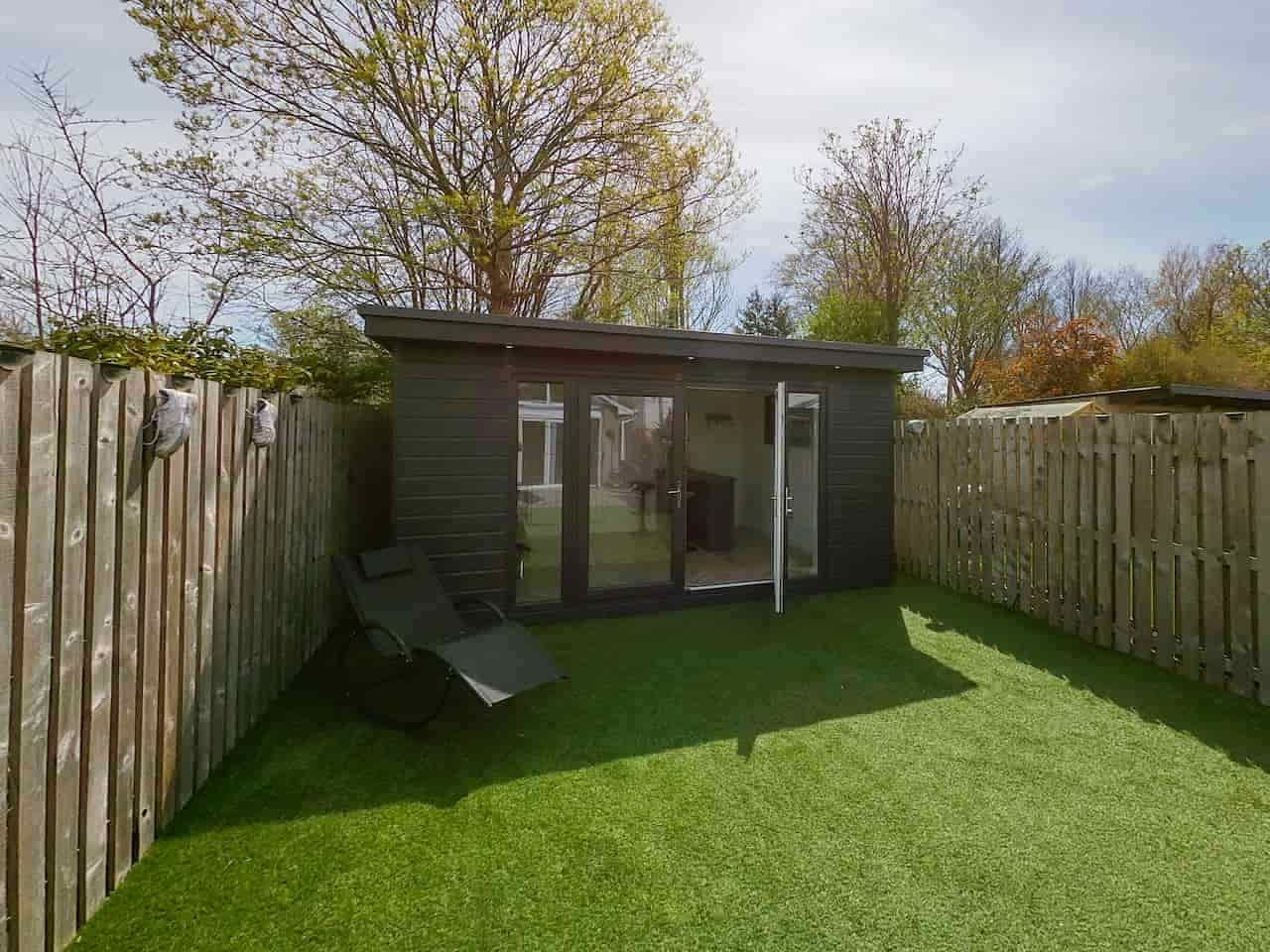
A detached garden room is the simpler, cheaper and faster option in almost every case. It operates as a separate building in the garden – a garden office, studio, gym or playroom – and is typically supplied and installed as a complete timber-frame kit by specialist garden room companies. Planning permission is often not required, Building Regulations may not apply for smaller structures, and the project can typically be completed in a matter of weeks rather than months. Our guide to building a garden office covers the detached approach in detail.
A full single-storey rear extension physically attached to the house and accessed through an internal door is a different category of project entirely – it requires Building Regulations compliance, involves structural work to the existing building and needs a professional contractor rather than a DIY approach. Both types are covered in the sections below.
Planning permission rules
For a single-storey rear extension to the house, permitted development rules in England allow extensions up to 3m beyond the rear wall for semi-detached and terraced houses, and up to 4m for detached houses, without a planning application – provided the extension does not exceed the height of the existing roof ridge and does not cover more than 50% of the original garden area. Under the larger home extension prior approval process, these limits increase to 6m for semi-detached and terraced houses and 8m for detached houses, subject to a neighbour notification period.
For a detached garden room treated as an outbuilding, different permitted development rules apply. The maximum height is 2.5m if the structure is within 2m of a property boundary. Beyond 2m from a boundary, the permitted height rises to 4m for a dual-pitched roof or 3m for any other roof type. The total floor area of all outbuildings must not exceed 50% of the original curtilage of the house. A garden room used as sleeping accommodation – a self-contained annexe – is treated differently again and will almost certainly require a planning application regardless of size.
Always confirm your planning position before spending money on design. Permitted development rights can be removed by Article 4 directions, by conditions attached to the original planning consent, or by the property being in a conservation area, national park or Area of Outstanding Natural Beauty. Check with your local planning authority before assuming PD rights apply – a pre-application enquiry is often free or low cost and gives a definitive answer before any money is spent on design or structural surveys.
Specification and insulation
For a year-round usable garden room or extension, insulation specification is the most important single decision. A structure with inadequate insulation is cold in winter and overheating in summer – a common characteristic of lower-specification garden room pods marketed as habitable but which prove impractical in the British climate beyond the warmer months. The difference between a habitable year-round space and a fair-weather summerhouse is almost entirely down to the insulation and glazing specification.
For genuine year-round use, target minimum 100mm PIR (polyisocyanurate) rigid insulation in the floor, 100mm in the walls and 150mm in the roof. These specifications achieve approximate U-values in the range 0.15-0.22 W/m2K, broadly equivalent to modern new-build standards. Timber-frame construction with mineral wool between studs is an alternative, but requires significantly thicker walls to achieve equivalent thermal performance – typically 150-200mm wall depth compared to 110-130mm with PIR. Double-glazed units with a minimum 4-16-4 configuration are the practical minimum; thermally broken frames prevent cold bridging at the glazing perimeter that would otherwise produce condensation and dramatically reduce effective thermal performance despite good wall and roof insulation. For south-facing rooms with significant glazing, solar control glass prevents overheating in summer without reducing winter heat gain significantly.
Electrics and heating
A garden room needs a dedicated electrical supply from the house consumer unit – a separate circuit run through armoured cable underground to the garden room, then distributed internally through a small consumer unit within the garden room itself. As covered in our guide to outdoor electrical sockets, this is notifiable work under Part P Building Regulations and must be carried out by a registered electrician. Plan the electrical supply at the design stage – it is significantly cheaper and less disruptive to install cabling during the build than to trench across a finished garden afterwards.
For heating, an electric panel heater with a smart thermostat is the simplest and most cost-effective solution for a well-insulated garden room. A 1-2kW panel heater is typically sufficient for a 15-25m2 space with good insulation. Running costs for occasional and regular daytime use are manageable for most households, and the absence of any gas infrastructure requirement keeps installation cost low. Pairing with a smart thermostat allows the room to pre-heat before use and drop back to frost protection overnight automatically, which meaningfully reduces the energy consumed for the same level of comfort.
Finding contractors
For a full house extension, the standard route is to engage a RIBA-registered architect to produce the design drawings – essential for a planning application, Building Regulations submission and tendering to builders accurately. Once design drawings are ready, get at least three quotes from contractors with verifiable experience of similar single-storey extension projects. Check references and, wherever possible, visit a completed project in person before committing. Membership of the Federation of Master Builders or equivalent trade body is a useful baseline indicator of professional standards, but does not replace personal references from recent clients. Ask specifically about projects of comparable scale and specification to yours, not the contractor’s most impressive portfolio pieces.
The garden room kit market is served by a range of specialist companies who supply insulated timber-frame systems with varying levels of installation support, from supply-only to fully installed and finished. The best approach is to specify exactly what you need – floor area, insulation specification, glazing type, cladding material – and get comparable quotes from two or three specialist suppliers alongside a quote from a local builder using your own materials. This comparison typically reveals significant variation in price for equivalent specification and gives the clearest sense of real market cost for your project. Be cautious of any supplier who is reluctant to commit to insulation U-values or specification details in writing – the thermal performance of the finished structure determines its long-term usability and running cost.
Cost and added value
A well-specified garden room or extension typically adds 5-15% to the value of a UK property, with the exact figure depending heavily on the quality of construction, local market conditions and how well the addition complements the existing house. A well-designed glass-and-timber garden room that extends the living space of a family home in an area with strong buyer demand for indoor-outdoor living space will typically add more in percentage terms than a basic timber garden office in a market where buyers prioritise other features. Estate agent valuations before and after are the most reliable guide for a specific property in a specific location – ask two or three local agents for their assessment of the impact before committing to the project cost.
The running costs of the structure over its lifetime should be factored into the total cost of ownership at the decision stage. A poorly insulated space that requires significant ongoing heating cost erodes the financial case for the project over 10-15 years, while a well-insulated structure with low running costs is much easier to justify. For the broader context of reducing heating costs across the home, our guide to energy saving in winter covers the measures that reduce the cost of heating any space, including a new garden room. The upfront capital saving from a cheaper insulation specification is rarely recovered from lower heating bills – the reverse is consistently true.
Share on socials: