At a glance
Radishes are the fastest vegetable you can grow in a UK garden. The quickest summer varieties are ready to harvest in as little as three weeks from sowing – a speed that no other food crop can match. That makes them uniquely satisfying for new gardeners, ideal for filling gaps between slower crops, and excellent for succession sowing through a long season.
Despite their speed and simplicity, radishes are frequently grown badly. The most common mistake is leaving them in the ground too long, at which point they become hollow, pithy and fiercely hot. Harvest them young and promptly and they are mild, crisp and genuinely delicious. Understand that one rule and growing radishes is almost foolproof.
About radishes
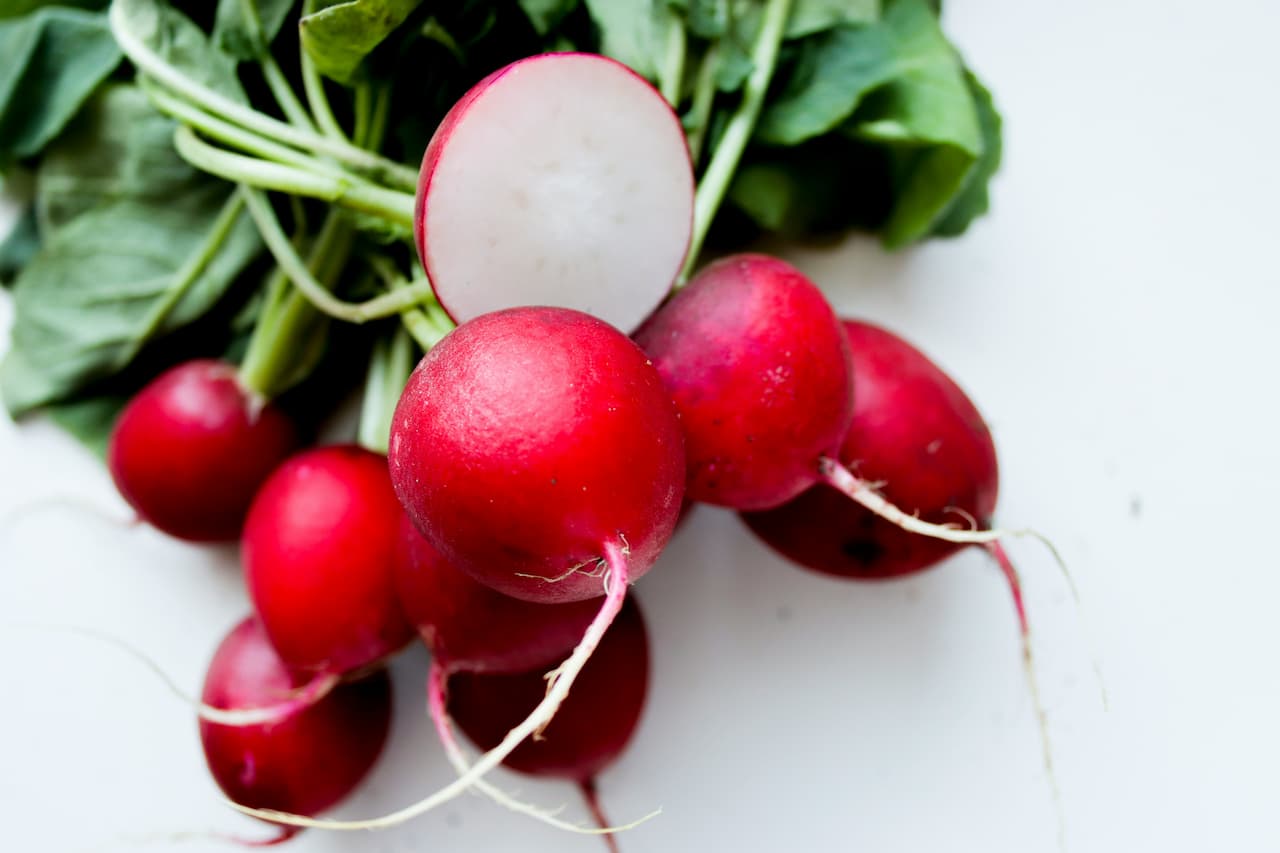
Radishes (Raphanus sativus) are a brassica family member, closely related to turnips and cabbages. The most familiar types in the UK are the small round or cylindrical summer radishes – bright red, white-tipped or pure white – that are eaten raw in salads. Winter radishes are a different proposition entirely: large, dense roots that can reach the size of a parsnip and are used cooked or pickled. This guide focuses primarily on the summer types which are by far the most commonly grown in UK raised beds.
The edible part of a summer radish is the swollen root, which develops just below the soil surface. The leaves are also edible and have a peppery flavour similar to rocket – young radish leaves make a useful addition to salads and are often discarded unnecessarily. The seed pods that form if the plant bolts and flowers are also edible, with a mild radish flavour and crisp texture when eaten young.
Sowing radishes
Radishes are always sown direct where they are to grow. Sow seeds 1cm deep, spacing them about 2.5cm apart in rows 15cm apart. There is no need for precise spacing – scattering seeds thinly in a band works well. Thin the seedlings to 5cm apart once they have germinated if they are very crowded, though summer radishes tolerate closer spacing better than most root vegetables.
Succession sowing is essential with radishes. A whole row sown at once will all be ready to harvest within a few days of each other, giving you far more than you can use before they deteriorate. Sow a short row every two weeks instead and you will have fresh radishes continuously rather than a frustrating glut.
Use radishes as row markers. Because radishes germinate so quickly – often within three to five days – they are excellent for marking the rows of slower-germinating crops like carrots. Sow a few radish seeds along the carrot row. The radishes appear first and show you where the row is, then the carrots emerge and the radishes are harvested long before the carrots need the space.
Ongoing care
Radishes need very little care during their short growing period. Consistent moisture is the most important factor – dry conditions cause the roots to become hot, pithy and cracked. Water every two to three days in warm weather to keep the growing medium evenly moist. In a raised bed the free-draining medium dries faster than open ground, so check regularly and do not let radishes go short of water even for a few days.
No feeding is required for summer radishes. They grow and mature so quickly that there is not enough time for a fertiliser application to make any meaningful difference. What matters is starting with fertile, well-prepared growing medium and keeping moisture consistent throughout the short growing period. Weed control in the early stages prevents competition, but established radish plants grow fast enough to shade out most weeds naturally.
Harvesting
Pull radishes as soon as they reach the size shown on the seed packet – usually 2-3cm diameter for round types or pencil thickness for cylindrical ones. Do not wait. Radishes left in the ground for even a few extra days quickly become pithy, hollow and fiercely hot. Pull one from the row and taste it – if it is good, harvest the rest of that sowing immediately. The whole point of growing your own is catching them at their peak.
Freshly pulled radishes will keep in the fridge for a week or so with the leaves removed – the leaves draw moisture from the root and cause it to go limp quickly. If you have more than you can eat immediately, radishes can be thinly sliced and pickled in vinegar with a little sugar and salt – they keep for several weeks and make an excellent condiment for sandwiches and salads.
Common problems
Flea beetle is the most common problem with radishes, creating a characteristic shothole pattern across the leaves. While the damage looks dramatic, it rarely affects the root development significantly unless the attack is very severe on very young seedlings. Fine insect mesh prevents flea beetle entirely and is the simplest solution. Slug damage to young seedlings is also possible – our guide to dealing with slugs covers the most effective control methods.
Best varieties
‘French Breakfast’ is the most popular UK radish variety – a cylindrical red and white root with a milder flavour than round types and a longer harvesting window before it becomes pithy. ‘Cherry Belle’ is the classic round red radish, very fast-maturing (as little as three weeks) and reliably mild. For something more unusual, ‘Watermelon’ radish is a large type with pale green skin and vivid pink flesh that looks spectacular sliced in salads, though it takes considerably longer to mature than summer types.
For autumn and winter, ‘Mino Early’ is a Japanese mooli-style radish producing long white roots up to 30cm that are used grated or sliced in Asian cooking. Winter radishes generally take four to eight weeks longer than summer types but are far more tolerant of cold and can be left in the ground through mild winters. They are sown in late summer and represent a completely different growing experience to the quick salad radishes most UK gardeners are familiar with.
Radishes are one of the most useful gap-fillers in a productive raised bed. Their speed means they can be squeezed into almost any spare corner between slower-growing crops – alongside leeks, between rows of brassicas, or at the edges of beds where taller plants have not yet spread to fill the space. Few vegetables offer so much return for so little investment of time, space and effort. For anyone starting out with raised bed growing, radishes are an ideal first crop to build genuine confidence – fast and reliable results, very forgiving of minor mistakes, and consistently rewarding in the kitchen when grown and harvested at exactly the right moment rather than left to go over in the ground.
Share on socials: