At a glance
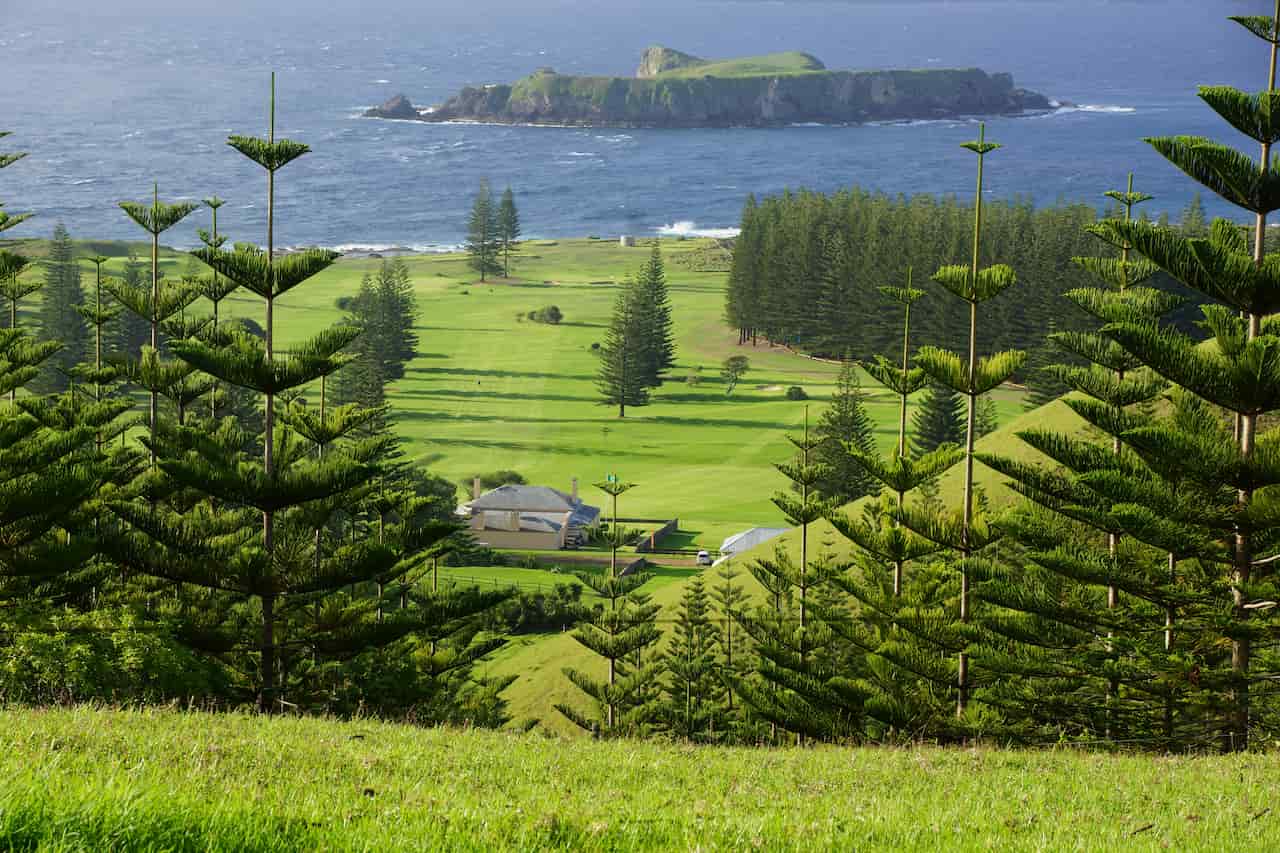
The Norfolk Island Pine – Araucaria heterophylla – is one of the most distinctive houseplants available in the UK. Its tiered, symmetrical branches and soft, bright green needle-like foliage give it the appearance of a miniature conifer, and in its native habitat on the remote South Pacific island that gives it its name, it grows into a tree reaching 50 to 65 metres tall. As a houseplant it remains manageable for many years, growing slowly upward and adding one or two tiers of branches each season. It is the kind of plant that outlives its owners when properly cared for – specimens decades old are not unusual in the right conditions.
In the UK, the plant is commonly sold in November and December as a living Christmas tree alternative, and frequently allowed to deteriorate in the dry heated air of a typical British home. This is a shame because the requirements are not complex: bright light, consistent moisture, good humidity and cool temperatures in winter. Get those four things right and it will grow steadily and reliably for years. Fail on humidity – the most common failure – and the lower branches will begin to drop, and once lost they will not regenerate. Prevention is not just better than cure. With this plant, prevention is the only option.
About the Norfolk Island Pine
The family Araucariaceae is genuinely ancient. The group was most diverse during the Mesozoic era and many genera did not survive the mass extinctions that ended the Cretaceous period, when Araucariaceae disappeared from the northern hemisphere entirely. The Norfolk Island Pine and the monkey puzzle tree are genuine living fossils whose basic architecture has changed remarkably little over hundreds of millions of years. This ancient lineage partly explains why the plant responds poorly to conditions it was never adapted to face – it has not had the evolutionary time to develop the flexibility of more recently evolved houseplants.
The most important single fact about this plant from a care perspective: once a lower branch drops, it will not grow back. The plant only produces new material from its growing tip and from the ends of existing live branches. Every tier is laid down from the top and works downward over years. The lower tiers are the oldest and most irreplaceable. Keeping them healthy is the primary goal of all care decisions.
Humidity – why it matters so much
Humidity is the single factor that most consistently determines success or failure with the Norfolk Island Pine in UK conditions. The problem is invisible – unlike insufficient light or overwatering, low humidity leaves no obvious early signs until branch drop has already begun. In a UK home in winter, relative humidity in a centrally heated room typically falls to between 20 and 40 percent. The Norfolk Island Pine requires a minimum of 40 to 50 percent relative humidity to maintain healthy foliage and branch structure, and performs best at 60 percent or above. The gap between what the plant needs and what a typical British home provides requires active intervention.
The mechanism is straightforward. The plant transpires moisture through its needle foliage continuously. At adequate humidity, this moisture loss is balanced by water absorbed through the roots. At low humidity, transpiration exceeds what the root system can supply – particularly in the lower branches which are farthest from the growing tip and receive the least priority in the plant’s internal water distribution. These branches desiccate progressively. The needles first, then the branch structure. Once the vascular tissue of a branch has dried beyond a certain point, the plant severs its connection to that branch. The branch dies. It does not recover.
The three practical solutions: a room humidifier running for several hours each day near the plant is the most effective single intervention. A pebble tray – a shallow tray of gravel filled with water to just below the pebble surface, with the pot sitting on top above the waterline – provides a smaller but useful contribution as evaporation raises local humidity. Daily misting with room-temperature water supplements both but should not be relied on alone – misting raises humidity transiently and the effect dissipates within minutes in a dry centrally heated room. Cold water applied to the needles causes white spotting; always use room-temperature water. Grouping the Norfolk Island Pine with other houseplants provides a modest microclimate benefit through collective transpiration.
Light, rotation and temperature
East or west-facing windows are the best positions: east provides morning direct sun and bright indirect light through the afternoon; west provides afternoon sun. South-facing windows are appropriate in autumn and winter when UK light levels fall significantly. North-facing rooms should be avoided if any alternative is available. In lower light the plant is already stressed and has no reserve capacity to handle additional problems.
Rotating the pot is specific to this species and frequently overlooked. The plant grows toward its light source – the branches on the window side extend further and grow denser than the shaded side. A quarter turn every two weeks maintains even growth around the circumference and preserves the symmetrical upright form. This takes ten seconds every two weeks and makes a significant visible difference over months. Early-stage leaning corrects over several months of consistent rotation. Severe long-established leaning is harder to fully correct as the internal structure has set, but improvement is still possible.
The central leader – the single upright stem – must never be cut. If it is removed intentionally or accidentally, the plant will not produce a replacement. It will fork from below the cut, producing competing stems that destroy the characteristic form permanently. Side branches can be removed if dead or damaged, but the central leader is sacrosanct.
Watering, compost and repotting
The Norfolk Island Pine wants to be kept evenly and consistently moist – not wet, not dry, but consistently damp throughout the root ball. Allow the top 1 to 2 centimetres of compost to dry before watering again, but do not allow the whole pot to dry out completely. In spring and summer this typically means watering every seven to ten days. In autumn and winter, every two to three weeks. Water with room-temperature water; cold tap water causes thermal shock to the roots. Use rainwater or allow tap water to stand for 24 hours to reduce fluoride content – the plant is sensitive to fluoride and salt accumulation, which causes needle tip browning over time.
The Norfolk Island Pine grows naturally in freely draining sandy soils. A standard multipurpose compost mixed with 20 to 30 percent perlite or horticultural grit provides adequate drainage while retaining enough moisture. The plant has a relatively shallow, fibrous root system – a wide, shallow pot is more appropriate than a tall deep container. A heavy ceramic or terracotta pot provides useful ballast for a plant that eventually becomes tall and top-heavy. Repot in spring only, every three to four years maximum, going up one pot size. Flush the compost thoroughly once or twice a year to remove accumulated fertiliser salts.
Seasonal care through the year
Common problems and diagnosis
When the Norfolk Island Pine shows signs of decline, identifying the specific cause before intervening matters – different problems require completely different responses.
Pests, feeding and maintenance
Mealybugs are the most common pest, appearing as white cottony deposits at branch junctions and along branches. The fine needle structure makes thorough manual removal difficult – wipe each visible deposit with a cotton bud dipped in rubbing alcohol, then follow with weekly neem oil spray for three to four weeks. The neem oil spray is particularly important for this species because reaching all hiding places manually is challenging. Isolate from other houseplants immediately. Spider mites appear as fine webbing between needles in very warm dry conditions – treat with neem oil spray and improve humidity, as spider mites are significantly more likely when humidity is low.
Feeding requires a balanced liquid houseplant fertiliser at half strength, applied monthly from April to September. Do not use high-nitrogen formulations – these produce soft, weak growth more susceptible to the humidity and temperature problems that already challenge the species. Do not feed from October to March.
For cleaning, a lukewarm shower – placing the plant in a shower tray and running water gently over the entire plant – is the most thorough method and simultaneously provides humidity and a thorough watering. Allow to drain completely before returning to position. Do not use commercial leaf shine products – the needle structure is not suited to polish application and the products block the stomata. Dead needles that accumulate inside the plant should be removed periodically – they harbour pests and mould in the warm humid conditions the plant prefers.
The Christmas problem
The plant is most commonly purchased in November and December as a Christmas tree alternative, which creates a specific problem: a centrally heated UK home in December with minimal outdoor light, windows closed for warmth, central heating running continuously, and potentially Christmas lights adding heat to the plant is close to the worst possible environment for the species. Plants sold at this time have often already been stressed by the retail cold chain. The combined effect of purchase stress, low humidity, inadequate light and decorative heat sources means many Christmas Norfolk Island Pines lose their lower branches within four to eight weeks of purchase.
If purchasing for Christmas use: keep lights battery-powered and low-heat if used at all. Position in the brightest available location. Set up humidity management from day one. After Christmas, remove decorations and treat the plant as the long-term houseplant it is. If the primary purpose is a short-term seasonal decoration, a different plant – or a cut tree – may be more appropriate. The Norfolk Island Pine repays sustained care over years; it does not benefit from being treated as a disposable seasonal item.
Buying a healthy plant
Signs of a healthy plant: the lowest branches should be firm and horizontal, not drooping. All tiers should have dense green needle coverage without yellowing. The central leader should be upright and straight. Reject any plant with drooping or yellowing lower branches – humidity damage has already begun and the progression is very difficult to reverse. Reject any plant with a crooked or multiple central leader – the characteristic form is already compromised. Check the compost – slightly moist is correct, bone dry or waterlogged are both bad signs.
The transition from shop to home is a critical period. Set up the humidity management approach immediately on bringing the plant home. Do not place it near a radiator. Give it the best available light. Water once, then check regularly rather than watering on a fixed schedule. The first month in a new home is when most newly purchased Norfolk Island Pines are lost – usually to the combination of residual retail stress and the dry heated air of a UK home in winter.
Long-term care and development
A Norfolk Island Pine that is well cared for over years becomes a genuinely impressive houseplant. The trunk thickens, the tier structure becomes more defined, the plant becomes taller and more substantial. By year five the lower tiers, having had five years to develop, span a significant width and the plant has developed a character that a newly purchased specimen cannot match. By year ten the plant may be 120 to 180 centimetres tall – no longer a windowsill specimen but a room feature.
Propagation is effectively impractical for home growers. Cuttings from side branches do not produce the upright central leader form – they grow as sprawling shrubs. Cuttings from the central leader tip preserve the upright form but removing the tip destroys the parent plant’s architecture. Propagation from seed is slow and fresh seed is rarely available in the UK. New plants are obtained by purchase. This means the plant you buy is likely the plant you will have for decades – there is no easy restart if poor early care causes branch loss.
The key commitments that make the difference over the long term: maintain humidity above 40 to 50 percent through winter, rotate the pot every two weeks year-round, keep the plant in the best available light, water consistently without waterlogging, and never cut the central leader. These requirements are not onerous and the reward for meeting them is a plant of genuine character and longevity.
Never move a Norfolk Island Pine outdoors in the UK climate. Unlike many houseplants that benefit from a summer spell outside, this species is not suited to outdoor conditions in Britain. Rain, temperature fluctuations and cold nights cause more stress than the benefits of outdoor light can compensate for. Keep it indoors year-round in a bright, humid position.
Share on socials: