At a glance
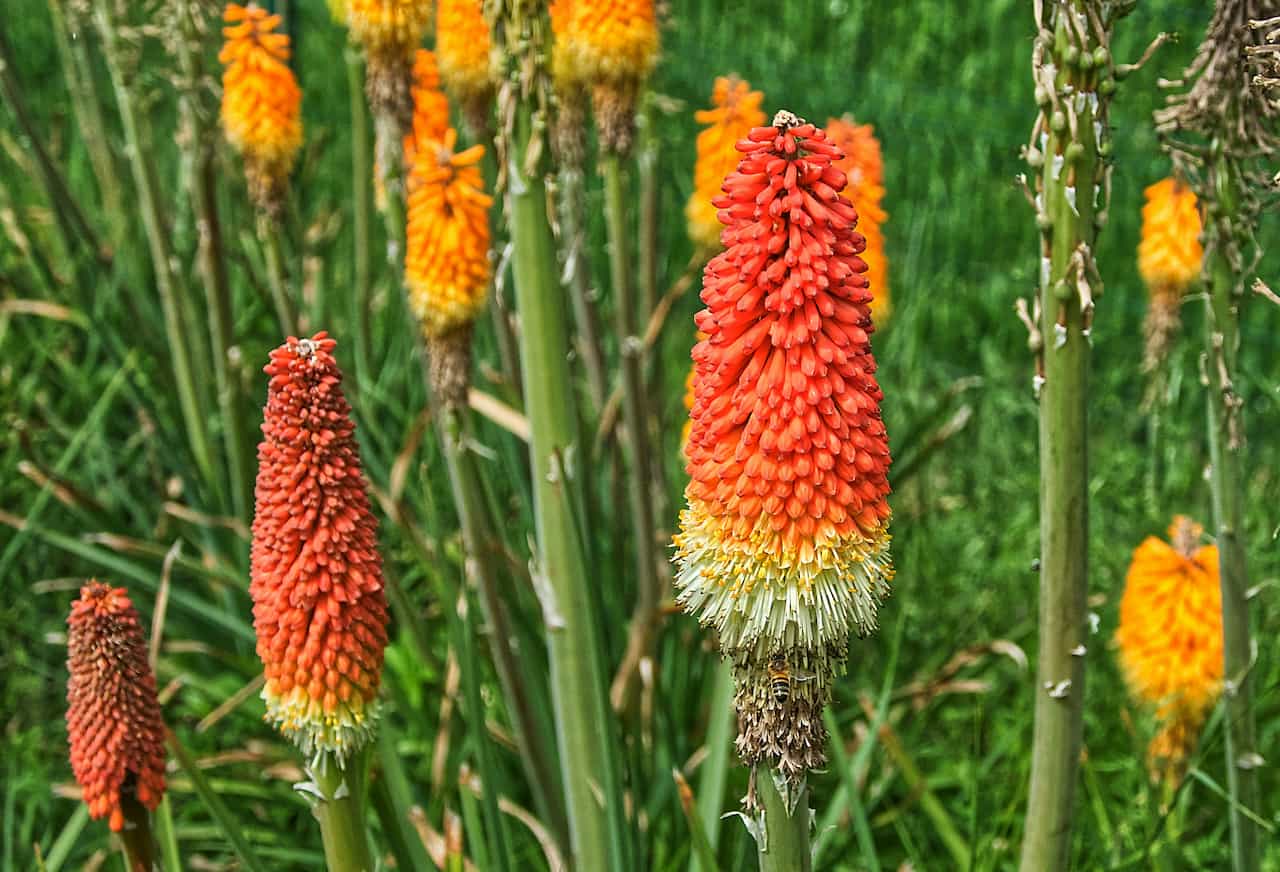
Kniphofia – more widely known as red hot pokers or torch lilies – are among the most architecturally striking perennials available to UK gardeners. The stiff, upright poker-shaped flower spikes in shades of red, orange, yellow and cream emerge on tall stems above clumps of strappy foliage, creating a dramatic vertical accent that few other plants can match in a summer border. Flowering from midsummer through to October depending on variety, they fill the gap when many other border plants have finished for the season and pollinators are still active. Bees and hummingbird hawk-moths are strongly attracted to kniphofia flowers – a clump in full bloom is rarely without activity. The flowers are also long-lasting once cut, making kniphofia a useful plant for those who grow for the vase as well as for garden display.
Despite their dramatic appearance, kniphofia are not difficult to grow once their fundamental requirements are met. The non-negotiable conditions are full sun and excellent drainage – they are native to South Africa and tolerate drought well once established, but are sensitive to waterlogging in winter. A wet, cold, poorly drained soil is the primary cause of kniphofia losses in UK gardens, and moving an established plant to better-drained ground is nearly always more effective than trying to amend a heavy clay soil in situ. Given the right position, kniphofia are long-lived and largely self-sufficient, requiring little more than an annual tidy and occasional dividing every four to five years to maintain vigour. They are also deer-resistant and rarely troubled by slugs or vine weevil – two significant advantages in gardens where these are persistent problems.
Growing Conditions
Drainage is the single most important factor in kniphofia success and the most frequently overlooked. On heavy clay soils, incorporate generous amounts of grit and coarse organic matter before planting – a full barrowload of horticultural grit worked into the planting area gives a meaningful improvement. Raised beds and sloped sites naturally drain well and suit kniphofia particularly well. In gardens where winter waterlogging is a persistent problem, kniphofia are best grown in large containers with a very free-draining compost mix, brought under cover or into a sheltered position from November to March. The combination of cold and wet is what kills kniphofia in UK winters – either cold alone or wet alone they can generally tolerate, but the two together over an extended period causes crown rot that is invariably fatal. Gardeners on free-draining sandy or chalky soils rarely lose kniphofia to winter damage at all, even in cold years.
Soil pH is not critical – kniphofia tolerates a wide range from mildly acid to mildly alkaline. Fertility requirements are modest: an established clump in reasonable garden soil does not need feeding unless growth seems weak, in which case a balanced slow-release fertiliser applied in spring is sufficient. Avoid high-nitrogen feeds which promote leafy growth at the expense of flowers. The strappy leaves are semi-evergreen in mild UK winters – they die back more completely in cold exposed positions. In either case, do not cut the old leaves back in autumn: they provide insulation for the crown through winter and should be left until spring, then removed along with any dead flower stems. As a general rule, the less you interfere with kniphofia out of season, the better they perform. They dislike excessive disturbance and thrive best when planted in the right position and simply left to establish over two to three seasons.
Best Varieties for UK Gardens
‘Royal Standard’ is the most widely grown variety in UK gardens and the most forgiving – robust, reliably perennial and producing the classic bicolour poker of deep red buds opening to yellow from July onwards. ‘Little Maid’ is the best compact variety for smaller borders, reaching only 60cm and producing elegant cream and pale yellow spikes from June – earlier than most other cultivars and a useful bridge between spring flowering plants and the main summer display. For late season interest, ‘Tawny King’ is exceptional, flowering into October with warm orange-buff spikes above broad arching foliage and reaching up to 120cm. It extends kniphofia interest well into autumn when little else is providing the same vertical drama in the border. The ‘Flamenco’ mixed seed strain offers a more economical way to establish a range of colours and heights from seed, though named cultivars from reputable suppliers tend to give more consistent height and colour results.
Plant different kniphofia varieties together to extend the flowering season from June to October. Early varieties like ‘Lemon Popsicle’ flower from June, mid-season varieties like ‘Royal Standard’ from July, and late varieties like ‘Tawny King’ carry the display into October. A grouping of three varieties of different heights and flowering times gives a long, layered display from a relatively small border area.
Planting and Establishment
Kniphofia are best planted in spring, from April to June, when the soil has warmed and the risk of prolonged cold and wet has passed. Bare-root plants and divisions should be planted at the same depth as they were previously growing – burying the crown too deeply is a common cause of rotting. Container-grown plants can go in at any time from spring to early autumn. Space plants 60-90cm apart depending on variety – they will spread over time and need room to reach their full effect without crowding. Water well immediately after planting and keep the soil moist for the first few weeks while the plant establishes. After the first season, established plants need very little watering even in dry summers – their South African origins make them genuinely drought-tolerant once the root system is properly developed. In the first winter, a light mulch of bark chip or dry straw around the crown provides useful insurance against frost damage while the plant is not yet fully settled.
Care, Dividing and Common Problems
Established kniphofia clumps benefit from dividing every four to five years. Without dividing, the centre of the clump gradually dies out and flowering quality declines – a ring of new growth around a dead centre is the classic sign that division is overdue. The best time to divide is early spring as growth begins, when the crown is easiest to work with and the new divisions have the full growing season ahead to settle before winter. Early autumn is also workable on light, free-draining soils. Lift the entire clump with a fork, divide it into sections each with a good portion of roots and foliage using a sharp spade or two forks back to back, and replant the healthiest outer sections at the same depth. Divisions from a mature plant will typically flower in the following season. Discard the old, exhausted centre section. After replanting divisions, water them in well and keep them moist for a few weeks until they show signs of new growth – wilting in the first week or two is normal and does not indicate failure.
Do not cut back kniphofia foliage in autumn. It is tempting to tidy the garden in autumn by removing the old leaves, but for kniphofia this is counterproductive and potentially damaging. The leaves form a natural insulating layer over the crown that protects it from frost. In mild UK winters this is rarely critical, but in cold, exposed gardens or during hard frosts it can be the difference between a plant that survives and one that does not. Leave the foliage until spring and then remove it cleanly as new growth begins to emerge.
Share on socials: