At a glance
Lawn feeding is one of the highest-return lawn care tasks available to UK gardeners, but it is also one of the most frequently misapplied. An unfed lawn gradually thins as grass plants deplete the available nutrients in the soil, becomes less competitive against weeds and moss, and recovers more slowly from wear, drought and disease. A regularly and correctly fed lawn is visibly different – deeper green, denser and more resilient to the conditions that cause thin, patchy grass. The critical qualifier is “correctly” – high-nitrogen feed applied in autumn, spring feed applied to frozen or bone-dry soil, or any granular feed applied without watering in leads directly to fertiliser scorch that can leave brown stripes lasting weeks. The number of lawn problems that originate in incorrect feeding – wrong product, wrong timing, wrong application – is substantial, and most of them are entirely avoidable with a basic understanding of what the different products do and when to use them.
The feeding programme that produces the best results in UK gardens is a seasonal approach: a nitrogen-rich feed in spring to drive growth and greening, one or two balanced summer feeds to maintain condition without excessive growth, and a low-nitrogen, high-potassium autumn feed to harden the grass for winter. This four-feed maximum across the season is appropriate for most domestic lawns. Ornamental or high-specification lawns may receive more frequent, lighter applications of liquid feed, but for the majority of UK garden lawns the seasonal granular programme is the most practical and forgiving approach, and consistently delivers excellent results without requiring precise timing or specialist equipment. The key principle throughout is that it is better to feed slightly less than slightly more – underfeeding produces a slightly less lush lawn that recovers quickly, while overfeeding or poorly timed feeding causes visible damage that takes weeks to recover from.
Understanding NPK and What Grass Needs
Lawn fertiliser labels display three numbers separated by hyphens – for example 20-5-10 or 12-0-9 – which represent the percentage of nitrogen (N), phosphorus (P) and potassium (K) in the product. Nitrogen drives leaf growth and the green colour that most people associate with a healthy lawn. Phosphorus supports root development and establishment – it is most useful when sowing or turfing, less important for established lawns. Potassium strengthens cell walls, improves drought and frost resistance, and increases disease resilience. The balance between these three nutrients should shift through the seasons: high nitrogen in spring when rapid growth and greening is the goal; lower nitrogen and higher potassium in autumn when the priority is hardening the plant for winter rather than driving leafy growth. A common mistake is applying a spring/summer feed in September because it is what is already in the shed – the high nitrogen in that product promotes exactly the soft, frost-vulnerable growth that a lawn going into winter does not need.
Iron (Fe) is a fourth element worth noting, though it is not part of the NPK ratio. Iron treatments suppress moss, deepen the green colour and harden grass without promoting excessive growth. Iron-containing lawn treatments such as ferrous sulphate are distinct from fertilisers and are used specifically for moss control and autumn hardening. They can be applied at almost any time the grass is actively growing without the scorch risk associated with nitrogen feeds, though autumn is the most useful application window when combined with scarification to remove the blackened dead moss. Some lawn care products combine iron and nitrogen in a weed, feed and mosskiller formulation – these are convenient for a combined spring treatment but should be chosen carefully, as the mosskiller component requires rain to activate and can be less effective in dry conditions.
Fertiliser Types Compared
Slow-release granular fertilisers are the most practical choice for most UK domestic lawns. The coated granules release nutrients gradually as they absorb moisture from the soil, which means the feed is delivered steadily over six to twelve weeks rather than as a single flush. This dramatically reduces the scorch risk, smooths out the growth response so you are not suddenly mowing twice a week, and means a single application covers a longer period. The trade-off is cost – slow-release products are more expensive per bag than quick-release equivalents – but the reduced application frequency and lower risk make them better value in practice for most gardeners. Look for products labelled as “controlled release” or with resin-coated granules on the packaging. Quick-release granular products are not without merit – they produce faster visible results and are cheaper – but they require more careful application and immediate watering in to avoid scorch, and a spreader rather than hand application to achieve even distribution.
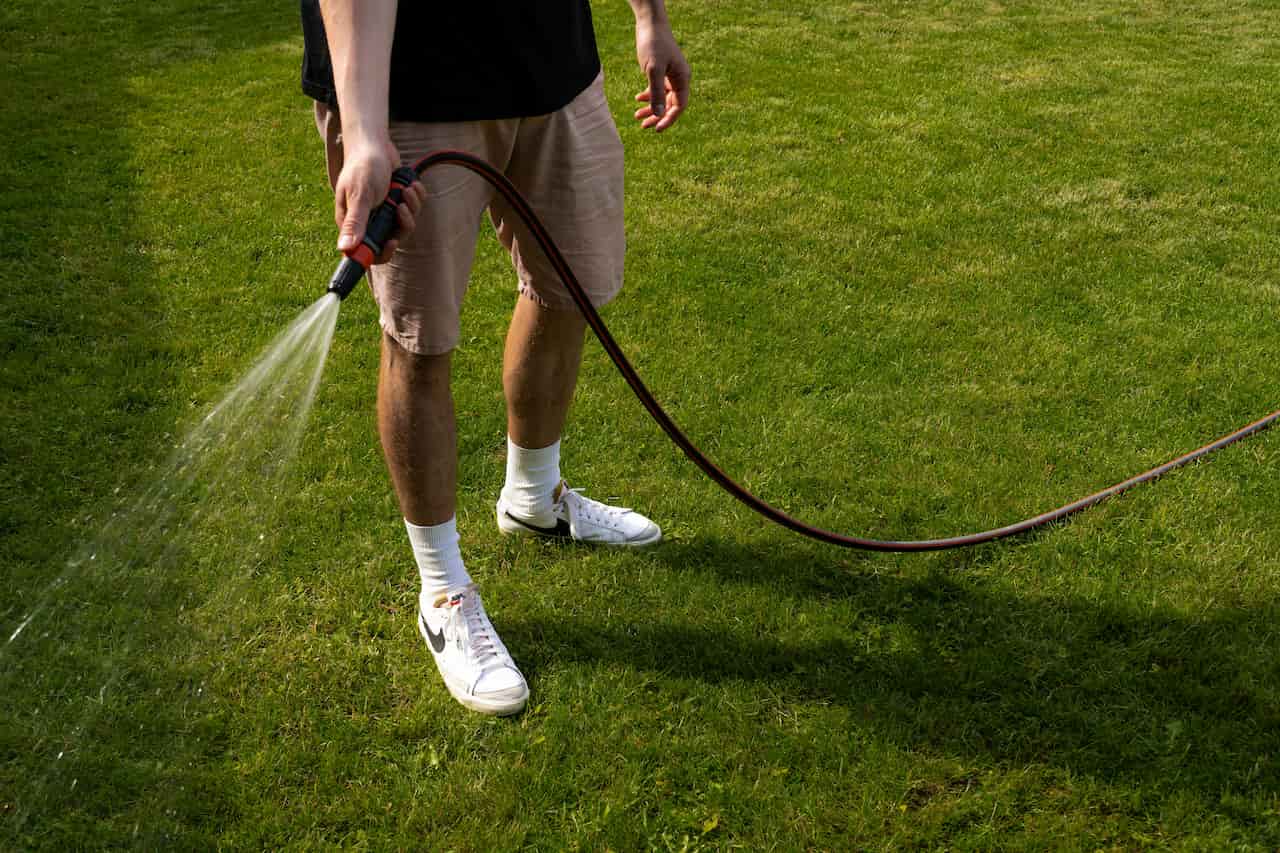
Always water in granular fertiliser immediately after application if rain is not forecast within 24 hours. Undissolved granules sitting on grass blades in contact with the leaf surface in dry conditions will draw moisture out of the grass through osmosis and cause scorch – the same process that burns slug pellets into the grass. A thorough watering immediately after spreading disperses the granules into the soil where they dissolve safely. On newly applied fertiliser that has been rained on naturally within a few hours, additional watering is not needed.
Seasonal Feeding Calendar
Common Mistakes and How to Avoid Them
Never apply lawn fertiliser at double the recommended rate to compensate for missed feeds. Doubling the rate does not produce twice the green – it produces scorch. Nitrogen at excessive concentrations draws water out of root cells through osmotic pressure, causing the grass to brown from the roots up in a process that is indistinguishable from drought stress. If you have missed a feed, apply at the normal rate and allow the lawn to recover naturally. An additional light feed two to three weeks later will accelerate recovery without risk.
Share on socials: