At a glance
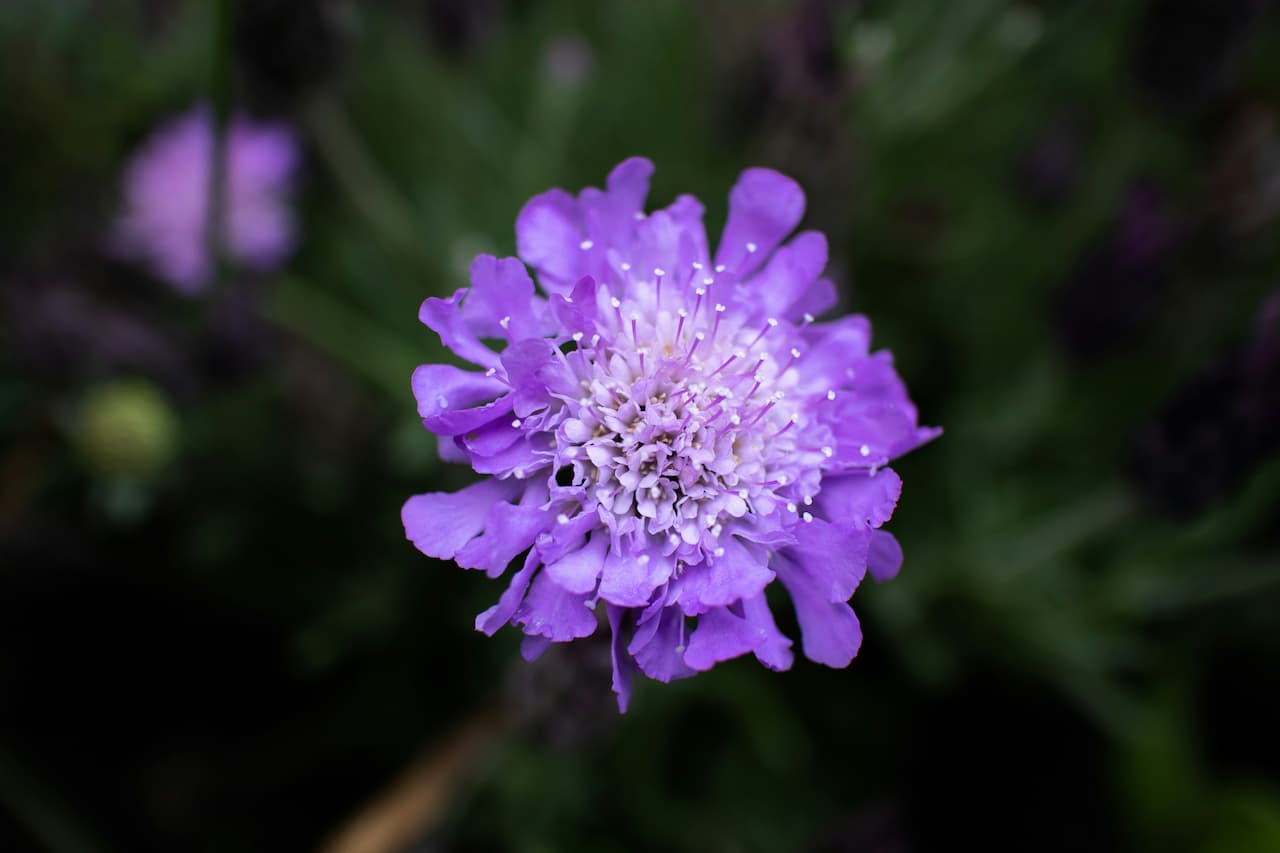
Scabious is one of the most wildlife-valuable plants you can grow in a UK garden and yet it appears far less frequently in borders than it deserves. The pincushion flowers – rounded domes of small florets in shades of blue, purple, lilac, pink and white – attract butterflies in quantities that almost no other border plant can match, and they do this while being straightforwardly easy to grow from seed, tolerant of poor dry soils where more demanding plants struggle, and willing to flower from June through October with only occasional deadheading. For wildlife gardeners in particular, scabious is a foundational plant that should feature in any border aimed at supporting late-summer pollinators.
The name scabious covers a group of related genera – Scabiosa, Knautia and Succisa – which share the characteristic pincushion flower form and broadly similar growing requirements. The most commonly grown types in UK gardens are the tall annual Scabiosa atropurpurea and its cultivars, the perennial Knautia macedonica with its deep crimson flowers, the native field scabious Knautia arvensis which naturalises beautifully in meadow-style plantings, and the compact perennial Scabiosa ‘Butterfly Blue’ which is deservedly one of the most popular front-of-border perennials available. Understanding which type suits your soil, space and design intention produces better results than choosing based on flower colour alone.
Best Varieties for UK Gardens
The variety choices within scabious are wider than many gardeners realise. Annual, biennial and perennial options cover everything from compact 30cm mound plants for front of border to tall 1-metre species suited to meadow planting and the back of naturalistic borders. The table below scores the main types across the criteria that matter most for UK garden performance.
Scabiosa atropurpurea is the annual species most frequently sold in seed catalogues, producing flowers on tall 60-90cm stems in a range that includes deep maroon, lavender-blue, salmon pink and pure white. The named cultivar ‘Tall Mixed’ is the most commonly sold form and a reliable performer. For cutting, it is one of the most useful summer annuals available – the flowers hold exceptionally well in water and the thin, branching stems mean the arrangement does not feel heavy or formal. Sow under cover from February and plant out from May, or direct sow from April where it is to flower; germination is fast and reliable at temperatures above 15°C.
For gardeners who want perennial scabious without growing from seed, pot-grown plants are widely available from UK garden centres and online suppliers from March onward. Scabiosa ‘Butterfly Blue’ and Knautia macedonica are both sold as 9cm pot plants that establish quickly when planted in spring and can flower in their first season. Division of established clumps is possible in spring or autumn – the clumps increase steadily and can be divided every two to three years to maintain vigour and produce new plants for other parts of the garden. Knautia macedonica clumps that have not been divided tend to become woody and flower less freely after five or six years, so division is useful maintenance as well as a source of propagation material.
Knautia macedonica is the perennial that most border designers reach for when they want the scabious effect without annual re-sowing. The deep crimson-red flowers are unusual in the genus – most scabious relatives are blue or purple – and they appear on wiry, branching stems from June through September, self-seeding freely enough to establish a colony over two to three seasons. It is fully hardy across the UK, tolerant of drought and poor soil, and thrives in gravel gardens and naturalistic planting schemes. The cultivar ‘Melton Pastels’ produces a mix of pink, red and lavender flowers from a single sowing.
Growing Conditions
Scabiosa caucasica deserves a mention as the traditional cottage garden perennial that was widely grown in Victorian and Edwardian gardens. It produces large, flat flower heads 8-10cm across on 60cm stems – significantly larger than most other scabious species – in pale lavender-blue or white. It is the most demanding of the species in terms of soil requirements, needing a well-drained, alkaline soil and excellent drainage, and it dislikes the acid soils found across much of northern and western Britain. In the right conditions it is long-lived and produces excellent cut flowers that last well in water. The cultivar ‘Miss Willmott’ is the most reliable white form; ‘Clive Greaves’ is the classic lavender-blue.
The wildlife value of scabious as a group is genuinely exceptional and worth emphasising for any gardener who makes ecology a priority. Research by the RHS and other organisations consistently places scabious among the top five most valuable garden plants for butterflies and hoverflies. The shallow, open flower structure of the pincushion head makes the nectar and pollen accessible to a wide range of insects – not just long-tongued species – and the long flowering season from June through October means the plant provides resources across the critical late summer and early autumn period when many other sources of nectar have finished. A mixed planting of Knautia macedonica, Scabiosa atropurpurea and Scabiosa ‘Butterfly Blue’ provides continuous flower across this entire window.
The soil preference of scabious is one of its most useful characteristics. It genuinely performs better in poor, freely draining soil than in the enriched, moisture-retentive borders that most garden plants prefer. This makes it a natural choice for chalky gardens, gravel beds, south-facing borders with sandy soil, and any area where other plants struggle from drought or thin topsoil. Clay soils can be made suitable by incorporating grit and raising the bed slightly to improve drainage, but heavy wet clay that stays cold and saturated in winter will kill perennial scabious through root rot rather than frost. Where clay soil is unavoidable, growing scabious in large containers with a gritty, well-drained compost mix is a practical alternative that gives the plant the drainage it needs while still allowing it to contribute to the garden’s wildlife value.
Seasonal Care
Growing Tips for Best Results
Plant scabious in groups of at least five. A single scabious plant produces flowers but rarely creates the butterfly-attracting effect that makes the genus so valuable for wildlife. A group of five or more of the same variety planted at 30cm spacing creates a mass of flower that is visible from a distance and builds a heat microclimate that both butterflies and other pollinators find actively attractive. The difference between one plant and five is disproportionately large in terms of wildlife value.
Share on socials: