At a glance
Thyme is one of the few culinary herbs that genuinely earns the label year-round. It is evergreen, hardy in UK conditions, and keeps its leaves and flavour through winter when most herbs have either died back or stopped producing. A well-established plant in good drainage can be harvested every month of the year, producing its best and most aromatic growth in late spring and summer when the essential oil content in the leaves peaks with the warmth. For the time and effort involved in establishing it – which is minimal – thyme offers an exceptional return.
The one requirement that thyme cannot negotiate on is drainage. This is a Mediterranean plant native to dry, rocky hillsides where rain drains away immediately and roots never sit in wet soil. Give it those conditions and it is almost indestructible. Leave it in heavy, waterlogged ground through a wet UK winter and it will rot at the roots and die. Getting drainage right is the single most important thing you can do for thyme, and the good news is that it is entirely achievable in any UK garden with basic soil preparation or a container.
Why thyme is worth growing – the perennial case
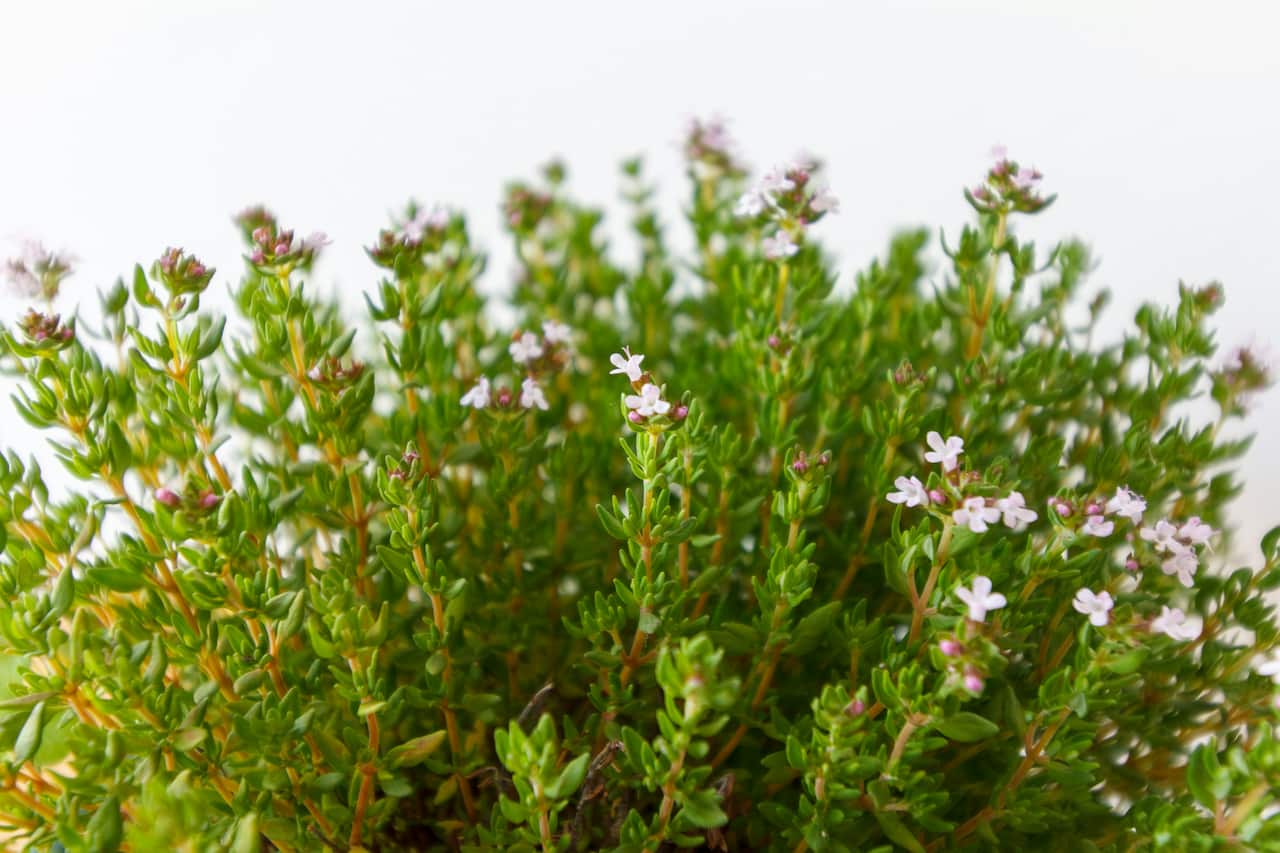
Thyme (Thymus vulgaris) is a woody-based perennial sub-shrub in the Lamiaceae family – the mint family – which also includes rosemary, lavender, sage and oregano. It is native to the western Mediterranean and was brought to Britain by the Romans, where it has been cultivated for culinary and medicinal purposes ever since. The plant forms a compact mounded or spreading bush of small, aromatic, dark grey-green leaves with small two-lipped flowers in late spring and early summer. Most commonly grown varieties reach 20-30cm tall and spread to about 40cm.
The culinary case is the most obvious one. Fresh thyme has a warm, earthy, slightly peppery flavour with sweet undertones that no dried version fully replicates. The volatile thymol oils that carry its character begin degrading the moment the stems are cut and dried – what survives in a jar of dried thyme is a fraction of what you get from a fresh sprig. Having it growing outside means you can pick a few sprigs whenever needed, with no cost and no waste. Thyme is central to bouquet garni and herbes de Provence, and is one of the most versatile cooking herbs there is, performing well with meat, fish, roasted vegetables, stocks, sauces and bread.
The garden case is equally strong. Thyme flowers prolifically in June and July, producing small clustered blooms that are among the most heavily visited by bumblebees, honeybees and solitary bees in the herb garden. Allowing plants to flower fully before cutting back provides weeks of forage for pollinators at a time when many other early summer flowers have already faded. Creeping thyme varieties form dense, fragrant mats that release their scent when stepped on, making them one of the best choices for filling gaps in paving, edging gravel paths or covering ground between stepping stones.
Varieties for UK gardens
The thyme family is large and varied, but for UK gardens the practical choice is between a handful of types based on how you plan to use them. The key distinction is between upright shrubby varieties grown primarily for cooking and low-growing creeping varieties grown mainly as ground cover or decorative plants.
For a kitchen herb bed, common thyme is the foundation and lemon thyme is the most useful addition. Common thyme covers all the classic applications – bouquet garni, roasts, stocks, herb breads – while lemon thyme opens up fish, chicken and lighter summer dishes where the citrus note complements rather than competes. T. pulegioides is worth considering if you want variety; its rounded leaves have an excellent flavour that some cooks prefer to common thyme. Creeping thyme is grown for a different purpose entirely – it is a garden plant first and a culinary herb second, with leaves too small and flavour too mild for regular cooking use, but unbeatable as a fragrant mat between paving stones or along path edges. Named cultivars like ‘Silver Posie’ (silver-edged leaves) and ‘Aureus’ (golden-edged) are primarily ornamental but fully edible.
All thyme varieties grow from seed slowly and named cultivars in particular may not come true from seed, so buying plants from a garden centre or herb nursery is usually the faster and more reliable option. Seed sowing is worth trying for common thyme if you want quantity: sow on the surface of gritty compost in March (thyme seed needs light to germinate, so do not cover), keep at around 18°C, and expect germination in 2-4 weeks. Plants from seed need a full growing season before they are ready to harvest seriously.
Soil, drainage and planting
Thyme’s requirements are essentially the inverse of most vegetables and many other herbs. Where a vegetable plot wants rich, moisture-retentive, fertile soil, thyme wants lean, gritty, fast-draining ground. Rich soil in full sun encourages lush, rapid growth that dilutes the essential oils and makes leaves less aromatic. Lean soil slows growth, concentrates the thymol compounds, and produces more intensely flavoured leaves. This is why thyme growing on a sunny, impoverished, south-facing bank often smells and tastes far more strongly than the same plant in a well-cultivated border.
On heavy clay soil, the practical options are either to build a raised bed or to improve a planting pocket significantly by removing a good volume of the existing soil and backfilling with a mix of garden soil, horticultural grit and coarse sand. The aim is a planting medium that drains fast enough that no puddle sits on the surface for more than a few minutes after rain. In containers, use two thirds peat-free multipurpose compost mixed with one third horticultural grit, and always ensure drainage holes are clear and unobstructed. A layer of crocks or coarse gravel at the base of the pot helps.
Plant container-grown thyme from spring through to early autumn. Space upright varieties 30-40cm apart; creeping varieties can be planted more closely at 20-25cm as ground cover. Firm in well and water once after planting. After that initial watering, leave established plants alone – thyme does not need or benefit from regular irrigation. In fact, overwatering is one of the most common ways to kill thyme in the first season. Water only during prolonged dry spells in summer, and only then for plants in containers, where the restricted root volume dries out faster than in-ground plants.
Propagate from cuttings for free plants. Take 8-10cm softwood cuttings in May or June, strip the lower third of leaves, and push into gritty compost. Keep in a warm sheltered spot – no propagator needed. Roots develop within 4-6 weeks and cuttings can be potted on or planted out the following spring. This is the best way to replace ageing woody plants and build up stock quickly at no cost.
Ongoing care and watering
Once established, thyme is one of the least demanding plants in the garden. The main ongoing tasks are watering containers during dry spells, watching for the early signs of woodiness that signal a plant needs pruning, and protecting in-ground plants in very wet winters. There is no feeding regime to follow – thyme in fertile soil grows too lush and loses flavour, so feeding is actively counterproductive. In a container, where nutrients leach out over time, a single dilute feed in spring with a balanced liquid fertiliser is sufficient and should not be repeated.
Winter management is primarily about preventing the only real threat: waterlogging. In high-rainfall areas or during particularly wet winters, a low cloche or glass pane placed over in-ground plants provides protection. Container plants are best moved to a rain-sheltered spot – under an overhang, against a south-facing wall, or into an unheated greenhouse or porch. The goal is not to keep them warm but to reduce the volume of water reaching the roots. Cold is fine; wet is not. Most named varieties of common thyme and lemon thyme are rated H4-H5 and will come through a normal UK winter without any protection at all as long as the drainage is right.
A note on growing from cuttings versus seed: taking softwood cuttings from an established plant in May or June is the fastest and most reliable way to get new plants. Strip the lower third of an 8-10cm cutting, dip in rooting hormone if available, and push into a mix of compost and grit. Keep in a sheltered spot out of direct midday sun. Roots form within four to six weeks and cuttings can be potted on by late summer, with plants ready to go into their final position the following spring. This is also the correct approach when replacing old woody plants – rather than attempting a hard renovation prune, take cuttings in early summer, let them root through autumn, and discard the old plant once the replacements are established.
Pruning – keeping plants productive
Pruning is the most important ongoing task for thyme after drainage. Without regular trimming, upright varieties become woody and sprawling within a few years – the base of the plant develops thick, lignified stems with few leaves, and the productive leafy tips migrate outward and upward until the plant is an ungainly mound of bare wood with a fringe of growth around the edges. This process can be slowed significantly, and productive life extended by several years, with timely annual pruning.
The critical rule for pruning thyme is never to cut back into old brown wood. Unlike some woody herbs, thyme does not reliably regenerate from bare lignified stems – cutting into old wood risks producing a dead stub rather than new growth. Always prune into the soft green growth, leaving some leaves on every stem you cut. If a plant has become very woody and the green growth is too far out to prune effectively without cutting into bare wood, the right response is to take cuttings and replace it rather than attempt a hard renovation prune.
Harvesting, using and storing thyme
Pick sprigs of thyme as needed throughout the year, snipping the soft stem tips with scissors or pinching them off with your fingers. The best flavour comes from the young leafy growth in late spring and summer, when the essential oil content is at its peak. Winter growth is thinner and the flavour slightly milder, but still perfectly usable – the evergreen nature of thyme means there is always something to pick.
Regular harvesting doubles as light pruning and actively benefits the plant by encouraging bushier, more productive regrowth. Picking frequently through spring and summer – even if you do not immediately need the leaves – is good practice for plant health as well as kitchen supply. Never remove more than a third of the plant at any one time, and always leave green growth on every stem.
Thyme stores better than most soft herbs. Whole sprigs keep well in a glass of water at room temperature for several days, or loosely wrapped in damp kitchen paper in the refrigerator for up to a week. For longer storage, drying works better for thyme than for most herbs – the woody stems and leathery small leaves hold their essential oils through drying far better than soft-leafed herbs like basil or chervil. Hang bunches in a warm, well-ventilated, dry spot for one to two weeks until fully dry, strip the leaves from the stems and store in a sealed jar. Dried thyme is a reasonably good substitute for fresh in long-cooked dishes, though not in fresh or lightly cooked applications.
Common problems
Thyme’s problem list is short – it is a naturally tough, pest-resistant plant. Most issues trace back to the two fundamental needs that are not being met: drainage and sunlight.
The companion planting value of thyme is worth noting for growers who use this approach. Thyme planted near brassicas is said to deter cabbage white butterflies, and its strong scent may confuse some pests that navigate by scent. Whether or not these effects are significant, the dense ground-hugging growth of creeping thyme between taller plants reduces bare soil, suppresses weeds and provides shelter for ground beetles and other beneficial predators. It earns its place in a mixed kitchen garden on these grounds alone, in addition to everything it offers as a culinary herb.
Share on socials: