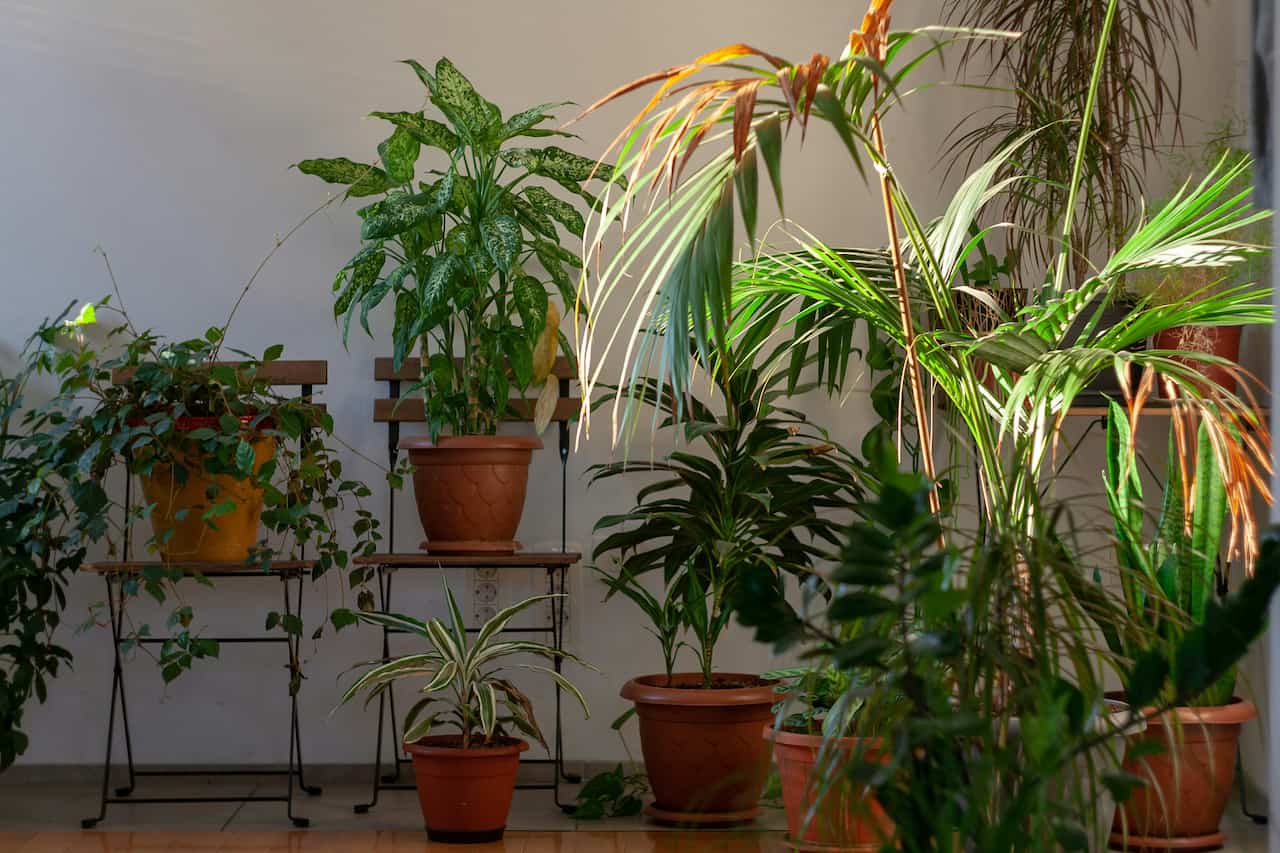
The vast majority of indoor plants that die in UK homes fail for one of three reasons: too much water, not enough light, or no feeding at all. These are not problems caused by complicated plant science – they are simple habits that, once understood, make the difference between a thriving plant and a slowly declining one. The good news is that most houseplants are surprisingly forgiving if you get the basics right, and recovering a struggling plant is usually straightforward once you identify what has gone wrong.
This guide covers the fundamentals that apply across virtually every houseplant you will grow in a UK home – how to water correctly, how to read light levels in different rooms through the year, when and how to feed, when repotting is needed, and how to recognise and deal with the most common pests. It also addresses the specific challenges that UK conditions create – our low winter light levels, central heating drying the air, and the temperature swings that come with rooms that are warm during the day and cold at night near windows.
Watering – the Most Important Habit
Overwatering kills more houseplants in the UK than any other single cause – not because gardeners water too frequently in terms of calendar days, but because they water without checking whether the plant actually needs it. The correct approach is to water in response to the plant’s condition, not to a fixed schedule. For most houseplants, this means checking the compost with your finger before watering: if the top 2-3cm of compost is still moist, the plant does not need water yet. If it is dry to that depth, water thoroughly until water runs freely from the drainage holes, then allow the excess to drain away completely before replacing the pot in its saucer.
Watering frequency by plant type – UK conditions
Plant type
Summer
Winter
Key rule
Tropical foliage (monsteras, pothos)
Every 7-10 days
Every 14-21 days
Check first
Succulents and cacti
Every 14 days
Monthly or less
Dry completely
Ferns and moisture lovers
Every 4-5 days
Every 7-10 days
Keep moist
Snake plants, ZZ plants
Every 14-21 days
Monthly
Almost drought-proof
The single most useful habit to develop is lifting the pot before and after watering. A pot that feels light relative to its size is dry at the roots; a pot that feels heavy is still carrying moisture. This is faster and more reliable than checking compost with a finger, especially for plants in decorative pots where the compost surface is hard to reach. Plants in terracotta pots dry out faster than those in plastic or glazed ceramic, because terracotta is porous and loses moisture through the sides as well as the surface – adjust your checking frequency accordingly.
⚠️Never leave a pot sitting in a saucer of water. Many houseplants will tolerate short periods of standing water, but roots left sitting in water for more than a day or two begin to rot. After watering, allow excess to drain freely then empty the saucer. The exception is for plants like peace lilies that actively prefer consistently moist roots – even these should not sit in a permanently flooded saucer.
Light Levels – Matching Plants to Positions
Light is the resource most consistently mismatched in UK homes. A room that feels bright to human eyes may provide only a fraction of the light intensity that a plant needs for healthy growth. The further a plant is from a window, the more dramatically the light level drops – even moving a plant from 1 metre to 3 metres from a south-facing window can reduce the light it receives by 75% or more. In the UK, this matters particularly in winter, when even south-facing rooms receive only a few hours of usable light per day.
Light level
Position in home
Suitable plants
Bright direct
Within 30cm of S/SE window
Cacti, succulents, herbs
Bright indirect
1-2m from S/E/W window
Monsteras, pothos, spider plants
Medium indirect
2-3m from window or N-facing
Snake plants, ZZ, cast iron
Low light
Dark corners, windowless rooms
Very few – consider grow lights
In UK winters, even plants described as suitable for “bright indirect light” may struggle if positioned more than a metre from a window. The practical response is to move plants closer to windows between October and March, rotating them back to their summer positions as the days lengthen in spring. A plant that sits happily on a shelf in June may need to be on the windowsill by December. If this is not possible, a basic LED grow light on a timer for 12-14 hours per day can maintain healthy growth through the darkest months for a modest electricity cost.
Amazon
Indoor plant care essentials – UK picks
As an Amazon Associate I earn from qualifying purchases. Prices correct at time of publishing.
Feeding and Fertilising
Most houseplants in the UK are never fed at all, which is one reason why they grow slowly, produce small leaves and gradually decline despite adequate watering and reasonable light. A plant growing in a pot has access to a fixed volume of compost, and the nutrients in that compost are depleted over months by the plant’s roots. Once the compost is exhausted – which typically happens within six to twelve months of potting – the plant has nothing left to draw on except what the gardener provides.
Feeding rules – when and how much
1
Feed only during the growing season – March to September in UK conditions. In winter, most houseplants slow or stop growth entirely. Feeding a dormant plant does not accelerate growth; it builds up salt deposits in the compost that can damage roots.
Critical
2
Use a balanced liquid fertiliser at half the recommended dose, applied every two to four weeks. Half-dose feeding applied regularly is significantly better for plants than full-dose feeding applied infrequently. It prevents nutrient spikes that can scorch roots and provides a steady supply throughout the growing period.
Key tip
3
Foliage plants need a higher nitrogen ratio (N-P-K with N highest). Flowering plants and those kept primarily for their display need higher phosphorus and potassium. A general balanced feed works for both but a specialist flowering feed will improve blooms on plants like peace lilies, orchids and anthuriums.
Useful
4
Always water before feeding if the compost is dry. Applying liquid fertiliser to bone-dry compost concentrates the salts and increases the risk of root burn. A well-moistened root zone absorbs diluted feed more evenly and safely.
Good practice
When and How to Repot
Repotting is needed when a plant has outgrown its current container – roots emerging from drainage holes, roots circling visibly at the surface, the plant drying out far faster than it used to, or growth that has slowed significantly despite adequate light and feeding. The best time to repot is in spring, when plants are entering their growing season and can quickly establish in fresh compost. Avoid repotting in winter when plants are dormant – disturbing roots at this time slows recovery and increases the risk of root rot in the cold, wet compost.
Step 1
Choose the right size pot. Go up one size only – typically 2-4cm larger in diameter than the current pot. A pot that is too large holds excess wet compost around the roots, which promotes rot. The plant needs to fill its pot with roots before going up again.
Step 2
Use the right compost. Standard multi-purpose compost holds too much moisture for most houseplants – mix it with perlite or horticultural grit at a ratio of roughly 3:1 compost to perlite. Succulents and cacti need a specialist free-draining mix or a 1:1 ratio.
Step 3
Loosen roots gently. Remove the plant from its old pot, tease apart any tightly circling roots with your fingers, and remove as much old compost as practical without damaging the root ball. This encourages roots to spread into the new compost rather than continuing to circle.
After care
Water well and wait. Water thoroughly after repotting to settle the compost and eliminate air pockets. Place out of direct sun for a week to allow root recovery. Do not feed for four to six weeks – fresh compost contains enough nutrients, and feeding too soon can stress already-disturbed roots.
Common Pests and How to Deal with Them
Common houseplant pests – identification and treatment
Fungus gnats. Tiny flies hovering around the compost surface – the larvae feed on roots in wet compost. Allow compost to dry out further between waterings, top-dress with a layer of horticultural grit to prevent adults laying eggs, or use sticky yellow traps to reduce adults. Nematodes watered into compost eliminate larvae.
Common
Spider mites. Fine webbing on the undersides of leaves, with stippled or yellowing foliage. Favoured by hot dry conditions near radiators. Increase humidity around the plant, wipe leaves with a damp cloth, or treat with a plant-safe insecticide. Repeating treatment twice at seven-day intervals breaks the life cycle.
Common
Mealybugs. White fluffy deposits at leaf axils and stem joints. Remove with a cotton bud dipped in rubbing alcohol, or treat the whole plant with a solution of diluted washing-up liquid and water. Persistent infestations may need a systemic insecticide. Check any new plant carefully before placing it near others – mealybugs spread readily.
Stubborn
Scale insects. Brown or tan oval bumps on stems and the undersides of leaves, which are the protective shells of the insects feeding beneath. Scrape off with a fingernail or soft toothbrush, then wipe the area with diluted rubbing alcohol. Scale is slow to spread but difficult to eradicate completely once established.
Manageable
Seasonal Care in UK Homes
UK conditions create specific seasonal challenges for houseplants that go beyond what standard care guides written for other climates address. Our winters are darker than almost anywhere else in Europe at similar latitudes, and our central heating systems create warm, dry air that stresses many tropical plants adapted to humid conditions. Understanding how to adjust care through the year is as important as getting the basics right.
Spring
Resume feeding as day length increases past 12 hours – usually mid-March in most of England, later in Scotland. This is the best time to repot, propagate, and move plants to their summer positions. Check for pests that may have established over winter in the warm house.
Summer
Active growing period – water more frequently and feed every two to four weeks. Watch for spider mites in hot sunny spells near windows. Open windows on warm days to increase humidity and air circulation. Move sun-sensitive plants back from south-facing windows if leaves show scorching.
Autumn
Taper off feeding from late September. Reduce watering frequency as growth slows. Move plants away from cold windowsills as night temperatures drop – temperatures below 10 degrees stress most tropical houseplants and below 7 degrees can cause irreversible cold damage to tender species.
Winter
Stop feeding entirely from October to February. Water sparingly – many houseplants need only a third of their summer water intake. Move plants closer to windows to maximise the limited winter light. Use a humidity tray (a saucer of wet pebbles beneath the pot) if heating is drying the air significantly.
Diagnosing Common Problems
Symptom diagnosis – cause and fix
Symptom
Most likely cause
Fix
Yellow leaves all over
Overwatering or root rot
Check roots, repot in fresh compost, reduce watering
Pale, washed-out leaves
Too much direct sun
Move further from window or add shade
Leggy, stretched growth
Insufficient light
Move closer to window or add grow light
Brown leaf tips
Low humidity or fluoride in tap water
Use rainwater or filtered water, increase humidity
Wilting despite wet compost
Root rot – roots cannot absorb water
Repot immediately, cut rotted roots, dry out
💡Group houseplants together to create a microclimate. Plants transpire moisture through their leaves, and a group of plants in proximity creates a more humid local environment than isolated individual plants. This is particularly beneficial in winter when central heating dries the air significantly. Grouping also makes it easier to mist several plants at once and gives pests fewer isolated positions to establish undetected.
Amazon
Indoor plant care essentials – UK picks
As an Amazon Associate I earn from qualifying purchases. Prices correct at time of publishing.