At a glance
Lemon balm is one of those herbs that earns genuine affection from gardeners who grow it well, and mild exasperation from those who did not think carefully enough about where they put it. The fresh, clean lemon fragrance the leaves release when brushed is one of the most immediately pleasant scents in any herb garden – uplifting in a way that more complex aromas are not – and the plant provides that fragrance generously, from the first new growth in spring right through until the frosts cut it back in late autumn. It makes exceptional herbal tea. It is a reliable bee plant. It grows on almost any soil, tolerates light shade, survives the coldest UK winters without any protection, and will be with you for decades once established. A well-sited and properly managed lemon balm plant is genuinely one of the best-value plants in a herb garden.
The complication is that lemon balm is a member of the mint family, and it shares mint’s fundamental characteristic: it spreads, vigorously and persistently, and it does not stop unless you physically contain it. Left to its own devices in open ground, a single lemon balm plant can colonise a square metre or more within two to three seasons, spreading both through underground runners and through prolific self-seeding. The seeds are lightweight and carried by wind, and a large plant in full flower produces thousands of them. This does not make lemon balm a bad garden plant – it makes it a plant that needs thinking about before you dig the hole, not after it has taken over the herb bed. Understand and deal with the containment question from the start and everything else about growing lemon balm is genuinely straightforward.
What lemon balm is – and why containment matters from day one
Lemon balm (Melissa officinalis) is a hardy herbaceous perennial native to the mountainous regions of southern Europe and western Asia, now naturalised across much of the temperate world. It belongs to the Lamiaceae family – the mint family – alongside thyme, sage, oregano, lavender and mint itself, all of which share the family’s characteristic aromatic leaves and square stems. The genus name Melissa is the ancient Greek word for honeybee, which tells you immediately about the plant’s relationship with pollinators: the small white to pale yellow flowers it produces in summer are rich in nectar and irresistible to bees. The common name “bee balm” is used interchangeably with lemon balm in many older gardening texts, and both names reflect the same reality.
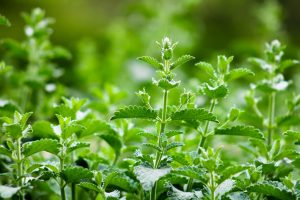
The plant grows as a clump of upright stems reaching 60-80cm tall in summer, sometimes taller in very rich or moist conditions. The broadly oval, toothed leaves have a notably wrinkled, crinkled texture that distinguishes them from most other herbs. The lemon scent is released by crushing or brushing the leaves and comes from essential oils – primarily citronellal – concentrated in glands on the leaf surface. This citronellal also gives the plant mild insect-repellent properties, which is why it has historically been used as a natural deterrent for some insects even as it draws bees in large numbers. The plant is fully hardy throughout the UK (H7, to -15°C), dies back to ground level each autumn and regrows strongly each spring. A well-established lemon balm clump can live for twenty to thirty years.
The spreading behaviour is worth understanding in detail because it determines how you manage the plant. Lemon balm spreads by two mechanisms that operate on different timescales. The underground runners extend outward from the main clump and produce new shoots at intervals, typically reaching 30-50cm from the parent plant in a season in good conditions. This underground spread is persistent and resumes each spring regardless of how hard the plant was cut back the previous season. The second mechanism – self-seeding – works over a longer timescale but at a greater distance. A plant allowed to flower and set seed produces large quantities of lightweight seeds that disperse widely. Self-sown seedlings appear throughout the garden in subsequent years, particularly in disturbed ground, cracks in paving, and at the base of walls and structures. Once a self-seeded colony is established in a new area it requires significant effort to eradicate completely, because the roots are established in the soil and regrow readily from fragments.
The practical lesson is that containment must be installed before the plant goes in the ground, not retrofitted later. A sunk pot barrier – a large plastic bucket or pot with the base removed, sunk flush with the soil surface – restricts underground spread to the interior of the container while allowing normal growth and harvest. Growing in a genuine above-ground container does the same job more reliably. Neither approach prevents self-seeding, so cutting the flowering stems off before the seed ripens is the second half of the containment strategy. Do both and lemon balm stays where you want it indefinitely.
Varieties worth knowing
The standard species (Melissa officinalis) is the most vigorous and produces the strongest lemon scent and flavour. Several named varieties exist and are worth knowing about, particularly for gardeners who want something ornamental as well as culinary, or who need a more compact plant for containers.
The golden and variegated varieties (‘All Gold’ and ‘Aurea’) are genuinely attractive ornamental plants and work well at the front of a sunny border where their bright foliage lights up a planting scheme. Both retain culinary value – the lemon scent and flavour are present and usable – though neither is quite as intensely aromatic as the standard species. Importantly, named varieties may not come true from seed: self-sown seedlings from golden-leaved parents typically revert to plain green. If maintaining the golden form matters to you, deadhead consistently to prevent self-seeding and propagate by division rather than seed. ‘Compacta’ is the variety to seek out for container growing where the standard species would outgrow its space – it reaches around 40cm rather than 80cm and is more manageable in restricted conditions. ‘Lime Balm’ has a distinct citrus character that differs noticeably from the standard lemon scent, and is interesting for culinary experimentation though less widely available than the others.
Starting and planting lemon balm
Lemon balm can be started from seed, bought as a young plant, or obtained as a division from an established clump. Each approach has different timescales and reliability profiles, and the right choice depends on how quickly you want results and what you have access to.
Starting from seed is the slowest route. Lemon balm seeds germinate erratically and slowly – they need light to germinate (sow on the surface, not buried), a consistent temperature of around 18-20°C, and patience: germination can take two to four weeks and not all seeds will germinate even under good conditions. The resulting seedlings grow slowly initially. For most gardeners starting from a single plant or a small clump of established plants, sowing from seed adds weeks of waiting with uncertain results compared to simply buying a small plant in spring. One exception: seed is the most economical option if you want several plants for a hedge, edge planting, or large area, where buying multiple established plants would be expensive.
The fastest and most reliable approach is division of an established clump. If a neighbour or fellow gardener has lemon balm – and in most gardens lemon balm is available for the asking, since anyone who has it has more than they need – a fist-sized division with a good root system will establish within weeks of planting in spring. Pot the division into fresh compost immediately after lifting, water well, keep in a sheltered spot for a week or two, then plant out into its prepared and contained site. Spring and autumn are both suitable times for division, though spring-planted divisions have the full growing season ahead to establish before their first winter.
Whatever the starting method, the containment decision must be made before the plant goes in. The three practical approaches each have distinct advantages depending on garden situation.
Growing conditions and seasonal care
Lemon balm is adaptable and forgiving compared to most Mediterranean herbs. It does not demand the sharp drainage and full sun that thyme, rosemary and marjoram require, and it grows in a wider range of soils and light conditions than almost any other herb in a UK garden. This adaptability is part of what makes it so easy to grow well – and part of what makes it so difficult to eradicate once unwanted.
The relationship between soil fertility and leaf quality in lemon balm is worth understanding. Like many aromatic herbs, lemon balm produces the most intensely scented leaves when growing in conditions that are moderately lean rather than very fertile. In very rich soil – heavily composted beds, for example – the plant produces abundant but less intensely fragrant foliage, because the essential oil concentration is diluted by rapid lush growth. This does not mean starving the plant: it grows in whatever soil is available and performs acceptably across a wide range. But if you have the choice, a reasonably ordinary garden soil is better than a heavily amended one for maximum aromatic quality. Container-grown plants fed regularly with high-nitrogen fertiliser produce leafy growth that looks good but tastes and smells relatively weak.
In partial shade lemon balm grows well and is somewhat less prone to bolting to flower than in full sun, giving a slightly longer harvest window of prime leafy growth before the plant turns its energy to flowering. The golden-leaved varieties (‘All Gold’ and ‘Aurea’) actually prefer partial shade – the golden colouring is more vivid and less prone to scorching in dappled light than in full summer sun. The standard green species handles full sun comfortably and flowers more freely in it, which is either a benefit (more nectar for bees) or a nuisance (more seed to manage), depending on your priorities.
Dividing the main clump every two to three years is important for maintaining a vigorous, productive plant. Lemon balm clumps that are never divided become dense and woody at the centre over time, with the most vigorous new growth confined to the edges. Division renews the plant by removing the old woody centre and replanting only the vigorous outer portions. It also gives you additional plants to share, establish in new positions, or pot up for growing on indoors through winter for a year-round leaf supply. Division is straightforward: lift the whole clump with a garden fork, pull or cut it apart into fist-sized sections each with a good root system, discard the woody centre, and replant the outer portions into fresh composted soil.
Harvesting and uses
Lemon balm leaves are at their most aromatic and flavourful in the period before the plant comes into flower – the volatile oils that give the plant its character are concentrated highest in young, actively growing leaves in late spring and early summer. Once the plant flowers, the essential oil content drops as energy is redirected to seed production, and the flavour of the leaves becomes less vivid. The solution is to harvest regularly throughout the season, and to cut the plant back hard when flower buds appear to reset it to leafy growth. After cutting back, wait two to three weeks for the new growth to reach a usable size, then harvest again. This cycle can be repeated two or three times through a UK summer.
For fresh use, pick individual leaves or small stems as needed. For larger harvests intended for drying, cut stems back to 10-15cm above ground on a dry morning after any dew has evaporated. Spread cut stems on a flat rack or tie in loose bunches and hang in a warm, dry, ventilated place out of direct sunlight. Lemon balm dries within a week or two in good conditions. Strip leaves from dried stems and store in an airtight jar. Dried lemon balm retains reasonable flavour for six to twelve months, though fresh is noticeably more aromatic – the drying process degrades some of the volatile oils that carry the lemon character.
Common problems
Lemon balm is one of the most disease-resistant herbs available for UK gardens. The problems that do occasionally occur are generally minor, and the most significant “problem” – its spreading behaviour – is a management issue rather than a pest or disease. If the plant is properly contained and regularly cut back, most of the difficulties that UK gardeners encounter with lemon balm simply do not arise.
Powdery mildew appears on lemon balm leaves in dry conditions, particularly in late summer when plants are stressed by heat and water deficit. It does not kill the plant and can be managed simply by cutting the affected stems right back to the base – the plant regrows cleanly and the mildew does not persist on the new growth. Good air circulation around the plant reduces the risk; avoid planting lemon balm against south-facing walls where hot, still conditions prevail. Aphid infestations on young spring growth are usually self-limiting – natural predators arrive within a few weeks and clear the colony without any intervention. For a plant you intend to eat from, a blast of water from the hosepipe is preferable to any pesticide treatment, and it is usually entirely sufficient.
The two management problems – spreading and flavour loss from flowering – are both entirely within a gardener’s control. Install the containment before planting and cut the plant back hard before it flowers, and neither becomes a genuine problem. Neglect both and the plant will gradually become both invasive and less useful, which is the experience that gives lemon balm its reputation for being difficult. It is not difficult; it simply requires those two specific interventions done at the right time.
Share on socials: