At a glance
Rhubarb is one of the most dependable plants you can grow in a UK garden or allotment. Hardy enough to survive almost any British winter, productive enough to yield substantial harvests for months, and once established it largely looks after itself. A well-sited rhubarb crown will outlast most other plants in the garden and continue producing reliably for ten, fifteen or even twenty years. The main requirements are patience in the first year and a willingness to leave it alone while it establishes before the real harvesting begins.
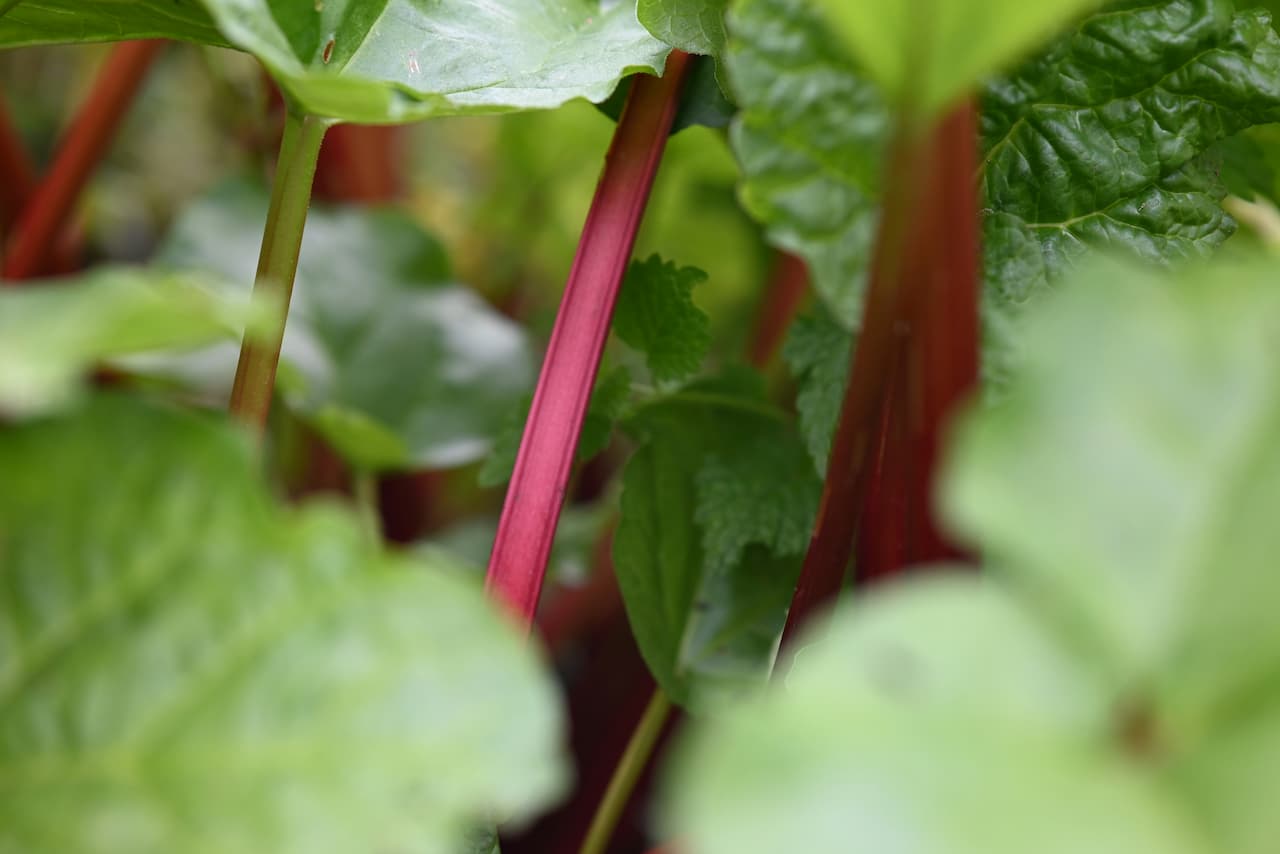
Botanically rhubarb is Rheum x hybridum, a vegetable grown for its thick leaf stalks rather than any fruit. The large leaves are toxic and must never be eaten or fed to animals – only the stalks are edible. This is one of the few areas of rhubarb growing where there is a genuine safety consideration. Once the leaves are stripped from harvested stalks, the stems themselves are straightforward to cook with and keep well in the fridge for several days.
Choosing a site
Rhubarb is more tolerant of site conditions than many vegetables, but it has genuine preferences that translate into real yield differences. Full sun or partial shade both work, but a position that gets good morning sun while avoiding the most intense afternoon exposure tends to produce the longest season of quality stalks. A south-facing wall is too exposed in summer; the north side of a fence is too shaded for consistent growth. The best positions have open sky but are not exposed to all-day direct sun.
Because rhubarb is permanent – a well-established crown should not need to move for ten to fifteen years or more – it is worth spending time choosing the right site before planting rather than discovering a problem after the fact. A position that works well for the first three or four years and then becomes progressively more shaded as a neighbouring hedge or tree matures is a common and frustrating mistake. Stand in the chosen position in midsummer and observe where shadows fall over the course of the day before committing to it.
Soil requirements are straightforward: rich, moisture-retentive but free-draining, with a pH between 5.5 and 7.0. Rhubarb does not tolerate sitting in waterlogged ground over winter, but it needs consistent moisture through the growing season. On heavy clay, a raised bed or a position on a slight slope where water drains away is ideal. On light sandy soils, the priority is building organic matter content to retain moisture through dry spells. Rhubarb is also one of the few productive garden plants that genuinely benefits from cold winters – the crowns require a period of cold exposure to break dormancy and produce strong growth in spring, which makes it naturally well-suited to UK conditions. This cold requirement also means that rhubarb performs reliably across most of Britain, including the cooler midlands and north where some other productive perennial crops struggle.
Varieties
The most widely grown UK varieties cover the season from late winter through to June. Choosing one early and one mid-season variety gives the longest possible harvest window and also spreads the workload of forcing if you choose to do it. The varieties below are all widely available as bare-root crowns in late winter and as potted plants in spring from UK suppliers.
Timperley Early is the first choice for growers who want the earliest possible harvest. In a mild year it produces slender, tangy-flavoured stalks from late February or early March outdoors, or from late January when forced. It is less vigorous than Victoria once fully established, but the season advantage it provides is significant for any kitchen where rhubarb is used regularly. Victoria is the benchmark variety – reliable, high-yielding, and producing thick red-green stalks with the classic strong flavour most people associate with garden rhubarb. It is the most widely grown variety in the UK for good reason and performs well across a wide range of soil types and conditions. Champagne is grown partly for its attractively deep-red colour and relatively tender texture, popular for desserts where appearance matters. Livingstone is later in the season and more disease-resistant than the earlier varieties, useful for extending the harvest window and for growers in areas with higher disease pressure.
Planting and establishment
Rhubarb is almost always planted as crowns – the thick, woody root sections with dormant buds – rather than grown from seed. Seed-grown rhubarb is unreliable in its characteristics and takes considerably longer to reach harvestable size. Crowns give a known variety with predictable flavour and colour, and in favourable conditions they can be harvested lightly in their second year.
Bare-root crowns are available from late autumn through to early spring from most UK nurseries and online suppliers. The best time to order is late winter for immediate planting. Avoid crowns that appear dried out, have soft or discoloured areas at the base, or show only one very small bud – you want a crown with several visible growth points and a healthy, firm root system. Potted rhubarb plants are also available in spring from garden centres, though they tend to be more expensive and the range of varieties is usually more limited than from specialist suppliers. Planting bare-root crowns in late winter or very early spring – before the buds begin to swell – gives the best establishment rates, as the plant transitions directly from dormancy into active growth in its permanent position without the shock of being moved in leaf.
Plant bare-root crowns between late autumn and early spring while the soil is not frozen. The ideal timing is late winter to early spring, just before the buds begin to swell. Before planting, prepare the ground thoroughly: dig in a generous quantity of well-rotted manure or compost – rhubarb is a greedy feeder and the preparation done now pays dividends over the whole productive life of the plant. A generous bucketful of manure per planting hole is not excessive.
Prepare the ground
Dig to a spade’s depth and work in a generous amount of well-rotted manure or compost. Remove all perennial weed roots.
Dig the planting hole
Make the hole wide enough to spread the roots without cramping or bending them. Space holes at least 90cm apart – 120cm is better for large varieties like Victoria.
Set the crown at the right depth
The growing bud should sit at or just above the soil surface. Burying the bud too deep is the most common cause of slow establishment. Spread the roots out below the bud naturally.
Firm in and water
Firm the soil around the crown to eliminate air pockets and water well. Apply a mulch of compost around the plant to retain moisture and suppress weeds.
Leave it alone in year one
Do not harvest any stalks in the first year. Take only a very light harvest in year two. Full harvesting begins in year three when the crown is properly established.
Forcing for early stems
Forcing is the practice of excluding light from the crown in winter to produce blanched, pink, exceptionally tender stalks three to four weeks earlier than the outdoor season allows. It works by exploiting the plant’s tendency to stretch rapidly towards any available light: deprived of it entirely, the stalks elongate quickly, remain pale and tender, and develop a sweeter, more delicate flavour than outdoor stalks because the reduced light also lowers the oxalic acid content that gives rhubarb its characteristic sharpness.
The most common method is to place an upturned dustbin, terracotta forcer, or large pot over the crown in January, plugging any holes to exclude all light. The warmth and darkness inside causes the stalks to grow rapidly. After three to four weeks – typically from late February through March depending on the weather – the stalks are ready to harvest. Check periodically by lifting the edge of the cover; when the pale pink stalks are 30-40cm tall with small, tightly folded leaves, they are ready.
Only force established crowns that have been growing for at least two or three years. Young crowns do not have sufficient energy reserves. Forcing also depletes the crown significantly, so a plant that has been forced should not be forced again for at least two to three years. Rotating forcing duties between several crowns – forcing one per year and leaving the others to grow normally – avoids depleting any single plant. After forcing, remove the cover and allow the crown to grow normally for the rest of the season; this recovery period is essential for maintaining the crown’s long-term productivity.
The stalks produced by forcing are noticeably different from outdoor stalks in ways that matter in the kitchen as well as the garden. They are paler, with deep pink rather than red colouring, significantly more tender, and sweeter in flavour because the reduced light suppresses the oxalic acid that gives outdoor rhubarb its sharpness. They require less sugar in recipes and are often tender enough to eat without peeling. The season advantage is considerable: a properly forced crown in a normal UK year will be ready to harvest in late February or early March, a full six to eight weeks before outdoor-grown stalks are worth picking. For households that value early-season cooking this is a genuine benefit, not just a curiosity.
Forced rhubarb does not need an expensive forcer. An upturned dustbin or even a large bucket with a brick on top works perfectly well. What matters is complete exclusion of light and a degree of insulation to retain warmth around the developing shoots. A pot with drainage holes that let in light will not give the same results as a truly lightproof cover.
Harvesting and ongoing care
The main harvesting season runs from April through to the end of June. Harvest stalks by grasping each one near the base and pulling with a slight twist – the whole stalk comes away cleanly from the crown. Cutting with a knife is also acceptable but leaves a short stub that can sometimes rot. Remove the leaves from harvested stalks immediately and dispose of them; they are not safe for consumption or for feeding to livestock.
How many stalks to take at each picking is a question of proportion rather than number. As a general rule, never take more than half the available stalks at any single harvest – the remaining foliage is needed to feed the crown. In practice, a well-established Victoria crown will easily produce twenty or more harvestable stalks through the season, and most households struggle to use them all before the end of June. If the stalks are building up faster than you can use them, stop picking rather than allowing cut stalks to go to waste, and let the crown put its energy into leaf development instead.
Harvesting should stop by the end of June at the latest. The large leaves and tall stems that develop through summer feed the crown and build the reserves that produce next year’s harvest. Allowing the plant to complete its full growing cycle – from emergence in spring through to leaf senescence in autumn – is what keeps a rhubarb bed productive year after year. Growers who continue pulling stalks into July and August are consistently disappointed by poorer harvests in subsequent seasons.
Autumn care is minimal but important. Once the leaves have yellowed and collapsed naturally – usually in October or November – cut or pull the dead foliage away and dispose of it. Do not cut back green leaves while they are still actively growing, even if they look untidy. Apply a generous mulch of well-rotted manure or compost around the base of each crown, keeping it clear of the central growing point to avoid encouraging rot. This annual mulch is the primary feeding mechanism for the long-lived crown and the simplest way to maintain consistent yields over many seasons.
Flower stalks – thick, rounded stems topped with a large cream flower head – occasionally emerge from established crowns, usually in late spring or early summer. Remove them as soon as they appear, snapping or cutting at the base while still compact. Allowing a rhubarb plant to flower and set seed diverts considerable energy away from stalk production, reducing the following year’s harvest.
Dividing crowns every five to ten years keeps the plants vigorous and productive. As rhubarb crowns age they become increasingly congested, with more and more dormant buds competing for the same root reserves. A congested crown produces more but progressively thinner stalks. Dividing resets this: lift the entire crown in late autumn or early spring when the plant is dormant, cut or break it into sections each with at least one strong dormant bud and a good portion of root attached, and replant the sections in freshly prepared ground. Each division will re-establish within a season and produce a harvestable crop within two years. Divisions can also be shared or swapped with neighbouring allotment holders – rhubarb is one of the most generous crops in the vegetable garden in this respect. A single established crown divided into five or six sections gives five or six new productive plants, all true to variety, at no additional cost.
Common problems
Rhubarb is generally robust, but a handful of problems recur in UK conditions. Crown rot caused by fungal pathogens – usually associated with waterlogged or compacted soil – is the most common serious issue, showing as softness and discolouration at the base of the crown. There is no treatment; the infected crown and surrounding soil should be removed and the position rested before any replanting. Honey fungus is a more persistent problem for established rhubarb beds, spreading underground from infected wood in the soil and eventually killing crowns. Signs include sudden dieback of otherwise healthy-looking plants. There is no chemical treatment available; remove infected crowns and roots and be aware that honey fungus can persist via buried wood for many years.
A common non-disease cause of poor performance is simply over-harvesting combined with stopping too late in the season. A rhubarb plant that is stripped of stalks through July and August will produce noticeably thinner, fewer stalks the following year. This effect is cumulative: a plant harvested too hard for two or three seasons in a row becomes visibly weaker each spring, producing stalks that are barely worth picking. Stopping by the end of June and leaving the summer foliage completely undisturbed is the single most effective thing any grower can do to maintain long-term bed productivity. It costs nothing and requires no special skill – just the discipline to stop when the calendar says so, even when the plants still look capable of producing more.
Share on socials: