At a glance
Spring onions – also known as salad onions or scallions – are one of the most rewarding crops you can grow in a UK raised bed. They take up very little space, mature in eight to twelve weeks from sowing, and provide a continuous harvest across a long season with minimal effort. A short row sown every three weeks from March to August will keep you in fresh spring onions from May right through to October, providing one of the longest and most consistent harvests of any vegetable available to UK gardeners.
Unlike bulb onions, which need months of careful growing to develop properly, spring onions are forgiving and fast. They do not need thinning to a precise spacing, they tolerate a range of soil conditions, and they can be fitted into gaps between slower-growing crops without competing meaningfully. For anyone new to growing their own food, spring onions are one of the most reliable starting points available – low investment, fast returns, and almost nothing that can go significantly wrong.
About spring onions
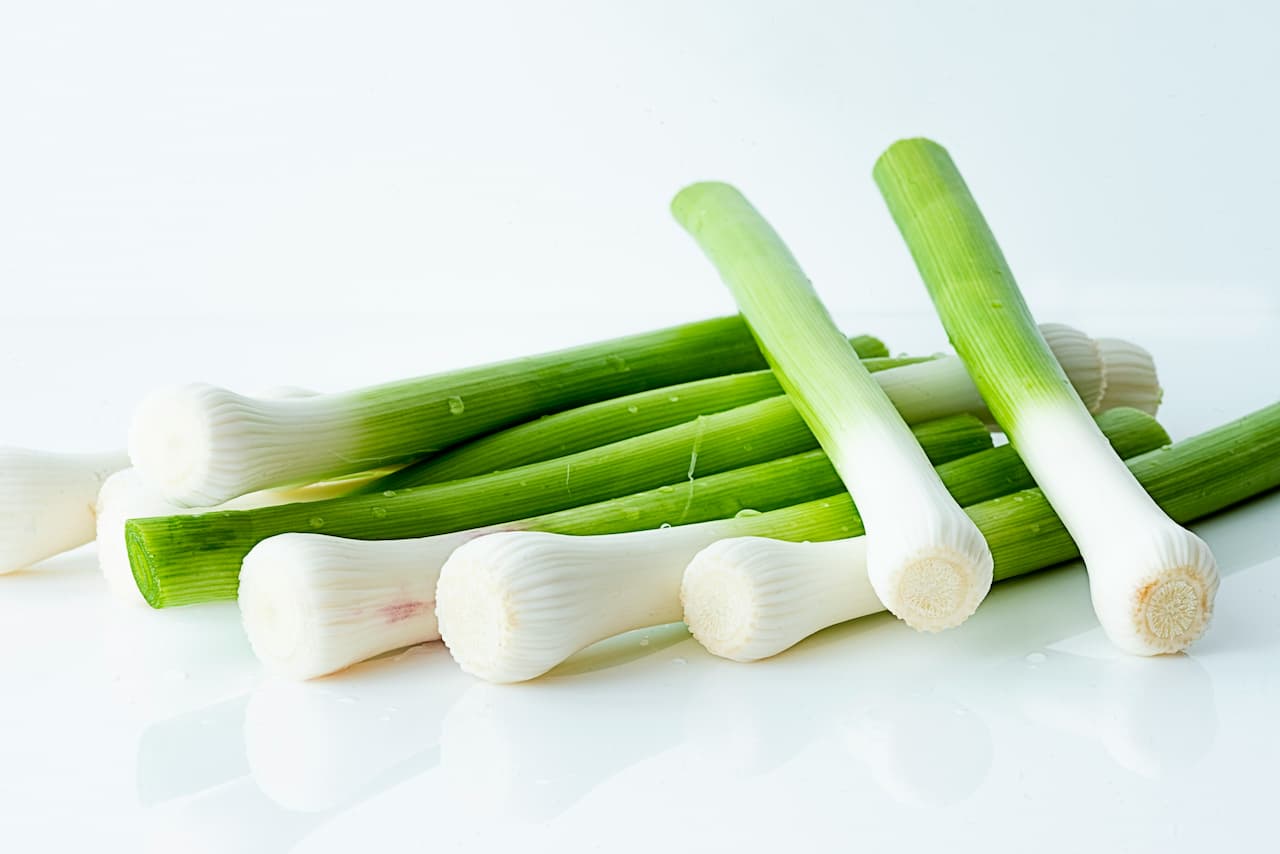
Spring onions are simply onions (Allium cepa) harvested before the bulb has had a chance to swell. The whole plant is eaten – the white base, the green tops and everything in between. Some varieties are specifically bred to stay slender and not form a bulb even when left in the ground past their ideal harvest point, while others are standard onion varieties simply harvested young. Both work well in the kitchen, but the purpose-bred types tend to have a more consistent pencil-thin shape and are better suited to production over a long season.
Spring onions are considerably milder than fully mature bulb onions, with a fresh, clean flavour that works well raw in salads, cooked briefly in stir-fries, stirred into sauces and dressings, or scattered as a garnish over noodles, soups and rice dishes. The green tops in particular are excellent used raw as a more flavourful alternative to chives. They are one of the few vegetables where there is genuinely no waste – every part of the plant from the fine root tips to the tops of the green leaves is edible and useful in the kitchen.
Sowing spring onions
Spring onions are always sown directly into the growing bed where they are to be harvested. They do not transplant well – root disturbance at transplanting causes setbacks and can trigger premature bolting, making the harvest tough and strongly flavoured rather than mild and tender. Sow seeds 1cm deep in broad bands or short rows, scattering them thinly rather than placing seeds individually. No thinning is required – spring onions grow perfectly happily shoulder to shoulder in dense rows, and the close planting actually helps support the slender stems upright through the season.
Germination takes seven to fourteen days in warm soil and longer in cool spring conditions – March sowings can take three weeks to appear in a cold spring. The seedlings emerge looking like fine grass blades and are very easy to overlook when weeding the surrounding bed – mark the row clearly with a label or cane immediately after sowing to avoid accidentally hoeing them out. Growth accelerates noticeably once the plants are established and the soil has warmed properly through April and into May, and from that point forward the plants develop quickly.
Sow little and often. A whole packet sown at once produces far more than any household can use in a short window. Sow a short row every two to three weeks instead and you will have a steady supply of fresh onions throughout the season rather than a glut followed by a long gap. This is the single most valuable habit for getting the best from spring onions in a raised bed.
Ongoing care
Spring onions need very little care once established, but the care they do need – consistent watering and weed control in the early stages – is important enough to make the difference between a good crop and a mediocre one. Getting these two things right from the start is the sum total of what spring onion care requires.
Harvesting
Pull spring onions when the white shank is roughly pencil thickness and the plant is 15-20cm tall. Grasp the plant at the base close to the soil and pull gently – they come out of loose raised bed growing medium easily without needing a tool. If the soil is slightly compacted around the base, ease a hand fork alongside the row first to loosen the roots before pulling to avoid snapping the stem. Harvest the largest plants from each row first, leaving the smaller ones behind to continue developing and thickening up over the following week – this extends the productive window of each sowing by one to two weeks and ensures you are always picking at the best size rather than harvesting everything at once.
Spring onions can be stored in the fridge for up to a week wrapped loosely in a damp cloth or standing upright in a small container of water with a loose bag over the tops, but they are genuinely at their best used within a day or two of harvest when the flavour is freshest and the green tops are still crisp. The white bases keep well for several days; the green tops wilt more quickly once cut. If you have surplus, the green tops can be chopped and frozen in small portions for use in cooked dishes – they lose their fresh texture after freezing and are only worth using in cooking at that point, but frozen tops are a useful ingredient for soups, stir-fries and fried rice through autumn and winter when fresh outdoor crops have finished.
Common problems
Spring onions face a small number of specific problems. Most can be avoided entirely with good growing practice from the outset, particularly the preventative use of insect mesh for onion fly and crop rotation discipline for white rot.
Best varieties
‘White Lisbon’ is the classic UK spring onion and has been grown in British gardens for generations. It is fast, reliable, widely available and produces the standard pencil-thin white-based onion most people think of when the crop is mentioned. It remains the benchmark variety against which all others are measured.
‘White Lisbon Winter Hardy’ behaves identically to standard White Lisbon in summer but has been selected for the cold hardiness needed to survive outdoors through a UK winter. Sowing in August and leaving it in the ground through winter with a light fleece covering produces an early harvest in March or April the following year – a genuinely useful gap-filler in the kitchen garden calendar when little else is ready.
Spring onions pair particularly well with fast-maturing brassicas in a raised bed. A row of spring onions alongside kohlrabi uses vertical space efficiently – the onions stay slender while the kohlrabi develops its swollen stem at ground level, and both mature in a similar timeframe. They also grow very well alongside pak choi, sharing the same preference for consistent moisture and cool growing conditions. Both can be harvested progressively so the bed keeps producing throughout the season rather than delivering a single concentrated harvest all at once.
This kind of layered cropping – fast crops filling the gaps between slower-growing ones – is one of the most productive and space-efficient approaches available to any raised bed gardener, and spring onions are ideally suited to playing that gap-filling role throughout the season because of their compact footprint, fast maturity and long sowing window.
Spring onions also make a natural companion to bulb onions in a raised bed rotation. A row of spring onions can be harvested from the same bed weeks before the bulb onions are ready, making productive use of the space during the period when the main bulb crop is still developing underground. This kind of layered cropping – fast crops filling the gaps between slower-growing ones – is one of the most efficient approaches available in a raised bed, and spring onions are ideally placed to play that role throughout the season.
Share on socials: