At a glance
A balcony is not a compromise garden. Managed well, it is one of the most productive growing spaces available to UK gardeners – typically sunnier than a ground-level garden, warmer against a south or west-facing building wall, more sheltered once windbreaks are established and entirely within reach from the kitchen door. The combination of those factors means balcony-grown herbs, salads and even tomatoes often outperform the same crops grown in open garden beds, simply because the environment is more controllable and the gardener engages with the space daily.
What balcony gardening demands most is an understanding of its constraints before planting begins. Weight limits, wind exposure and the speed at which containers dry out in an elevated position are the three factors that catch most balcony gardeners out in their first season. Address all three correctly and the growing space that remains is genuinely impressive even on a two-metre-wide apartment balcony. This guide covers each of those foundations before moving to the crops and planting schemes that make a balcony genuinely productive and visually satisfying through the UK growing season.
Weight limits and structural considerations
The single check that must happen before any significant planting on a balcony is confirming the structural load limit. Most UK residential balconies are engineered to carry a live load of 1.5 to 2.5 kilonewtons per square metre – roughly 150 to 250 kilograms per square metre of floor area. That sounds generous until you account for what filled containers actually weigh. A 40-litre pot of moist compost weighs approximately 45 to 50 kilograms. Three such pots clustered in one corner of a balcony represent 135 to 150 kilograms concentrated on a small floor area, and that is before accounting for any furniture, people or the structural weight of the balcony surface itself.
The practical response to weight limits is to distribute load rather than concentrate it. Spread containers across the full floor area rather than grouping them. Use lightweight containers – fibreglass, resin, fabric grow bags – rather than terracotta or concrete. Mix perlite or vermiculite into compost at around 20% by volume to significantly reduce the weight of each filled pot without meaningfully reducing plant performance. If in any doubt about the structural limit of a specific balcony, ask the building manager or consult the lease documentation before placing any significant weight.
Never assume a balcony can take unlimited weight. Older UK residential buildings in particular may have lower structural limits than modern developments. Balconies that have visible cracks, flex noticeably underfoot or have been flagged in building surveys should not be used for container gardening without a structural engineer’s sign-off. The weight of water-saturated compost in multiple large containers is genuinely significant.
Understanding your balcony conditions
Before choosing a single plant, spend a day observing the balcony across different times. Note where the sun falls and for how long, where the wind comes from and at what strength, and whether there are any sheltered pockets created by the building structure itself. A balcony that faces south-west and is partially sheltered by a projecting wall on one side may have a genuinely warm, sheltered microclimate in one corner while being completely exposed elsewhere. Growing in the sheltered corner and using the exposed areas for windbreak plants rather than productive crops transforms what is possible.
Urban balconies above the third floor often experience significantly more wind than those at ground level – not just prevailing wind but turbulence created by the building itself and by surrounding structures. Wind is the balcony gardener’s most persistent problem because it dramatically accelerates water loss from both the compost and the leaves, can physically damage plants and snap tall stems, and makes the space uncomfortable to use on the days when growing conditions would otherwise be ideal. Addressing wind before planting is not optional – it determines what is possible to grow.
Containers and compost
Container choice on a balcony is driven by weight first and aesthetics second. Terracotta is beautiful but heavy and porous, losing moisture rapidly in exposed positions – a combination that creates constant work in summer. Resin pots that mimic the look of terracotta weigh a fraction as much and retain moisture far better. Fabric grow bags are the lightest option of all, fold flat for storage over winter, and produce excellent root aeration that many crops respond to positively. For a productive balcony where weight and water retention both matter, a combination of resin pots for permanent plantings and fabric grow bags for seasonal crops covers most situations well.
Compost choice matters more on a balcony than in an open garden because every plant is entirely dependent on what is in its pot – there is no surrounding soil to draw on for nutrients or moisture regulation. Use a good quality peat-free multi-purpose compost mixed with 15-20% perlite to improve drainage and reduce weight. For tomatoes, peppers and other hungry crops, add a slow-release granular fertiliser at planting and follow up with a liquid tomato feed every ten days from first flowering. Herbs prefer a leaner, free-draining mix – standard multi-purpose with additional horticultural grit suits Mediterranean herbs such as thyme, rosemary and oregano particularly well.
Best crops for UK balconies
The best balcony crops share three characteristics: they are productive relative to the space they occupy, they tolerate container growing without a significant reduction in yield, and they are things the gardener actually wants to eat or use regularly. Growing food that goes from pot to kitchen in thirty seconds is one of the genuine pleasures of balcony growing and should inform crop choice as much as any other factor.
Herbs are the non-negotiable starting point for any balcony. Basil, chives, parsley, mint, thyme and rosemary all grow excellently in containers, produce continuously through summer when cut correctly, and require almost no maintenance beyond regular watering. Keep mint in its own pot – it spreads aggressively in shared containers and will outcompete everything else. Cherry tomatoes in a container 30 litres or above on a south or west-facing balcony produce abundantly from July through September with reliable daily watering and fortnightly feeding. Chillies are an outstanding balcony crop because they adore the warmth that urban south-facing balconies generate and will continue producing well into October in a sheltered position.
Wind, watering and maintenance
Wind management is more important than any plant choice. A balcony exposed to strong prevailing wind will defeat almost every growing attempt regardless of how well the containers and compost are chosen. The solution is not solid barriers, which create destructive turbulence on their lee side, but permeable windbreaks – trellis with climbing plants, willow hurdles, or purpose-built mesh windbreak fabric – that filter and slow the wind rather than blocking it completely. A 50% permeable barrier reduces wind speed on the sheltered side by around 70% across a distance of up to five times the barrier height.
Watering is the most time-consuming balcony maintenance task and the one most often cited as the reason people give up. In July and August a fully planted balcony with multiple large containers may need watering every single day – or twice daily in a heatwave. Installing a simple drip irrigation system on a timer, fed from a water butt or an outdoor tap, transforms this from a daily obligation into a weekly check. The initial cost of a basic timer and drip line is recovered in the first summer through dramatically reduced plant losses from drying out.
Making the most of a small balcony
Vertical growing is the key to maximising output from a small balcony floor area. A two-metre-wide balcony has limited floor space but potentially four or five metres of wall and railing height that can carry wall-mounted planters, hanging baskets and climbing plants on trellis. Strawberries in a hanging basket at railing height, climbing French beans on a trellis fixed to the wall, wall-mounted pocket planters of herbs and a few large floor-standing containers covers most productive balcony scenarios efficiently without the floor feeling cluttered.
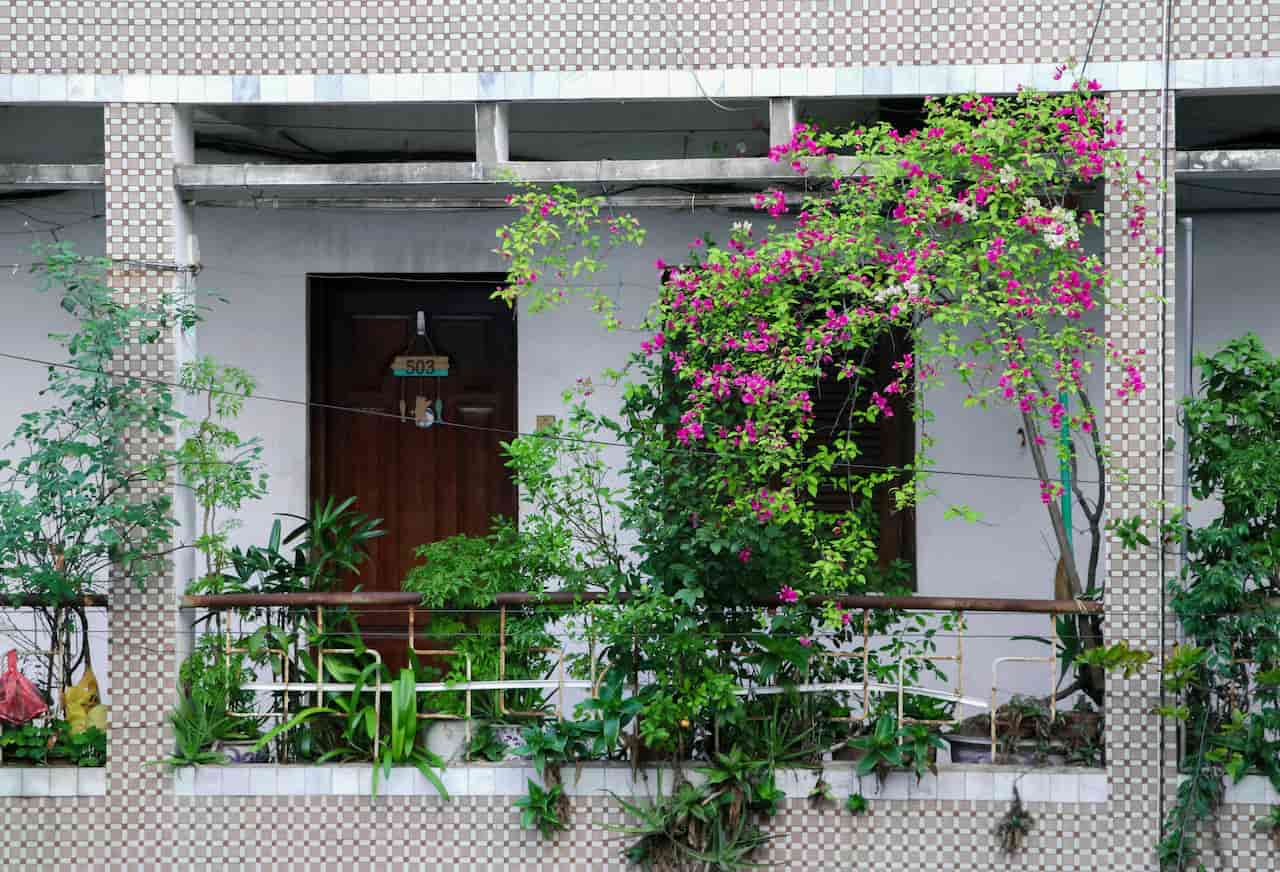
Flowers deserve equal space alongside food crops. A balcony planted only with vegetables looks productive but feels utilitarian. Mixing in nasturtiums, which spill beautifully over container edges and are both edible and excellent for attracting aphid-eating insects, alongside pelargoniums for summer colour and a climbing sweet pea for scent, produces a space that is genuinely pleasurable to use rather than just efficient to harvest. The psychological benefit of spending time on a well-planted, scented balcony that produces food is considerable and is reason enough on its own to choose a few ornamental plants alongside the productive ones.
Think in layers, not just floor area. The most productive balcony gardens use railing space for trailing plants and small pots, mid-level wall space for mounted planters and trellis, and floor space for the largest containers only. A single 1.8m section of trellis on the wall with climbing French beans produces more food per square centimetre of floor space occupied than almost any other approach available to the balcony gardener.
Share on socials: