At a glance
Begonias are one of the most versatile plant groups available to UK gardeners and houseplant growers – covering everything from the compact, near-continuously flowering wax begonias used as summer bedding to the dramatic large-flowered tuberous types grown in pots and hanging baskets, and the extraordinary foliage of Rex begonias kept as year-round houseplants. What unites all of them is a set of non-negotiable care requirements that, when respected, make begonias genuinely easy to grow. Get these wrong – particularly around watering and drainage – and begonias fail reliably regardless of the type.
The most important piece of knowledge before acquiring a begonia is understanding which of the three main types it belongs to, because the watering frequency, feeding approach and seasonal care all differ meaningfully between them. A care routine that keeps a fibrous wax begonia thriving will rot a Rex begonia’s rhizome within a fortnight. Getting the type right first is the foundation everything else builds on.
Understanding begonia types
The three groups – fibrous, tuberous and rhizomatous – differ in their root structure, growth habit, flowering season and seasonal care requirements. Most begonias sold in UK garden centres are labelled by variety name rather than type, which is why it is worth knowing what distinguishes each group before buying.
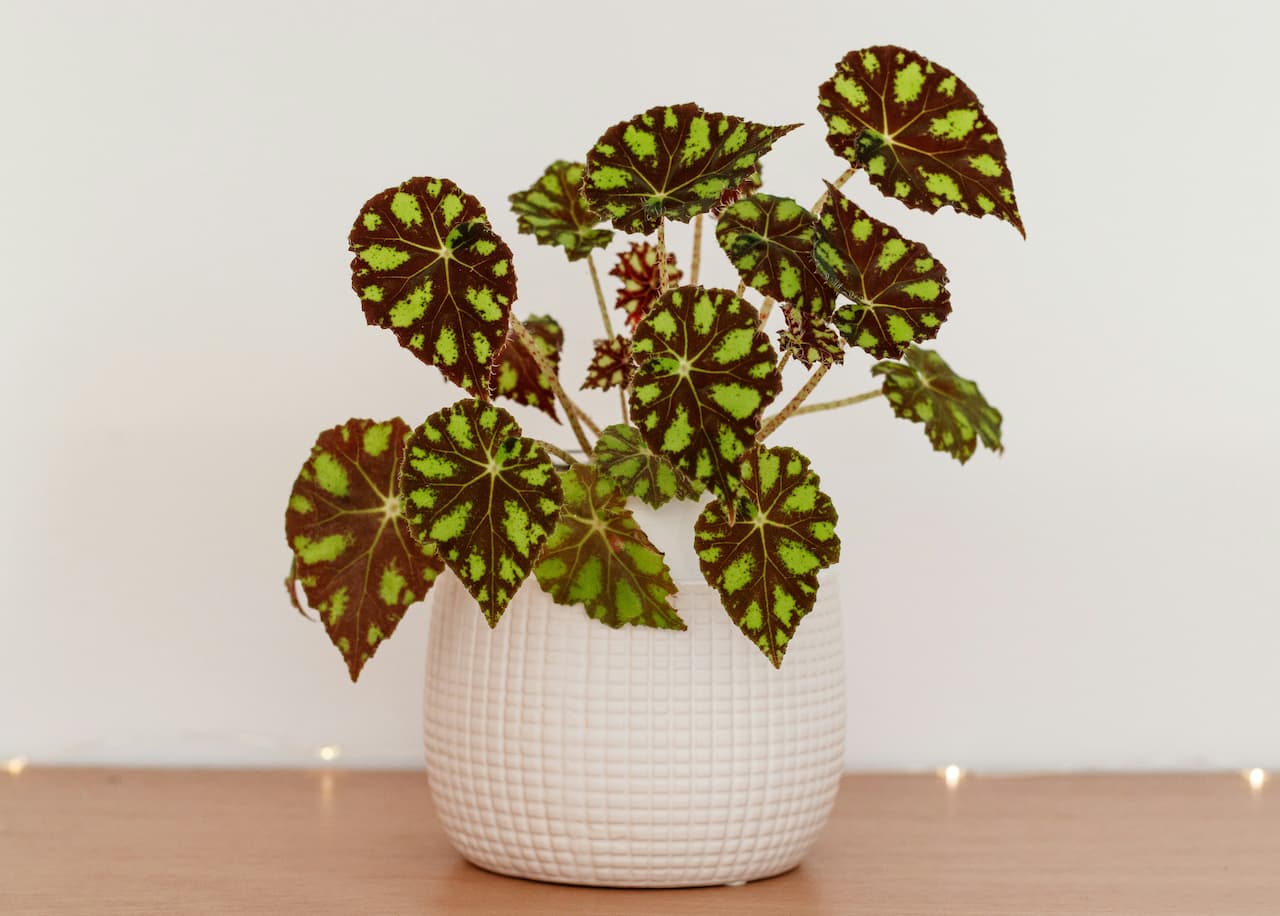
Fibrous-rooted begonias are the most forgiving and the most widely available in UK garden centres. Wax begonias flower almost continuously from late spring through to the first frosts and are equally at home as a summer bedding plant outdoors or as a windowsill houseplant. Tuberous begonias produce the most dramatic flowers in the genus – some exhibition varieties reach 15cm across with heavily ruffled petals – but they require lifting and dry storage through the UK winter, which adds a seasonal maintenance step that fibrous types avoid entirely. Rhizomatous begonias, including the Rex group with their extraordinary metallic and patterned foliage, are grown primarily as houseplants for their leaves rather than flowers. Their care differs from the other two types – less frequent watering, wider and shallower pots, and a preference for being left undisturbed once settled in a good position.
Light and watering
All three begonia types perform best in bright indirect light. The principle is consistent: no direct afternoon sun, which scorches leaves and bleaches flower colour on every type, and no deep shade, which produces etiolated growth in fibrous types and causes loss of the metallic patterning in Rex begonias. An east or west-facing windowsill that receives direct sun only in the early morning or late afternoon is ideal for most houseplant begonias. Outdoor tuberous begonias used as patio or basket plants prefer a sheltered position in partial shade – full UK summer sun on a south-facing wall creates heat stress and accelerated compost drying that requires constant attention.
Watering is where begonias are most often killed. Root rot caused by consistent overwatering or by sitting in standing water is the single most common cause of begonia failure, and it is entirely preventable. The correct approach for fibrous and tuberous types is to water thoroughly until water drains from the base, then allow the compost to partially dry before watering again – checking at 2-3cm depth rather than testing the surface, which dries faster than the root zone below. Rhizomatous types, including Rex begonias, prefer to dry out more substantially between waterings – their horizontal rhizome stores moisture and their relatively small root system makes them more vulnerable to root rot than the other types.
Water begonias from below when possible. Sitting the pot in a shallow tray of water for 20-30 minutes, then removing and allowing to drain, encourages roots to grow downward toward moisture and keeps the leaves and crown completely dry. Begonia leaves and stems that stay wet – particularly in the lower light and reduced airflow of a UK autumn – are susceptible to powdery mildew and crown rot. Bottom watering reduces both risks significantly and is particularly worth adopting for houseplant types kept year-round indoors.
Feeding and soil
Begonias are hungrier than their delicate appearance might suggest during the active growing season. Fibrous and tuberous types in active growth benefit from a balanced liquid houseplant fertiliser at half the recommended dose every two weeks from late spring through to early autumn. Once flower buds form and open, switching to a high-potash feed – the same formula used for tomatoes – encourages more prolific flowering and stronger colour in the petals. Rex begonias grown for their foliage respond better to a balanced feed applied monthly rather than the high-potash one, since the potash push encourages flowering at the expense of the dramatic leaf development that makes Rex types worth growing.
Drainage in the compost is as critical as correct watering. Standard multipurpose compost holds too much moisture for begonias at typical UK indoor temperatures in winter, and the combination of wet compost and low winter temperatures creates ideal conditions for root rot. Mixing 20-30% perlite or horticultural grit into houseplant compost improves drainage significantly without reducing moisture retention to the point where the compost dries too quickly in summer. Always use pots with drainage holes. Rex begonias in particular benefit from a wide, shallow pot rather than a deep one – the pot shape matches their shallow, laterally spreading rhizome and reduces the volume of slow-draining compost below the root zone.
Repotting is needed roughly every one to two years for houseplant begonias, and spring is the best time to do it when the plant is about to enter its most active growth phase. The signal is roots circling the base of the pot or emerging from drainage holes, or a plant that dries out very rapidly after watering even when the compost looks healthy. Move up only one pot size at a time – a pot significantly larger than the existing root ball holds far more compost than the roots can absorb moisture from, and the excess compost stays wet, increasing rot risk considerably. Always water thoroughly after repotting and place in bright indirect light for two weeks before resuming the normal feeding routine.
Overwintering tuberous begonias
Tuberous begonias are not frost hardy and will be killed by the first ground frost in the UK if left in the ground or in an unprotected pot outdoors. Lifting and storing the corms through winter is non-negotiable for anyone wanting to keep their plants from year to year. The process is not complicated but the timing matters: lifting too early, before the foliage has died back naturally, interrupts the plant’s process of withdrawing nutrients from the leaves back into the corm for winter storage.
Never let tuberous begonia corms freeze during storage. A single frost will destroy a corm entirely. An unheated garage in a mild southern UK winter is usually adequate, but in Scotland or northern England an unheated outbuilding may not stay reliably frost-free in January and February. When in doubt, store inside the house in a cool spare room at 8-12C – the cooler the better as long as it stays above freezing.
Common problems
Powdery mildew is the most frequently encountered problem with begonias kept as houseplants in the UK. It appears as a white or grey powdery coating on the upper leaf surface, typically in autumn when light levels drop, ventilation decreases and the plant is moved away from windows for winter warmth. Rex begonias and tall cane-type Angel Wing begonias are considerably more susceptible than the compact floriferous types – unlike compact houseplant types that tolerate lower humidity well, larger-leaved begonias need good airflow to stay clear of fungal issues. Preventing mildew is far easier than treating it: water from below rather than overhead, provide good airflow around the plant and avoid overcrowding on windowsills. Removing the worst-affected leaves and improving ventilation usually resolves mild outbreaks. Persistent cases respond to a dilute neem oil solution applied to both leaf surfaces weekly.
Share on socials: