At a glance
Verbena bonariensis is one of those rare plants that earns its place in a border by doing almost everything right. Its tall, branching stems rise to 1.5 metres or more above the border and carry clusters of tiny vivid purple flowers from June right through to the first frosts of autumn, giving it one of the longest flowering seasons of any perennial commonly grown in UK gardens. The stems are so slender and see-through that you can plant it in front of other plants without obscuring them – it adds a purple haze above the border without any of the solid visual mass of a conventional tall perennial, creating a layering effect that no other plant quite replicates.
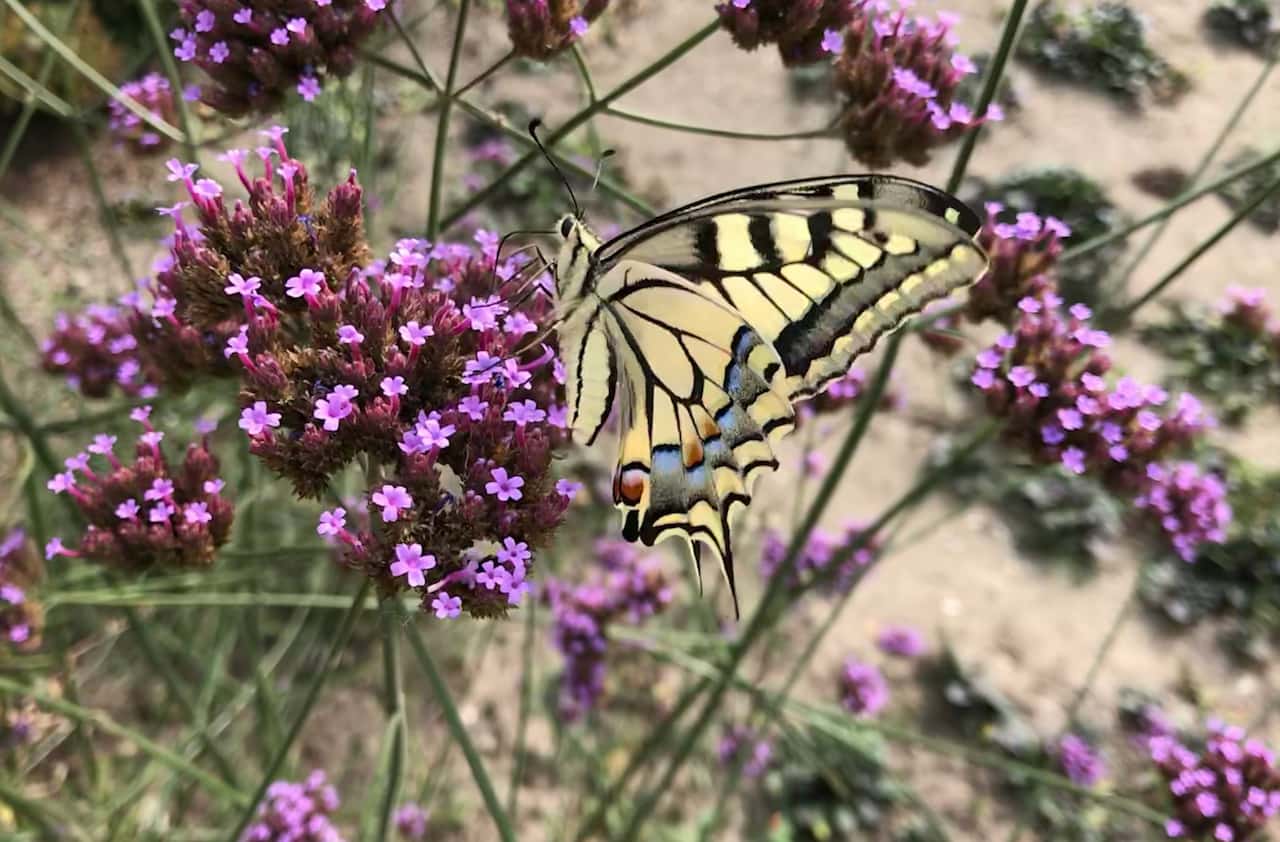
It is also one of the best pollinator plants in the UK garden calendar. Butterflies in particular – including painted ladies, small tortoiseshells and red admirals – are drawn to verbena bonariensis in numbers that can be quite startling on a warm August or September day. Bees work the flowers throughout the long season too. For anyone trying to support wildlife in their garden, this is an essential plant. This guide covers how to grow and manage it successfully in UK conditions, including how to make the most of its self-seeding habit.
About verbena bonariensis
Verbena bonariensis originates from South America – specifically the open grasslands and disturbed ground of Argentina, Brazil and Uruguay – and was introduced to British gardens in the early twentieth century where it has naturalised in some areas. It is not reliably hardy across the whole of the UK. In colder northern gardens it behaves as a short-lived perennial or annual, dying off in winter, but its prolific self-seeding habit means that new plants appear each spring from seed dropped the previous autumn, effectively giving it permanence in the border even where the parent plant does not survive the winter.
In milder parts of the UK, particularly in the south and south-west of England, established plants can develop a woody base and survive several consecutive winters, becoming progressively more robust and floriferous as the crown strengthens. In most UK gardens it is best treated as a short-lived perennial that perpetuates itself through self-seeding rather than by longevity of the parent plant. The result either way is a border filled with tall purple stems every summer with minimal effort and no replanting required once established.
Planting and growing
Verbena bonariensis is straightforward to grow from seed or plug plants. For the best results from seed, the key details to get right are germination temperature, sowing timing and light – verbena bonariensis seed needs surface sowing without covering, and germination can be slow and erratic compared to many annuals even under good conditions. Plug plants bought from garden centres in spring are the simplest route and will flower the same year, while seed-grown plants started early indoors also flower in their first season if sown in February.
Verbena bonariensis does not need staking despite its height. The wiry, branching stems are naturally strong and flex in the wind rather than snapping, and plants support each other when grown in groups. It looks particularly effective planted in groups of five or more where the interlocking stems create a transparent purple haze – a single plant looks thin and inconsequential by comparison. Space them at 45-60cm and allow them to knit together naturally.
Plant in groups. The signature effect of verbena bonariensis – that purple haze floating above the border – only works in groups. Five plants is a minimum; seven or nine in a loose drift creates something genuinely dramatic in full flower from August onwards. Odd numbers look more naturalistic than even groupings in informal borders.
Ongoing care
Verbena bonariensis is a genuinely low-maintenance plant once established in the right position. In a well-drained, sunny border it needs very little ongoing attention – occasional watering in the first season while the roots establish and the plant becomes drought tolerant, and that is essentially the full extent of the care requirement. Do not feed heavily; like many long-flowering perennials, verbena performs best in moderately fertile rather than rich soil. Excessive nitrogen produces lush, floppy growth and reduces the density and quality of flowering.
Deadheading spent flower clusters encourages fresh ones to form on the same stems and can extend the display noticeably into later autumn, but in practice most gardeners simply let the plant run its course and self-seed freely through the border – which is arguably the most rewarding approach and the one that gives verbena bonariensis its characteristic naturalistic quality in the garden. Cut plants back to ground level in late winter once the stems have died back fully; in mild winters, the base may remain semi-green and can be cut back hard in March to encourage strong new growth.
Self-seeding
The self-seeding behaviour of verbena bonariensis is one of its greatest practical assets in the garden and the main reason it remains a permanent fixture in borders where it has been grown for more than one season. Seeds ripen from August onwards and are dispersed by wind, germinating the following spring. Seedlings appear throughout the border in positions you would never have thought to place them deliberately – at the base of roses, between ornamental grasses, along the edge of paths – and this spontaneous placement frequently produces more natural-looking results than any arrangement that could have been deliberately planned and executed. This ability to knit disparate plants together and create loose, naturalistic links across a border is what makes verbena bonariensis so uniquely valuable in informal and wildlife gardens.
Cold gardens and reliable seeding. In gardens in northern England and Scotland, verbena bonariensis may not self-seed reliably if the first autumn frosts arrive before the seed ripens fully on the plant. In these areas, collect a few seed heads in September when the seeds are visibly ripe and dark, store them dry indoors over winter and sow fresh seed each February to maintain the display year after year.
Common problems
Verbena bonariensis is largely pest and disease free in UK conditions – one of its most significant practical virtues alongside its long flowering season, ornamental quality and exceptional wildlife value. The few issues that do arise are easily managed. The problems that do occasionally arise are almost always environmental rather than caused by pest or disease organisms, and the solutions are straightforward.
Planting combinations
Verbena bonariensis is one of the most versatile plants for weaving through a border because its transparent stems let you see directly through to whatever is behind or below. This see-through quality means it can be positioned at almost any depth in a planting scheme – mid-border or even towards the front of a deep border – without obscuring shorter plants growing in front of or below it. It works particularly well woven through ornamental grasses such as miscanthus or pennisetum, with the vivid purple flower clusters emerging above the grass plumes and seed heads in August and September for a striking textural combination. Planted in front of dark-leaved shrubs or deep green hedging, the vivid purple flowers are shown off dramatically against the contrasting backdrop.
For a naturalistic, high-impact pollinator border, combine verbena bonariensis with sedum spectabile for late-summer colour and catmint for the earlier season – this three-plant combination delivers continuous colour and pollinator interest from May through to October with almost no maintenance required. The full range of wildlife-focused planting options across all seasons is covered in our guide to the best plants for garden wildlife. Verbena bonariensis also looks outstanding planted above lavender at the border edge, where the tall purple stems of the verbena rise above the compact silver-grey mounds of the lavender and both plants flower simultaneously in midsummer, sharing the same preference for full sun and well-drained soil. For a complete late-season pollinator border, add buddleia as a backdrop shrub – the combination of buddleia, verbena and sedum creates a sequence of colour and nectar that runs from July through to October and supports an exceptional range of butterfly and bee species through the late season when many other garden plants have finished flowering.
Share on socials: