At a glance
The slow worm (Anguis fragilis) is one of Britain’s most misunderstood and most valuable garden residents. Despite its appearance, it is not a snake – it is a legless lizard, completely harmless to humans and highly beneficial to gardens. Slow worms are specialist predators of the small slugs that cause most garden damage: the grey field slugs and keeled slugs that destroy seedlings, tunnel through potato tubers and devour hostas overnight. A compost heap with a resident slow worm population is one of the most effective forms of natural pest control available to UK gardeners, and it costs nothing once established.
Slow worms are widely distributed across the UK wherever suitable habitat exists – rough grassland, south-facing banks, compost heaps, sunny borders and overgrown corners. They are fully protected under the Wildlife and Countryside Act 1981. In many suburban gardens they live quietly for years, invisible to the gardener who never looks under the right places. Creating habitat for slow worms is simple: they need warmth for basking, shelter for resting and hibernating, and a chemical-free environment that supports the invertebrate prey they depend on.
What is a slow worm?
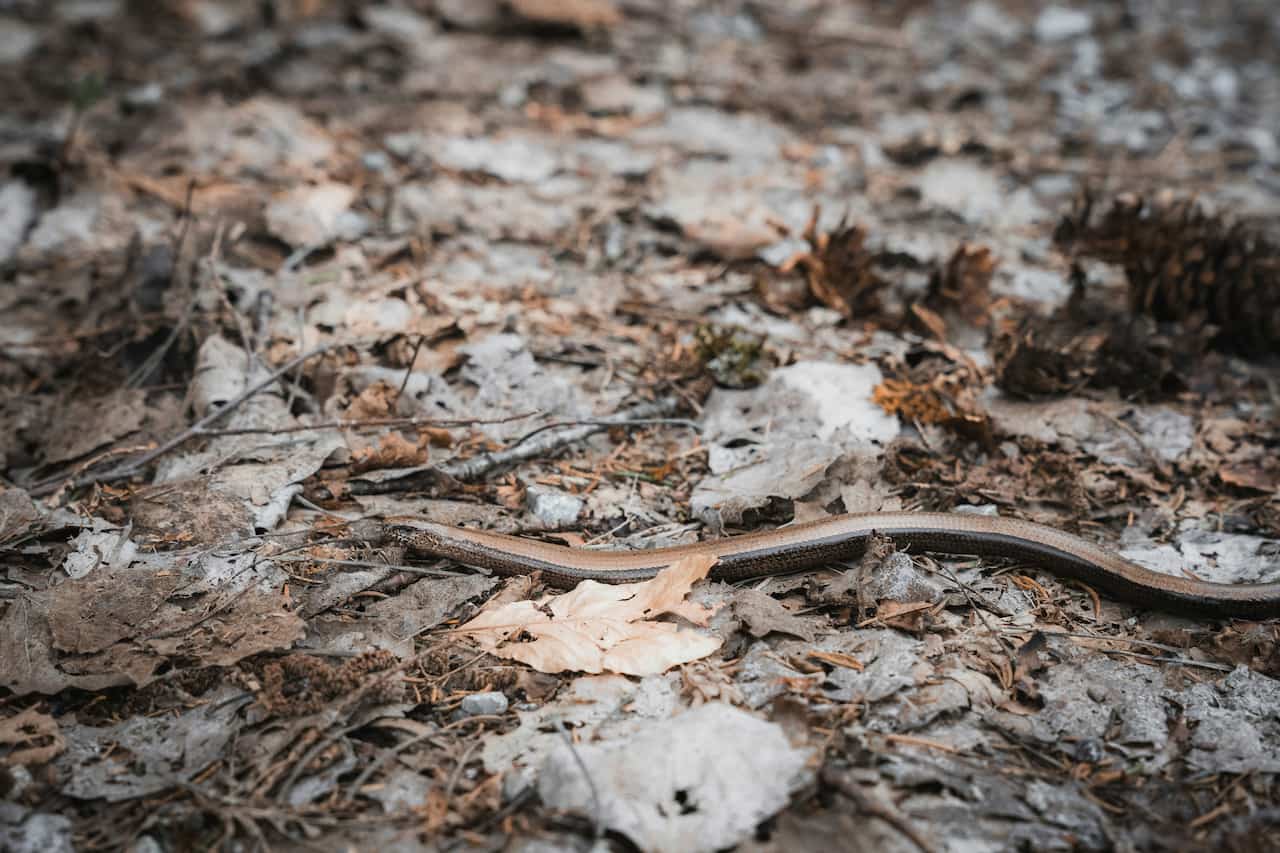
Slow worms (Anguis fragilis) are legless lizards – the only legless lizard native to the UK. They are not snakes, not worms, and not related to either. Several physical features distinguish slow worms from snakes: they have eyelids and can blink (no snake can do this), they have visible ear openings, and they can shed their tail as a defence mechanism – a capability called autotomy that no native UK snake possesses. The shed tail wriggles to distract a predator while the slow worm escapes, and a partial tail regrows over several months, though the regrown version is shorter and different in appearance to the original.
Adults are typically 30-50cm in length and vary considerably in colour. Males are usually a uniform golden or grey-brown. Females are often larger and typically have a darker dorsal stripe running along the spine. Juvenile slow worms are striking – they emerge from the female’s body as tiny golden or copper-coloured animals with a black underside and a fine dark back stripe, sometimes described as looking like a thread of burnished metal in the grass. This colour gradually changes over the first few years as the animal matures.
The misidentification of slow worms as snakes causes unnecessary alarm and, historically, unnecessary killing. The Wildlife and Countryside Act 1981 makes intentional killing of slow worms an offence, but more practically, an understanding of what slow worms actually are makes the alarm completely unnecessary. They are calm, gentle animals that do not bite (though they can, weakly, if handled roughly), do not move fast, and will simply try to hide when encountered. The population in any given area is typically stable or slowly growing where habitat conditions are maintained – slow worms are not invaders or pests in any sense, but established residents that have been in the area for years or decades.
Slow worms are also notably long-lived for their size. Wild slow worms commonly live 20-30 years, and captive individuals have been recorded at over 50 years old – an extraordinary lifespan for an animal of under 50cm. A slow worm that takes up residence in your garden may still be there a decade or two later. They are live-bearers: the female carries eggs internally and gives birth to fully formed young in late summer, typically August or September. A brood of six to twelve golden juvenile slow worms appearing in a compost heap or under a refugia is one of the more remarkable wildlife encounters available to UK gardeners.
Basking, refugia and warmth
Slow worms are ectothermic – they cannot generate their own body heat and depend on external sources to reach their active temperature. Unlike some lizards that bask openly on rocks or walls, slow worms warm themselves by pressing against objects that have absorbed and retained heat. This behaviour makes them easy to attract by providing the right structures in the right positions.
The single most effective slow worm attractant is a piece of old roofing felt placed flat on the ground in a sunny, sheltered corner. The dark felt absorbs heat from the sun and the underside creates a warm, dark microhabitat that slow worms discover quickly and return to repeatedly. A piece around 30x60cm is sufficient. Position it where it will receive morning sun – slow worms warm up in the morning and hunt through the day and into the early evening. A spot against a south or south-west facing wall, fence or compost heap combines good solar exposure with the shelter slow worms prefer. Check the refugia by lifting one edge very slowly and gently every few days through spring and summer – this allows any slow worms present to move away without being harmed.
Once a refugia is established and slow worms are using it, do not move it to a different position – slow worms locate refugia by scent and memory and a relocated mat will take time to be rediscovered. If the area immediately around the mat becomes overgrown and the solar exposure is blocked, clear the vegetation rather than moving the mat. Multiple refugia positioned at different points in the garden increase the chance of supporting a larger population – each individual slow worm will have a preferred basking site and may not range far from it. Placing a second mat near the compost heap and a third near a south-facing border edge gives a better coverage of the garden than a single mat in one corner.
How to check a refugia correctly. Never lift a refugia mat fully and quickly – this exposes the slow worm suddenly and gives cats and other predators an easy target. Instead, lift one edge slowly and peer underneath. If a slow worm is present, lower the edge gently. The slow worm will move away within a few minutes. This approach also avoids injury – a sudden lift can cause a slow worm to shed its tail unnecessarily.
Shelter, habitat and hibernation
Beyond the basking refugia, slow worms need the broader garden environment to be hospitable throughout the year. Dense, undisturbed ground-level vegetation is essential for hunting and hiding during the active season. Long grass, ground cover planting, thick leaf litter and the shaded damp areas under dense shrubs all provide the cool, moist microhabitat slow worms use when they are not basking. The transition zone between a sunny south-facing area and a damp, shaded area – for example, the base of a south-facing compost heap against a shaded fence – concentrates all the habitat elements in one place.
Hibernation runs from approximately October to March in UK conditions, though this varies with temperature and location. Slow worms hibernate underground or beneath large flat objects – deep compost heaps, log piles, the base of compost bins, stone walls and piles of rotting timber all provide suitable hibernation sites. They may hibernate communally in groups, sharing a favoured site that has been used for many years. The practical implication of this for gardeners is that autumn garden clearance – the impulse to tidy up all the dead stems, clear the compost heap, remove all the leaf piles – removes exactly the structures slow worms need for winter survival. A garden where one corner is left deliberately rough and undisturbed supports far more slow worms than one that is cleared to bare soil every autumn.
The relationship between slow worms and compost heaps deserves particular emphasis. A garden with a working compost heap – one that is active, moist and regularly supplied with garden and kitchen waste – provides slow worms with warmth, shelter and prey in one location. The combination makes compost heaps the single most important slow worm habitat feature after the basking refugia. If space allows, a second resting heap – one that is not being actively added to or turned – alongside the active heap provides an undisturbed structure that slow worms can use through winter. In the UK’s typical autumn garden routines, the habit of fully emptying and clearing out the compost heap before winter is one of the most damaging things for slow worm populations. Leaving the lower layer in place, even while adding fresh material on top, maintains the habitat value through winter.
Food and hunting
Slow worms are specialist predators of small invertebrates, with a particular focus on slugs. They cannot tackle the large adult slugs that are visible to gardeners, but they are highly effective against the small grey field slugs and juvenile slug stages that are hardest to control by other means and do the most damage to seedlings and young vegetable plants. They also eat earthworms, small beetles and beetle larvae, small spiders and other soft-bodied invertebrates. A slow worm hunts by following scent trails at ground level through dense vegetation, working through the base of borders and vegetable beds where small slugs shelter.
Slow worms are also useful allies in areas that are hardest to protect by other means. The base of hedges, the edges of compost bays, the undersides of raised bed timbers and the damp shadowy zones between borders and hard surfaces are all prime slow worm territory. These are the same areas where small slugs are most numerous and hardest to reach with any surface-applied control. A slow worm that has established a territory covering these zones is working exactly where slug pressure is highest. The cumulative effect over a full growing season – from the first warm nights of early spring through to late October – is a measurable reduction in slug damage to the plants that benefit most from protection.
The implications for garden management are straightforward. Mulched vegetable beds, compost-rich borders and areas of undisturbed ground under shrubs all harbour the slug species slow worms prefer. The chemical-free approach to the whole garden is essential: slug pellets and insecticides are not only unnecessary where slow worms are present – they actively undermine the natural pest control the slow worms provide. Slug pellets poison slow worms directly, as they eat poisoned slugs and absorb the toxin. A vegetable garden managed without chemicals, with a refugia nearby and a compost heap providing additional prey, gives a resident slow worm everything it needs to provide continuous pest control through the growing season.
One aspect of slow worm pest control that is worth understanding is the difference in diet across the slow worm’s size range. A juvenile slow worm – just emerged from the female’s body at a few centimetres long – can only tackle the smallest invertebrates. An adult slow worm at 40-50cm can handle slugs up to around 3-4cm long. This means a garden that supports slow worms of all ages – juveniles produced from compost heap births alongside the adults that produced them – is tackling slug populations across multiple size classes simultaneously. Encouraging breeding as well as residence is therefore more valuable than simply attracting adults to a garden.
Threats and garden dangers
Seasonal calendar and legal status
Understanding the slow worm’s year makes it possible to give appropriate support at each stage and avoid accidentally disrupting it.
Connectivity between gardens matters as much for slow worms as it does for hedgehogs, frogs and other ground-level wildlife. Slow worms move relatively slowly and over relatively short distances compared to birds or mammals, so their ability to colonise new gardens depends heavily on whether gaps and passages exist between adjacent properties. A slow worm population established in one garden may take many years to spread to neighbouring gardens if the boundary is a solid wall with no ground-level access. Gaps in fencing at ground level, passages under gates and low-cut hedges that allow ground movement all help slow worms spread naturally through a neighbourhood. Co-ordinating with neighbours to maintain these connections as part of a broader wildlife gardening approach creates a much larger effective habitat than any single garden.
Slow worms are protected under the Wildlife and Countryside Act 1981. It is an offence to intentionally kill, injure or sell them. They are classified as a reptile, not a snake or a worm, and are the only legless lizard native to the UK. The other UK reptiles – the grass snake, adder and common lizard – share habitat with slow worms in many gardens and may be found under the same refugia or compost heaps. Finding any of these species should be treated as a positive sign: a garden that supports reptiles is ecologically rich and well-managed from a wildlife perspective. The best response to any reptile under a refugia is to lower the covering gently and leave the animal undisturbed.
Share on socials: