At a glance
House martins are among the most charismatic summer visitors to UK homes and gardens. These small aerial birds arrive from sub-Saharan Africa each spring, filling the air with their chattering calls from late April through to October. They are entirely aerial feeders – catching every meal on the wing from flying insects – and their arrival signals the warmest months of the gardening year as surely as any plant in the border. Attracting them, and more importantly helping them breed successfully, is one of the most direct conservation contributions any UK householder can make.
House martins are now on the Red List of Birds of Conservation Concern following a long and accelerating decline. They have lost nearly half their UK population since 1970. The causes are interconnected: loss of natural nest sites as buildings are renovated and re-clad, collapse of flying insect populations, drought reducing mud availability in dry springs, and pressures on the African wintering grounds. Individual action – fitting nest cups, providing mud, managing gardens for insects – cannot reverse these pressures alone, but it addresses the factors that householders can directly control. A colony that becomes established on your property is genuinely significant, and once established it returns reliably year after year.
About house martins
The house martin (Delichon urbicum) is a small hirundine – a member of the swallow family – distinguished from the swallow by its shorter, less deeply forked tail, stockier build and, most distinctively, a bright white rump patch visible from below as the bird flies. The upperparts are glossy blue-black and the underparts are pure white. At close range, the feet are covered with white feathers right to the toes – a characteristic shared with no other UK bird. House martins are smaller and plumper than swallows, and feed at higher altitude on warm days when insects rise on thermals, dropping closer to the ground in cool, overcast conditions when insects fly lower.
The nest itself is an extraordinary piece of engineering. Both sexes collect wet mud pellets from suitable sources and transport them to the nest site, pressing each pellet into the structure with their bill. The finished nest is a roughly hemispherical cup with a small entrance hole at the top, attached to the junction of a wall and an eaves overhang. It is built from the outside inward over two to four weeks. A new nest requires something between 1,000 and 1,500 individual trips. The birds reinforce the mud structure with cobwebs and plant fibres, and when dried it is remarkably solid – a well-built house martin nest can survive for many years, being repaired and relined at the start of each season. The interior is lined with feathers and plant material and kept remarkably clean.
House martins are colonial nesters. Natural nest sites – the deep eaves overhangs of traditional buildings, particularly older houses with wide soffits – are becoming rarer as modern construction and renovation replace them with flat, smooth facades that provide no attachment point. A colony of anything from two to twenty or more pairs nesting on a single building is not unusual where conditions are right. The colonial habit is important to understand when providing artificial nest sites: a single cup is less attractive than a cluster, and a property near existing nest sites is more likely to be colonised than an isolated one.
Artificial nest cups – fitting and position
Artificial nest cups are the single most effective measure available for attracting house martins. These pre-formed cups, made from papier-mache or ceramic, replicate the shape and dimensions of a natural house martin nest. They are fixed directly to the wall under the eaves overhang. House martins are attracted to existing nests, and artificial cups trigger the same response – birds investigating a property for nesting opportunities will readily investigate and accept artificial cups.
One technique that significantly improves the chances of house martins investigating and accepting artificial cups is playing recordings of house martin colony calls near the cups during late April and May. House martins are attracted to the sound of an active colony, and broadcasting calls for a few hours on calm mornings when birds are prospecting for nest sites can accelerate the process of attracting scouts. Several apps provide recordings for this purpose. Runs of two to three hours in the morning during the prospecting period give the best results.
Persistence matters with house martins. The first season after cups are installed may produce no occupants, particularly if there is no established colony in the immediate area. The second and third seasons see higher rates of uptake, as birds from nearby colonies investigate the new site and word – in the form of colony call behaviour – spreads. Do not remove or reposition cups after one fruitless season. Leave them, keep the mud supply fresh in spring, and try the call playback technique. House martin colonisation of new sites often happens suddenly after one or two seasons of apparent non-interest.
Mud supply for nest building
House martins build their nests entirely from mud, making hundreds or thousands of individual trips to collect pellets of wet clay-rich soil and carry them to the nest site. A new nest requires somewhere between 1,000 and 1,500 mud-carrying trips. In dry springs – which have become more frequent – the absence of suitable mud near the nest site is one of the most significant barriers to successful nest completion. Providing a reliable mud supply is simple and can make the difference between a pair completing a nest and abandoning the attempt.
A wildlife pond with a shallow mud margin provides the ideal mud source naturally and is used by house martins spontaneously without any additional effort. The combination of a wildlife pond and a nesting colony on the adjacent house creates a self-sustaining habitat where mud, water and insect food all come from the same area. In gardens without a pond, a shallow tray or half-buried container kept topped up with wet clay from a garden centre or from any patch of clay subsoil in the garden will serve equally well for the weeks when mud is critical.
Insects and feeding habitat
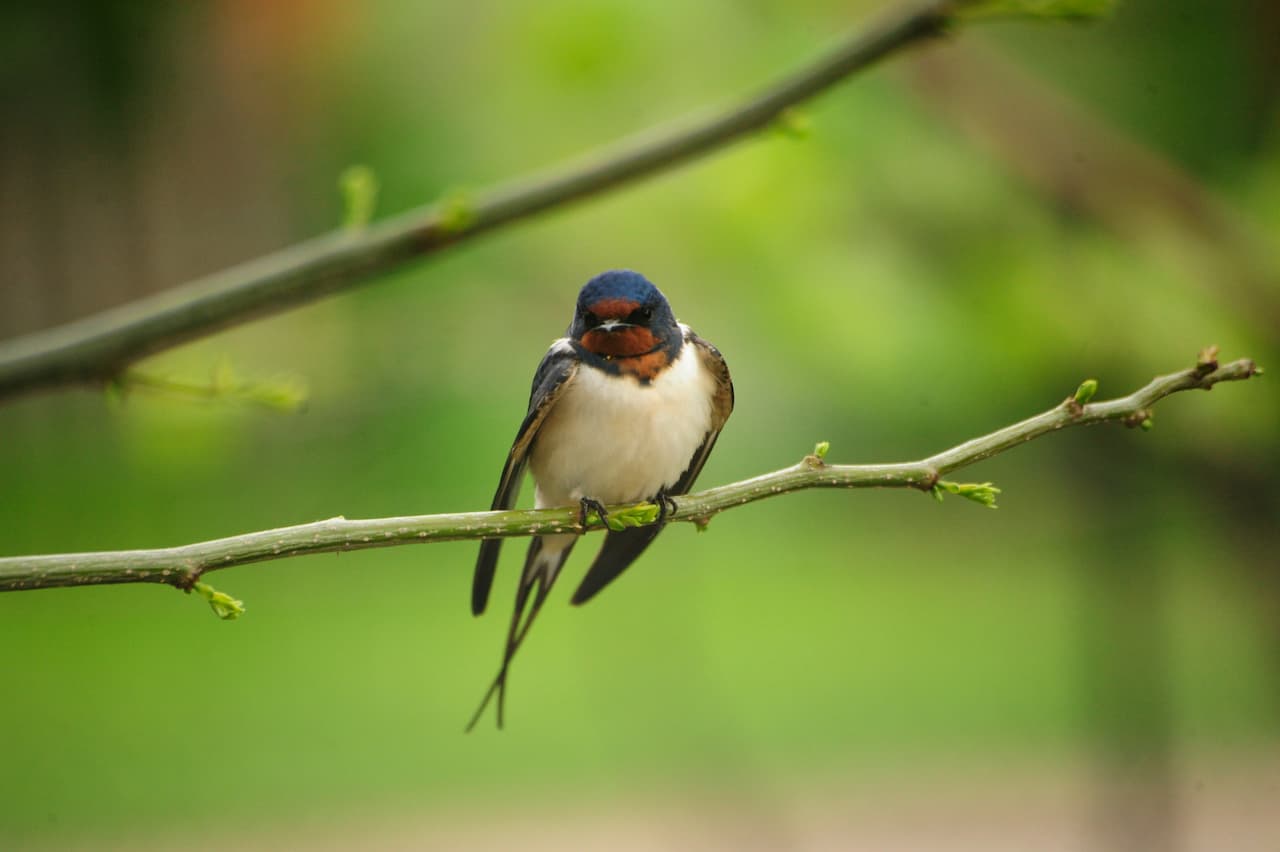
The swift and the swallow are the two birds most commonly confused with the house martin in UK gardens. All three are aerial insectivores that appear together over water and open ground in summer, but their flight styles, silhouettes and behaviour are distinct once you know what to look for. The swift is larger, has a more scythe-shaped wing outline and a screaming call; it spends most of its life in the air and never perches except at the nest. The swallow is longer-tailed, flies closer to the ground and frequently perches on wires and fences. The house martin is the stockiest of the three, has the most pronounced white rump and often feeds at greater height than the other two on warm days.
House martins feed entirely on small flying insects and airborne spiders caught on the wing. They do not feed on the ground, in vegetation or at bird tables. What determines how well a local house martin population can feed and breed is the abundance and diversity of small flying insects in the airspace above and around the garden – and the primary driver of that abundance is the management of the garden and the surrounding landscape.
A garden managed without insecticides produces dramatically more flying insects than one where pesticides are used routinely. The insects most important to house martins – aphids, small flies, beetles, mayflies and gnats – are the same insects that are most directly affected by insecticide use and by the removal of diverse flowering plants. A garden with a wildlife pond, mixed border planting that flowers continuously from spring to autumn, areas of rough grass and no chemical inputs is close to optimal house martin feeding habitat. Ponds are particularly valuable: the aquatic larvae of midges, mayflies and other pond insects emerge as winged adults throughout summer and provide a reliable, concentrated food source that house martins exploit intensively.
Why numbers are declining
It is worth being precise about what the Red listing means. The Red List is the highest category of conservation concern for UK breeding birds – it does not mean house martins are endangered in the global sense, but it does mean that the UK breeding population has declined so significantly and so consistently that the species qualifies for the most serious level of conservation attention. The 47% recorded decline between 1970 and 2014 did not reverse in the years following that measurement. House martin numbers are not recovering. The distinction between the Red List and the Amber List that house martins occupied for many years matters because it signals an urgency that was not previously recognised and should inform the priority any householder places on taking action.
House martins were moved to the Red List of Birds of Conservation Concern in 2021, reflecting a 47% decline in UK breeding pairs between 1970 and 2014 with no subsequent recovery. The Red listing is the most serious conservation designation for a UK breeding bird. The causes are multiple and not fully understood, but the key factors are:
The legal protection for house martins and their nests does create some practical complications around home maintenance. Buildings with active colonies cannot have eaves repairs, soffit cleaning or gutter replacement done between April and October without first confirming that all nests are empty – and last broods may not fledge until September or even October. The practical solution is to plan all eaves-related work for the November to March window. This is not always convenient, but it is not negotiable legally where active nests are present. A property with a house martin colony is worth managing around this constraint. The alternative – an eaves repair that destroys a colony of twelve pairs in July – is both an ecological loss and a legal risk.
Individual action is most effective when it happens at scale across a neighbourhood. A single property with nest cups creates an opportunity for two to twenty pairs. A street where several households fit nest cups and manage their gardens for insects creates a colony network that is far more resilient and productive than any single site. The most effective conversation any individual can have about house martin conservation is with their neighbours, not with conservation organisations.
Seasonal calendar and legal protection
House martins and their nests are protected under the Wildlife and Countryside Act 1981. It is an offence to intentionally damage or destroy an occupied nest, or to disturb birds at the nest. Any repair work to eaves, soffits or gable ends must be completed before birds arrive in April, or deferred until after all broods have fledged and the birds have departed in October. The legal protection is not a minor formality – penalties for deliberate nest destruction are real, and householders whose renovation work destroys a house martin colony in the middle of the breeding season are committing an offence.
Connecting your garden and home environment to the broader landscape matters for house martins. They range widely when feeding – a colony on a building may forage over a radius of several hundred metres – and the quality of the feeding habitat across that wider area significantly affects breeding success. A garden that provides good insect habitat combined with properties near open water, rough grassland or mixed farmland gives a colony the diversity of aerial insect species that supports multiple broods through the season. Urban gardens near parks, allotments or rivers are often better house martin habitat than might be expected, because these features provide the water, rough vegetation and insect diversity that house martin populations need.
Recording whether house martins nest at your property each year, and how many pairs and broods are raised, is useful data for long-term monitoring of the UK population. Citizens submitting records to national bird monitoring schemes contribute to the evidence base that informs conservation policy and funding. Even simple presence or absence records from a single property over several years have value. Details of nest sites, arrival and departure dates and brood numbers can be submitted via various online recording platforms operated by UK conservation bodies.
Share on socials: