At a glance
Moles are among the most persistent garden pests in the UK and among the most misunderstood. The garden centre shelves offer an impressive range of deterrents – sonic spikes, windmill spinners, vibrating stakes, repellent granules, and castor oil sprays – and most of them have little or no reliable evidence of effectiveness in real garden conditions. The reason is straightforward: moles are highly adaptable, sensory-driven animals that tunnel continuously through their territory and quickly habituate to novel stimuli. A sonic spike that disturbs a mole on day one is ignored by day three. Understanding what actually works requires understanding the animal first.
The most important fact to grasp about a mole problem is scale. A single mole can produce a dozen or more mole hills per day and tunnel through several metres of new ground. What looks like an infestation across a whole lawn is very often the work of a single animal working its territory systematically. This matters because it changes the approach: you are not dealing with a colony that requires widespread treatment, but a single animal following a regular tunnel network that can be identified, targeted and trapped. Persistent activity in the same area over several days is the best confirmation that the mole is still present and working active tunnels.
Understanding mole behaviour
The European mole (Talpa europaea) is a solitary mammal that spends almost its entire life underground, emerging only rarely. It feeds almost exclusively on earthworms, which it immobilises with a paralysing bite and stores in underground larders for later consumption. This diet drives its tunnel-building behaviour: it is constantly expanding and patrolling its tunnel network to intercept worms that fall through from the surface above. Moles are most active in spring and autumn when worms are near the surface in warm, moist soil, and less active in summer when worms retreat deeper in dry conditions and in winter when cold soil temperatures reduce worm activity.
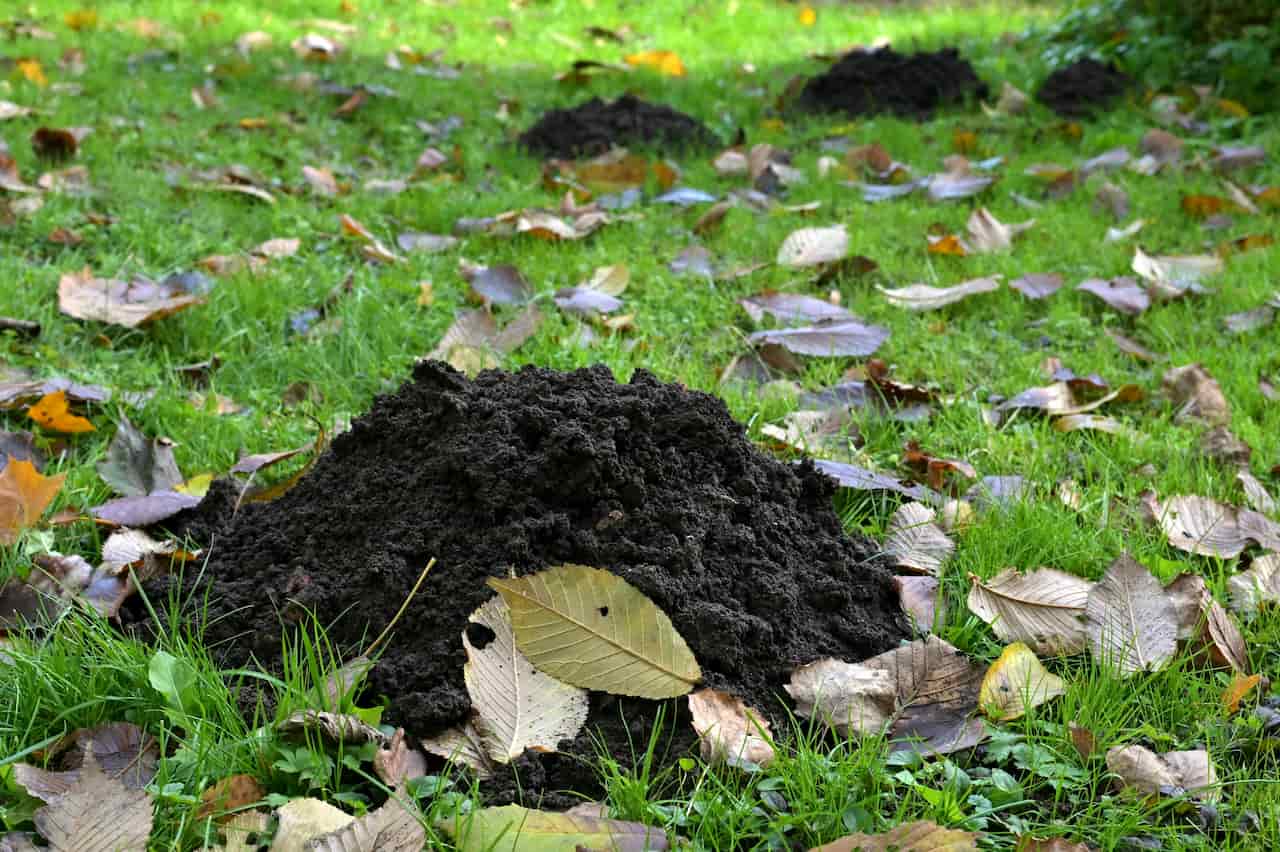
A mole’s tunnel network consists of deep permanent tunnels used for travel between feeding areas, and shallower surface runs where active feeding takes place. The surface runs are the ones visible as raised ridges across a lawn, and the mole hills are spoil heaps created when the mole excavates new tunnel sections. The mole patrols its surface runs regularly – typically every four to six hours – making these the most effective locations for traps. Deep tunnels are harder to locate and less reliably patrolled, making them less productive for trapping.
The damage moles cause
The primary damage from moles is to lawns, where the hills of fine, loose soil smother and kill grass beneath them, and the surface runs lift and disrupt the turf. Hills that are not cleared promptly leave bare patches that weeds colonise rapidly. On a bowling-green quality lawn or a sports pitch, even a single mole causes significant damage very quickly. In a cottage garden or informal lawn, the damage is more manageable and some gardeners choose to simply flatten the hills and accept occasional activity rather than pursuing active control.
In vegetable gardens and raised beds, moles cause damage by undermining the root systems of plants – the tunnel running beneath a row of vegetables can collapse the root zone, causing plants to wilt and die as if from drought. Mole runs also create pathways that voles and field mice use to access root crops, bulbs and seeds, meaning the secondary pest damage can exceed the direct mole damage in some situations. In borders, moles disturb the roots of established plants and can undermine newly planted specimens before they have established.
Control methods compared
Trapping is the only control method with consistent evidence of effectiveness for removing moles permanently from a garden. This is the method used by professional mole catchers, who work by identifying active tunnels, setting traps correctly in the run, and checking them at regular intervals. The DIY version of this approach is entirely achievable with the right traps and technique, but requires patience and a willingness to learn the correct placement method – a trap set in the wrong location or incorrectly positioned in the run will not catch anything regardless of how long it is left.
Sonic deterrents are the product category most heavily marketed to gardeners but with the weakest evidence base. Some gardeners report success with them, but controlled trials have not demonstrated reliable effectiveness, and the mechanism by which vibration at the surface would consistently deter an animal that spends its life in a vibrating environment – next to roads, next to footpaths, near all kinds of surface activity – is not well established. They are best considered a low-cost experiment rather than a reliable solution. If a mole does move away after a sonic spike is installed, it is not possible to know whether the spike caused it or whether the animal’s normal territorial movement had reached the edge of its range anyway.
How to set mole traps correctly
The most widely available and effective traps for DIY use are the scissor trap (also called the half-barrel trap) and the tunnel trap. Both work by being positioned within the mole’s active run so the mole triggers the mechanism as it passes through during its regular patrol. The key to success is finding a genuinely active run rather than an old or abandoned one, and positioning the trap correctly within it.
To identify an active run, press down the raised ridges of several surface runs with your foot or a board. Check the next day – runs that have been pushed back up from below are active and being used. Runs that remain flat have been abandoned. Choose the most consistently re-raised run for trap placement. Dig into the run carefully with a hand trowel, removing a section of soil long enough to accommodate the trap. The trap should sit within the tunnel so that the mole encounters it as it travels along its natural route – the opening of the trap aligned with the direction of the tunnel. Replace any soil loosely over the trap to exclude light, which moles are sensitive to and will avoid. Check traps every 24 hours, ideally morning and evening. If nothing is caught after three to four days, move the trap to a different section of active run.
Repairing the lawn after moles
Once mole activity has stopped – either because a mole has been caught or because it has moved on – the lawn repair work can begin. Mole hills that have been left for more than a few days will have killed the grass beneath the smothered area, leaving bare patches in the turf. The hill soil itself is actually very fine and fertile – it is subsoil brought to the surface and makes an excellent topdressing material for the repaired areas.
To repair mole-damaged grass, first flatten any remaining hills by raking the loose soil outward rather than removing it entirely – this redistributes the fine material across the surrounding turf where it is beneficial as a light topdressing. Remove any remaining grass-smothering concentrations of soil. Firm the lifted surface runs by treading them back down and then rolling or tamping the surface level. Rake the bare patches lightly to loosen the surface, apply a lawn repair seed mix at the recommended rate, and water in. Keep the area moist until the new grass establishes – typically two to three weeks in warm conditions. Firm any loose areas first – mole-damaged ground is often soft and spongy underfoot where tunnels run just below the surface.
Moles are not protected in the UK but trapping must be humane. In England, Scotland and Wales, moles may be killed or trapped, but certain methods are illegal including the use of spring traps that do not kill instantly, and gas cartridges in gardens (permitted on agricultural land only). Scissor and tunnel traps that kill instantly are legal. Live-capture traps are also legal but require daily checking and a method of humane dispatch or relocation. Check current Wildlife and Countryside Act provisions before using any unfamiliar method.
Common problems and solutions
Share on socials: