At a glance
Walk into any garden centre in May and there will be two things sold as “geraniums.” One is a tender pelargonium: bright-flowered, frost-shy, South African in origin, completely unable to survive a British winter outdoors. It goes mushy by November. The other is an actual geranium, genus Geranium, cranesbill, a fully frost-hardy perennial that dies back in autumn and comes roaring back each spring for years on end. Garden centres label both the same, which is why every year thousands of people buy one expecting the other and end up either throwing out a perfectly good perennial in October or standing at a frost-killed windowbox wondering where it all went wrong.
The word “hardy” is your practical shortcut. Hardy geranium stays in the ground, comes back reliably, asks virtually nothing from you, and provides months of flower in return. Pelargonium needs lifting, overwintering frost-free, and replacing annually. Both are excellent in the right context. The key is knowing which one you have.
Choosing the right variety for your garden
There are around 400 species in the genus Geranium plus hundreds of named cultivars, which sounds overwhelming but actually means there is a genuinely good option for almost every garden situation. The thing to resist is picking a variety because you like the look of the label and planting it somewhere inappropriate. Match plant to position and these things practically manage themselves. Get it backwards and you will spend two years wondering why it is not performing before giving up on hardy geraniums entirely, which would be a shame.
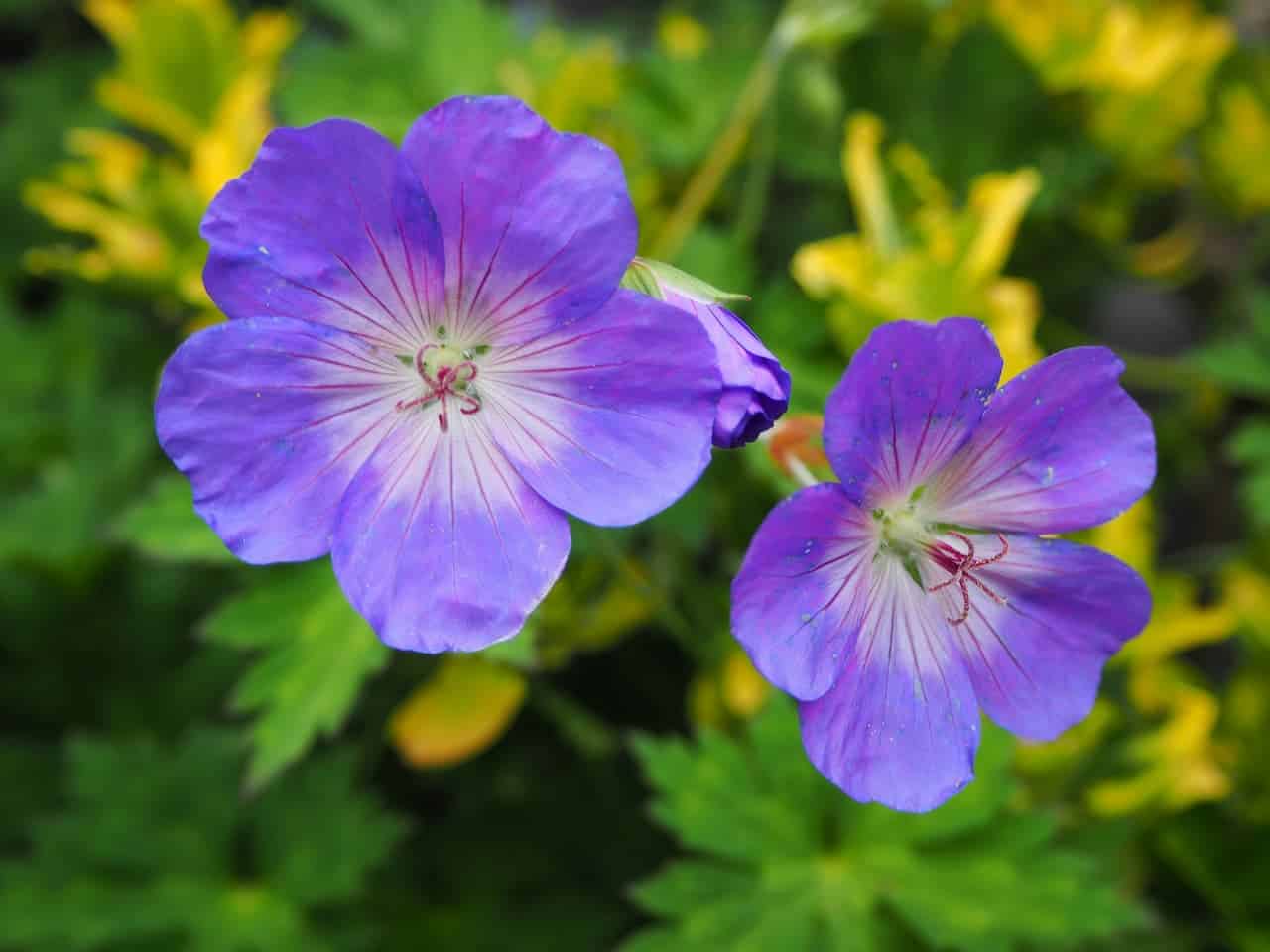
For most borders in most UK gardens, Rozanne is the answer if you are not sure where to start. It is the most popular hardy geranium in cultivation for good reason: large violet-blue flowers with purple veins and a white centre, flowering from July right through to October or sometimes November, on a plant that spreads vigorously to form dense, weed-suppressing mounds. It was named Plant of the Centenary at the 2013 Chelsea Flower Show. Rozanne is a sterile hybrid, so it does not self-seed, and it does not need the hard cut-back between flushes that most other varieties do. It needs more space than it looks like it will when you buy it in a 2-litre pot; give it 60 to 80cm radius and it will reward you.
If you have dry shade to deal with, under trees or in the rain shadow of a wall, Geranium macrorrhizum is the variety to know. It forms dense, spreading clumps of semi-evergreen, aromatic foliage and produces clusters of magenta or pink flowers in May and June. The scent when you brush the leaves is distinctive, variously described as “medicinal” or “apple-minty,” depending on who you ask. More relevantly, it will grow in conditions that defeat most other perennials, building genuine ground cover that suppresses weeds once established. For deeper shade still, Geranium phaeum flowers willingly in genuinely poor light in May and June and grows to 60 to 80cm.
At the other extreme, in sunny, dry spots where most perennials sit and sulk, Geranium sanguineum, the bloody cranesbill, is outstanding. Low and compact at 15 to 30cm, it tolerates drought once established and flowers for months with magenta-pink blooms. The species form is tough as old boots. For a bold statement in a summer border, the psilostemon group gives you tall plants with vivid magenta-pink flowers and a distinctive black eye. Patricia (AGM) is the most widely available cultivar and one of the best, reaching 60 to 80cm and flowering June to September. Johnson’s Blue gets recommended constantly and has genuinely beautiful blue flowers, but it is a floppy, short-flowering plant largely superseded by Orion and Brookside, which give you the same blue with a stronger habit and longer season.
If your soil sits wet in winter, be realistic. Waterlogging kills hardy geraniums. None of them, not even the toughest, will survive permanently saturated ground.
Planting – where, when and how
Hardy geraniums will grow in almost any soil that drains. Most prefer moist but free-draining ground in sun or partial shade, which covers the majority of UK garden borders without much fuss. The exceptions are the shade specialists and sun-lovers covered in the variety section above. With those, the difference between “mostly anything” and a specific requirement genuinely matters when you are planting into a tricky position.
Autumn is the best time to plant, specifically September and October while the soil is still warm. A plant put in at this time of year has all winter to establish its root system before it needs to put energy into growth and flowering, and the result is usually a noticeably better first-season performance. Spring works well too, from March to May, with the advantage of warm, quickening soil and a whole growing season ahead. Container-grown plants from garden centres can go in at virtually any time the ground is workable and not in hard frost; just water more diligently through any dry spells in the first summer.
Bare-root plants, available from specialist nurseries by mail order through winter and early spring, need a different approach. Do not try to plant bare roots directly into the border in November. Pot them up as soon as they arrive, keep them somewhere sheltered, and plant out once they have put on visible growth, usually late February onwards. Planted before they have a root system worth speaking of, they will sit and rot in cold wet ground.
There is rarely any need to heavily improve the soil before planting. Hardy geraniums are not demanding. Dig in a handful of compost if the soil is genuinely impoverished, but lavishly enriched ground tends to push these plants into excessive leafy growth at the expense of flowers. Plant at the same depth as the pot, firm the soil around the roots, water in, and add a light mulch of well-rotted compost around the base to conserve moisture through the first summer and keep weeds down while the plant establishes.
The cut-back – the most important thing you will do all year
Most first-time growers of hardy geraniums do not cut them back after flowering. They watch the first flush go over in June or July, see the plant looking slightly tired, and either do nothing or give it a tentative trim. The result is a plant that spends the rest of summer looking progressively worse: yellowing foliage, sparse new flowers, contributing nothing positive to the border by August.
The solution is to cut back hard. When the first flush of flowers is clearly over and the foliage is looking tatty, take a pair of shears to the whole plant and cut it back to 10cm from the ground, or even lower. Not a tidy trim. A proper haircut. Every stem, all the way down.
Then wait three to four weeks. The plant produces a flush of fresh, clean growth and a second round of flowers that continues well into September, and in good years October. You have extended the season by six to eight weeks at no cost beyond two minutes with a pair of shears. Do this once and you will never skip it again.
The timing matters more than the precision of the cut. The plant tells you when it is ready: the first flush is clearly over, the foliage looks tired, the show is done. In most parts of the UK this is June or July, but a late season can push it to early August. After cutting back, give the plant a light liquid feed, half-strength balanced fertiliser, to drive the new growth through strongly. Heavy feeding is counterproductive; too much nitrogen pushes soft growth prone to mildew.
Rozanne is the main exception. It is a sterile hybrid with a continuously flowering habit and does not need the hard cut-back to produce a second flush. If the foliage looks rough in midsummer a light tidy does no harm. Geranium sanguineum, macrorrhizum, and cantabrigiense also do not respond to hard cutting back in the same way and are better left alone. For everything else in the genus, the cut-back is the difference between a plant that performs well all summer and one that does not.
Use shears, not secateurs. Hardy geraniums have multiple stems growing in all directions and cutting them back individually takes an age. A pair of garden shears over the whole clump in one sweep is the correct tool. Precision is irrelevant. The only thing that matters is getting all the growth down quickly so you do not put it off.
Ongoing care and dividing
Once established, hardy geraniums are among the lower-maintenance choices in the perennial border. Slugs tend to leave them alone in favour of softer targets. Rabbits largely ignore them. They do not need staking. The main annual jobs are the cut-back in early to mid summer, a light granular feed in spring, and an autumn tidy when the foliage dies back.
Every three to five years, established clumps benefit from being lifted and divided. Left alone in the same spot, the centre gradually becomes woody and congested, and flowering diminishes. The outer edges continue to be vigorous but the heart of the plant is essentially dead wood. Division fixes this and gives you free plants in the process.
Do it in spring or early autumn. Lift the entire clump with a garden fork, working around the outside to avoid slicing through roots. For smaller or younger clumps, pull the root mass apart by hand. For larger, older clumps, push two garden forks back-to-back into the centre and lever them apart, or cut through with a sharp spade. Each section needs a decent root system and at least two or three growing shoots. Replant immediately at the same depth, water well, and the divisions establish quickly. Spring-divided plants usually flower in the same season.
Most varieties grow well in containers if the pot is large enough. Rozanne is particularly good in a 45cm-plus container where it spills over the edges and creates a waterfall of blue flower through summer and into autumn. Container plants need more water than those in the ground and a monthly liquid feed through the growing season. In the ground, once established, they largely fend for themselves.
Problems to watch for
Hardy geraniums do not attract the range of pests and diseases that more demanding perennials do. Most issues that occur are caused by poor conditions rather than anything particularly malign, and most respond well to the same intervention: cut back hard, improve drainage or air circulation, and the plant recovers.
Powdery mildew is the most common problem, appearing as a white, powdery coating on the leaves in late summer. Geranium pratense hybrids are the most susceptible, particularly in hot, dry conditions or positions with poor air movement around the clumps. A mildewed plant is not finished. Cut it back hard, remove the affected material, and improve conditions: water at the base, reduce crowding, feed lightly to encourage healthy new growth. Prevent it by not letting plants dry out at the roots during summer and ensuring the plants are not too densely packed.
Vine weevil is the more serious concern. Adult vine weevils notch leaf edges in summer, which is ugly but not critical. The real damage is done by the larvae, which eat roots underground through autumn. The first sign is often a plant that suddenly collapses and dies in September or October for no obvious reason. Lift the root ball and you will find fat, creamy-white grubs. Biological nematode treatment applied to moist soil in August or September, when soil temperatures are between 5 and 20 degrees, is the most practical approach for plants in the ground.
Self-seeding is not a problem as such, but Geranium pratense in particular will naturalise itself across a border with considerable enthusiasm. If unwanted seedlings concern you, deadhead promptly before seed sets, or plant sterile hybrids like Rozanne or Jolly Bee, which cannot self-seed.
Share on socials: