At a glance
Most people have grown a marigold at some point, even if they could not tell you which one. That is where the trouble starts. The word covers three distinct plants that behave quite differently in the garden, and growing the wrong one for the wrong purpose is the reason a lot of people end up disappointed. Get the type right, and marigolds repay almost no effort with months of colour and genuine benefits in the vegetable garden. Get it wrong, and you just end up with something that rots in August.
I grow all three types every year. French marigolds go round the tomatoes on the allotment. Calendula fills gaps in the border from April onwards and ends up in the kitchen. The African types I use more sparingly, in sheltered spots where the big flowers have a chance. They are very different plants for very different purposes, and treating them as interchangeable is the first mistake to avoid.
Three plants called marigold: why the name causes so much confusion
The confusion starts with naming. French marigolds are from Central America, not France. African marigolds are also from Central America, not Africa. Pot marigolds are not in the same genus as either of the first two. The name “marigold” is essentially a folk category covering plants that share yellow and orange flowers and a strong scent, and that is roughly where the similarity ends.
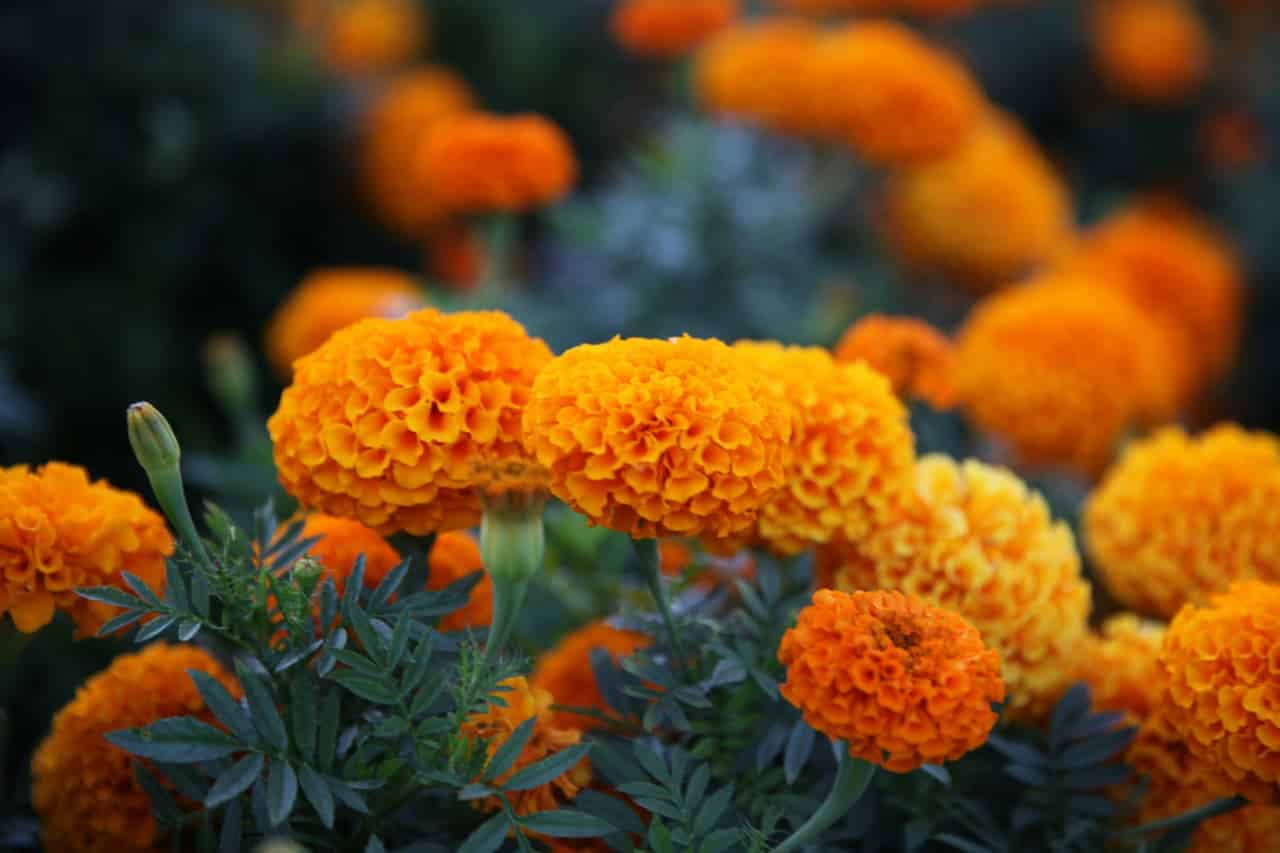
French marigolds (Tagetes patula) are what most people picture when they think of marigolds. Compact and bushy, 20 to 35 centimetres tall, producing masses of small ruffled flowers in orange, yellow, red, and bicolour forms through summer and into autumn. They branch naturally from the base without any pinching needed. They are half-hardy annuals killed by frost, but fast from seed: in good warmth they germinate in five to seven days and flower in 50 to 60 days from sowing. For sheer volume of flowers per square foot, nothing in the half-hardy annual category beats a well-planted French marigold.
African marigolds (Tagetes erecta) are taller and more dramatic: 35 to 90 centimetres with large globe-shaped double flowers up to 12 centimetres across. They take longer to flower than French types, needing 75 to 100 days from sowing. The trade-off for the size is that those large, dense flower heads trap moisture in wet weather and rot. In an average British summer this is something you have to manage. In a dry year, African marigolds are magnificent. In a wet one, they are work.
Signet marigolds (Tagetes tenuifolia) are the least grown of the three Tagetes and worth knowing about. Masses of small single flowers above finely divided foliage, growing 20 to 45 centimetres. They have a pleasant citrus scent that the other Tagetes species lack. ‘Lemon Gem’ is pale yellow and ‘Golden Gem’ is a richer gold. Both work well as edging plants and in containers, and they attract more open-access insects than the double forms.
Pot marigolds (Calendula officinalis) are a different genus entirely and genuinely different in character. Native to southern Europe, calendula has been grown in British gardens since medieval times. It is a hardy annual, tolerating frost and self-seeding reliably. Flowers from spring through to November’s first hard frost in a good year. The petals are edible and have genuine herbal properties. The flowers look like large, open daisies in shades of orange and yellow. If you are growing marigolds for the kitchen or for a medicine cabinet, calendula is what you want. If you are growing them around your tomatoes, you want Tagetes.
The four types at a glance, with their key attributes:
Sowing marigolds: timing and what each type needs
Tagetes and calendula have fundamentally different sowing requirements because one is half-hardy and the other is fully hardy. Getting the timing right for each avoids the two most common failures: frost-killed Tagetes planted out too early, and calendula started indoors unnecessarily when it would have been quicker and easier to sow it directly.
For French and African marigolds, sow indoors in March or April. Fill module trays with seed compost, push one seed per module about a centimetre deep, and cover lightly. They need 21 to 24 degrees for good germination and will be up in five to seven days at the right temperature. A warm windowsill works, or a propagator if you have one. When seedlings are large enough to handle, transplant to individual 9 centimetre pots and grow on at cooler temperatures, around 10 degrees. French types can also be direct sown outdoors from late May when the soil has warmed and frost risk has passed; they germinate fast and can catch up surprisingly quickly with indoor sowings. African marigolds are not worth direct sowing: they need the longer season that an indoor March start provides.
Calendula is the easy one. Sow direct into the ground from March onwards, or in September for flowers earlier the following spring. Just rake the soil to a fine tilth, scatter seed thinly, cover with a centimetre of soil, and water. Germination is reliable and the seedlings are recognisable from early on. Thin to 25 to 35 centimetres. Once calendula is established in a garden it largely takes care of itself through self-seeding; you may not need to sow again at all in subsequent years.
For Tagetes, harden off indoor-raised plants for 10 to 14 days before planting out. Move them outside during the day and back in at night, gradually extending the time over the fortnight. Plant out after the last frost, which is typically late May or early June across most of England.
The sowing and growing season mapped by task:
Sun, soil, feeding and keeping them flowering
Sun is the one non-negotiable for marigolds. Both Tagetes and calendula produce their best displays in full sun. In partial shade they survive but flower poorly, produce stretched growth, and are more susceptible to disease. If you only have a shady spot, save it for something that actually tolerates shade and grow marigolds somewhere else.
Soil requirements are forgiving. Marigolds tolerate almost any well-drained soil, and Tagetes specifically flowers better in average or moderately poor ground than in rich, heavily composted soil. Rich soil pushes leaf production at the expense of blooms: the same principle that applies to zinnias and cosmos. Calendula is similarly tolerant; it will grow in most conditions including clay, though it prefers decent drainage.
Spacing matters more than most people allow for. French marigolds need 20 to 30 centimetres, African types 30 to 40 centimetres, calendula 25 to 35 centimetres. Crowded plants produce more disease, especially grey mould on the flower heads. Give them room to move air through.
Feeding with a high-potash liquid fertiliser through the growing season keeps Tagetes flowering continuously. High-nitrogen feeds produce exactly the lush, soft, flowerless plants you do not want. For calendula, feeding is rarely necessary except in containers or genuinely poor soil.
Deadheading is the single most important task for Tagetes, and it deserves proper attention rather than a casual pinch. The whole seed pod needs to come off, not just the faded petals, because a Tagetes plant that has successfully set seed will slow its flower production noticeably. Cut or pinch back to the next set of leaves, removing the entire spent head. Do this every week through the season and French marigolds will flower from June until the first October frosts. Neglect it for two weeks and you will see the difference. African marigolds in wet weather: remove any flowers showing grey mould immediately, cutting back to healthy growth.
The whole pod, not just the petals. Most people pinch off the dead petals and leave the green seed pod below. That pod counts as setting seed and the plant still slows down. Get your fingers below the dead flower, find where the stem meets the next set of leaves, and cut there. You are removing everything above those leaves.
What marigolds actually do in the vegetable garden
The companion planting claims for marigolds have been repeated so often that people no longer question whether they are true. Some of them are. Some are not. Knowing which is which saves you from planting marigolds in the wrong places and missing what they are genuinely good at.
The whitefly deterrence around tomatoes is real. The strong scent of Tagetes foliage confuses whitefly that are looking for host plants. French marigolds planted around tomatoes, peppers, and aubergines at 30 centimetre spacing reduce whitefly numbers. This works better in greenhouse conditions where the enclosed space concentrates the scent, but it is also effective outdoors. I have grown tomatoes with and without French marigolds around them over multiple seasons and the difference is consistent. This is not marginal: eight tomato plants out of ten showing whitefly damage dropped to one in ten after five seasons of consistent French marigold planting around them. Plant the marigolds at the same time as the tomatoes, or slightly before, so they are established when the pest pressure builds in July.
The nematode control claim is also backed by research, though it requires patience to work properly. Tagetes roots release thiophenes, compounds that are toxic to root-knot nematodes in the soil. To get this benefit, the plants need to be in the ground for a full growing season, not just a few weeks. Dig the spent Tagetes plants into the soil in autumn as a green manure. The nematode-suppressing compounds can persist in the soil for up to three years. This is most useful on allotments with persistent nematode problems affecting tomatoes or other susceptible crops.
Both Tagetes and calendula attract hoverflies, whose larvae eat aphids at a considerable rate: up to 50 per day. Single-flowered and open-centred varieties are more accessible to hoverflies than the large, densely doubled forms. Signet marigolds (Tagetes tenuifolia) are particularly good for this because their small, single flowers are easy for short-tongued insects to access. Planting any type of marigold along the edges of vegetable beds creates a hoverfly corridor that benefits the whole plot.
The claim about marigolds deterring slugs is one that does not hold up in practice. Slugs eat marigold seedlings readily. Young plants need protecting at transplanting time, not less so because marigolds are involved.
The companion planting evidence summarised by use:
What calendula is for: eating, skin care and the kitchen
Calendula earns its place in a different way from Tagetes. Its companion planting value is real but secondary to what it actually offers: petals you can use.
The flavour of fresh calendula petals is mild and slightly peppery, with a faint warmth that is sometimes compared to saffron. They add colour to any dish where you scatter them fresh: salads, rice, soups, scrambled eggs. Dry the petals and they store in a sealed jar for months, ready to use through winter when the plant is long gone. To dry them, spread on a piece of paper in a warm, airy room for a few days until crisp. Pull the petals away from the green base before drying: it is the petals you want, not the whole flower head.
Calendula oil is made by infusing dried petals in a carrier oil for four to six weeks in a sunny spot. This oil is the basis for skin balms, lip balms, and healing salves that have been part of herbal medicine traditions for centuries. The anti-inflammatory effect is something I have used on my own hands after heavy digging sessions, and it works. Making it requires nothing more than dried petals, a glass jar, and whatever oil you prefer to use as a base: sweet almond, olive, and sunflower all work.
Only use Calendula officinalis for edible and herbal purposes. French and African marigolds are not the same thing. Tagetes petals are technically not toxic but they are bitter and unpleasant. Only eat flowers grown without pesticides. This is not a minor caveat: Tagetes grown for bedding in garden centres may well have been treated.
Varieties worth growing and the problems to expect
For the allotment or any vegetable garden use, French Tagetes patula is the one to go for, and within that group the Bonanza series is the best all-rounder. Compact at 25 to 30 centimetres, excellent branching, large flowers for a French type, and reliable performance across a long season. It is also widely available. Safari is worth trying for the unusual crested flower forms and good grey mould resistance in wet summers. Durango produces the largest flowers in the French category, at 6 to 7 centimetres across, and the bold single-colour forms are the most striking.
For the big, dramatic display in a sheltered sunny border, African Tagetes erecta Inca series is the variety to choose. It reaches 35 to 40 centimetres with 10 centimetre blooms and is shorter and more wind-resistant than older African types. Vanilla is worth growing once if you want something genuinely different: the only cream-white African marigold widely available, and striking when planted among orange forms.
For calendula, Indian Prince is the standout. Deep orange petals with dark red reverses at 60 centimetres, with strong stems for cutting and a generous self-seeding habit. Art Shades is a softer mix of apricot, orange, and cream that works well in cottage garden borders where you want something less intense than straight orange.
Marigolds have few serious problems. Slugs attack young transplants in the first two to three weeks: copper tape, ferric phosphate pellets, or beer traps until the stems toughen. Grey mould on African marigold heads in wet weather is the most common disease problem: space plants well, water at the base, and remove affected heads before the spores spread. Red spider mite can affect African marigolds under glass: raise humidity, consider predatory mite controls. A minor but genuine issue with handling Tagetes in quantity: the natural oils in the foliage can irritate skin, so wear gloves for any prolonged handling such as planting out large numbers.
Key varieties compared across the attributes that matter for UK growing:
Only eat Calendula officinalis, not Tagetes. French and African marigolds (Tagetes) are commonly sold as food-grade edible flowers in some contexts, but they taste bitter and have been treated with pesticides in most garden centre stock. The edible marigold for the kitchen is the pot marigold, Calendula officinalis, grown by yourself from seed without pesticides. Never assume a garden centre plant is safe to eat.
Share on socials: