At a glance
Britain is home to 24 bumblebee species, but the vast majority of gardeners will encounter only 6 to 8 of them on any regular basis. Several species are genuinely rare, confined to specific habitats and regions, and others have declined so dramatically in the past century that two have been lost entirely from the UK. The ones that do visit gardens are doing so partly because gardens have become among the most reliable sources of nectar and pollen in a landscape that has lost much of its floral richness since the 1940s. Getting to know the species that visit your garden, understanding what each needs, and making informed choices about planting and management can make a real difference to a group of insects under considerable pressure.
Bumblebees are not just charming – they are essential. As generalist pollinators that can forage in cooler and wetter conditions than most other bee species, they carry the pollination work of early spring and late summer when other pollinators are largely absent. Many food crops, including tomatoes, courgettes, beans and soft fruit, are far more productive with bumblebee pollination than without it. A garden that supports a healthy bumblebee population is also a more productive kitchen garden, not just a more beautiful one.
Identifying UK bumblebee species
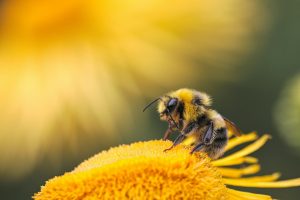
Bumblebee identification is genuinely possible in the garden with a little practice. The key features to look for are the colour banding pattern on the abdomen and thorax, the colour of the tail (the tip of the abdomen), and body size. Males, females (workers) and queens of the same species can look slightly different, and some species are variable, so there is always an element of uncertainty – but for the six or seven most common garden species, a good view is usually enough to make a confident identification.
The colony year – queens, workers and males
Bumblebee colonies are annual. Unlike honeybees, which maintain a colony through winter, bumblebees start afresh each spring when a mated queen emerges from hibernation. Understanding this cycle explains a great deal about when and why you see different bees doing different things throughout the year, and it also clarifies what gardens need to provide at each stage.
A bee on the ground is not always dying. Bumblebee queens in early spring and workers in hot weather often appear exhausted on the ground. Before assuming the worst, offer a small amount of sugar water (one teaspoon of white sugar dissolved in one teaspoon of warm water, placed on a flat surface near the bee) and give it 20-30 minutes in a sheltered spot. A cold bee just needs to warm up. A bee that is genuinely at the end of its life will not recover regardless.
What bumblebees need from gardens
The needs of a bumblebee colony can be summarised as three things: food (nectar and pollen) across a long season, somewhere to nest, and a landscape without pesticides that is genuinely hospitable to invertebrates. Most gardens can provide the first. Nest sites are harder because what bumblebees actually want – undisturbed tussocky grass, old rodent burrows, compost heaps with stable temperatures – is rarely on the managed gardener’s agenda. Purpose-built bumblebee boxes exist and are occasionally used, but occupancy rates are lower than for bird boxes because bumblebees are selective nesters. The most reliable nest-site provision is simply leaving areas of the garden alone: a rough corner with coarse grass, a compost heap that is not turned through spring and summer, a bank with dense vegetation.
Pesticide use is the most straightforward thing to address. Systemic insecticides – particularly neonicotinoids – are extremely harmful to bumblebees and persist in plant tissues and soil for months or years. Even contact insecticides like pyrethrin, while breaking down faster, kill bees that encounter treated plants when foraging. The simplest and most impactful decision is to stop using all insecticides in the garden, and to stop buying plants from garden centres that have been treated with systemic pesticides, which are absorbed into every part of the plant including pollen and nectar.
The best plants for bumblebees
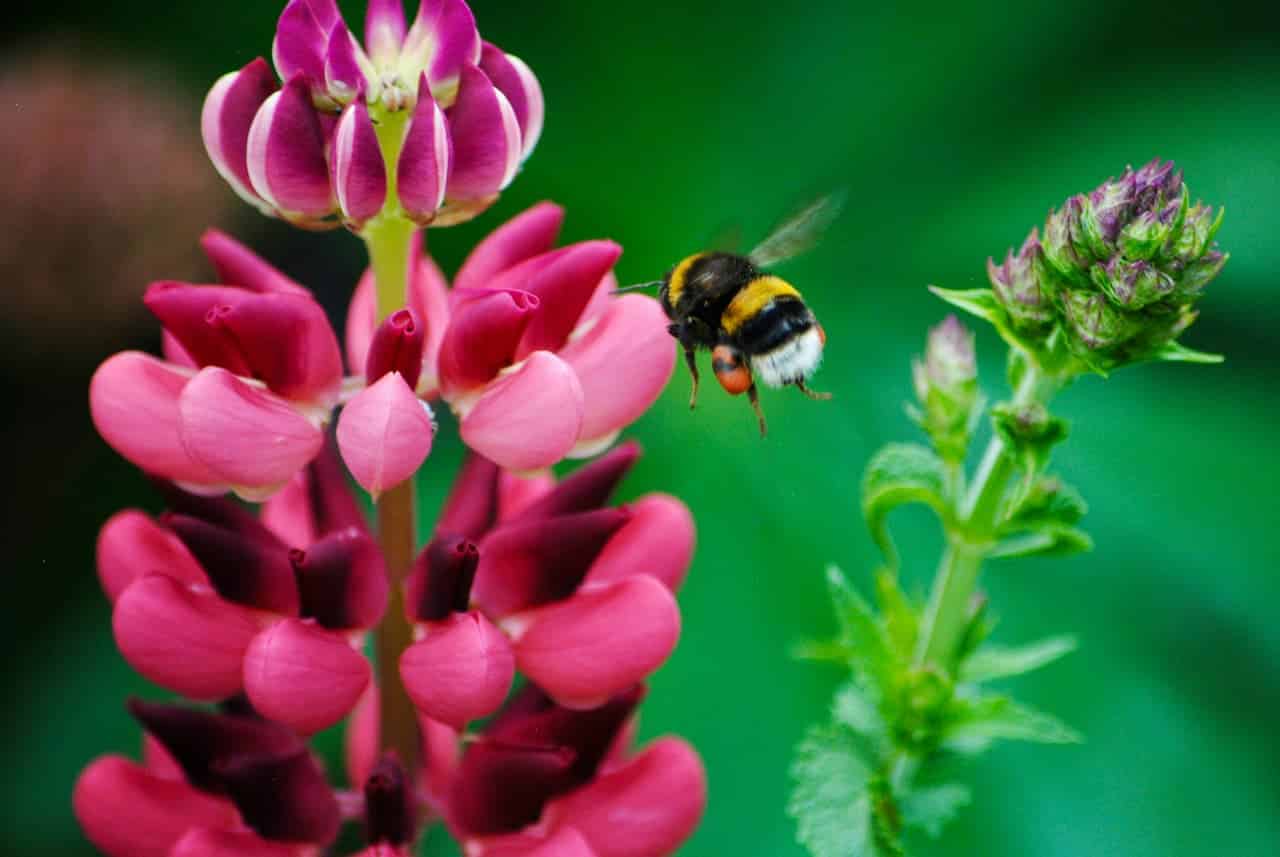
Different bumblebee species have different tongue lengths, which means some can access nectar from deep tubular flowers that others cannot reach. Short-tongued species like the buff-tailed, white-tailed and red-tailed bumblebees prefer open, accessible flowers – lavender, clover, knapweed, borage, single-flowered roses and bramble are all excellent. Long-tongued species like the garden bumblebee and common carder bee can access foxglove, honeysuckle, comfrey, red clover and aquilegia, which short-tongued bees largely ignore. A garden with a mix of flower structures across both groups gives the widest range of species the best chance.
The single most important principle is continuity. A garden that flowers brilliantly in July but has nothing in February, March, September and October is providing a feast during the easiest weeks and a famine during the hardest. Planting for early spring (crocus, snowdrop, hellebore, pulmonaria, aubretia) and late autumn (ivy in flower, Michaelmas daisy, Verbena bonariensis, sedum) is as important as the summer showpieces.
Size matters – telling species apart
Body size is a genuinely useful identification feature once you have a reference point. The buff-tailed bumblebee queen is famously large – one of the biggest bumblebees you will see. Early bumblebee workers and queens are notably small. The common carder bee sits in the mid-range. Getting a feel for relative sizes helps when two similar-looking species visit the same flower, because size can often separate them even when the colour pattern is ambiguous or the lighting is poor. The variation within a colony also matters – a buff-tailed worker can look surprisingly different from its queen, and is sometimes misidentified as a smaller species.
Common questions about bumblebees
Bumblebees generate a lot of questions from gardeners, partly because they are so visible and partly because many of the things they do – investigating gaps in walls, flying in cold weather, apparently crawling helplessly – look alarming but are entirely normal behaviour. Most encounters with bumblebees in the garden require no intervention at all. The instinct to help is admirable but it occasionally works against the bees.
Never use neonicotinoid insecticides in a bumblebee-friendly garden. Products containing imidacloprid, clothianidin or thiamethoxam persist in soil and plant tissue for months to years. They impair navigation, memory and foraging ability in bumblebees at concentrations far below what kills them outright. Many garden centre plants are pre-treated with these chemicals. Ask before buying, and look for peat-free, pesticide-free plants or grow from seed.
Share on socials: