At a glance
Buddleia davidii is a fast-growing deciduous shrub that puts on enormous amounts of new growth each season. Left unpruned, it becomes a tall, leggy plant with most of its flowers clustered at the very tips of long arching stems high above eye level, while the lower portion becomes bare and woody. Hard annual pruning keeps the plant compact, encourages masses of new stems from the base, and produces the largest flower spikes at a useful height.
The connection between pruning and flowering is direct and reliable. Buddleia flowers on wood grown in the current season. Cutting the plant back hard in spring triggers a flush of vigorous new growth, and those new stems carry the flower spikes later in summer. The more new growth produced from low down, the more flowers carried at eye level. A buddleia that has not been pruned for several years will still flower, but sparsely, high up, on weak stems that flop under the weight of the blooms.
How buddleia grows and why pruning matters
The key to understanding buddleia pruning is the plant’s growth habit. Unlike shrubs that flower on the previous year’s wood and must not be touched in spring, buddleia davidii produces its flowers on the stems it makes in the current growing season. This means cutting old growth away in spring does not remove flower buds. Instead, it forces the plant to make a large quantity of strong new stems, each of which will carry a flower spike. Not all buddleias share this habit, which is why the species or type matters before pruning begins.
When to prune buddleia
Timing is the single most important factor in buddleia pruning. Prune too early, in autumn or winter, and the new growth that follows is exposed to hard frosts, which can kill soft young shoots and even damage main stems. The correct time to prune buddleia davidii is late winter to early spring, from late February through to April, once the worst frosts have passed but before the plant puts on significant new growth. A reliable practical indicator is the appearance of small green buds breaking along the main stems, showing the plant has survived the winter and is ready to respond to pruning with vigorous regrowth.
Pruning later in April or into early May is also an option and has a useful effect: it delays the main flowering flush to August rather than July, which coincides with the peak emergence of summer butterflies such as peacocks, red admirals and small tortoiseshells. By pruning different plants in a collection at different times, it is possible to extend the nectar season considerably. In colder parts of the UK and in exposed positions, waiting until March or April rather than late February reduces frost risk to regrowth. Do not prune hard in autumn. Deadheading spent flower spikes in autumn is acceptable if preventing self-seeding is a priority, but structural pruning always waits until late winter.
How hard to cut
Most buddleias benefit from hard pruning every year. The standard approach is to cut all main stems back to a low framework, typically to within thirty to sixty centimetres of the ground, leaving a short stump with two or three healthy buds visible on each stem. This sounds severe but buddleia responds vigorously. The stumps will produce multiple new stems, each carrying flower spikes by July or August.
The exact cut height does not need to be precise. The goal is to remove the long growth from the previous year entirely and leave enough of each stem that strong buds are present to drive regrowth. Each year of pruning, the stumps get slightly thicker and taller as a small amount of stem is added. An established plant that has been pruned annually for ten years will have a framework of gnarled stumps thirty to sixty centimetres tall from which vigorous new growth emerges every spring. For very old plants that have become woody and congested at the base, cutting back harder to just above ground level can rejuvenate them entirely. Buddleia alternifolia and Buddleia globosa must not be pruned this way, as both flower on the previous season’s wood; hard spring pruning removes all their flower buds.
How to make the cuts
Use sharp, clean loppers or secateurs for stems up to about two centimetres in diameter. A pruning saw handles thicker main framework stems cleanly without tearing. Blunt or dirty tools crush stems rather than cutting them cleanly, which slows healing and creates entry points for disease.
Make each cut just above a healthy bud or pair of buds, angling the cut slightly away from the bud so water sheds away rather than sitting on the wound. There is no need to apply wound sealant to buddleia cuts. The plant heals quickly, and wound paint is now understood to do more harm than good by trapping moisture. Work systematically from one side of the plant to the other, cutting each stem back to the chosen height. After cutting, remove all the prunings from around the base of the plant before they have a chance to harbour pests. The pile of cut material from a mature buddleia is substantial, so have a plan for disposal before you start.
Feeding after pruning
A dose of general-purpose fertiliser applied after pruning gives the new growth a boost. A balanced granular fertiliser, or a good layer of well-rotted garden compost mulched around the base, provides the nutrients needed for the flush of vigorous growth that follows cutting back. Buddleias are not heavy feeders and one application in spring is sufficient. Avoid high-nitrogen fertilisers, which promote excessive leafy growth at the expense of flowers.
Deadheading through summer
Removing spent flower spikes during summer encourages the plant to produce further flushes of flowers rather than putting energy into seed production. Cut spent spikes back to the nearest pair of leaves or side shoot. A well-tended buddleia that is regularly deadheaded from the first flush in July through to early September will carry flowers continuously over a much longer period than one left to set seed.
Deadheading also reduces the amount of self-seeding, which can be significant with some cultivars. Buddleia davidii spreads freely from seed and can become a nuisance, or even an ecological problem, if allowed to set and disperse. In certain habitats, such as riverbanks and disturbed ground near railway lines, it is considered invasive. Removing flower heads before seeds develop is a practical way to limit this spread.
Leave seed heads through winter for wildlife. If reducing self-seeding is not a priority, leaving the seed heads intact through winter provides food for finches and other seed-eating birds during the coldest months. Remove them as part of the spring pruning.
What to do with neglected plants
A buddleia that has not been pruned for several years is not lost. Even very large, overgrown specimens usually respond well to hard renovation pruning. The approach is to cut the entire plant back to within thirty to sixty centimetres of the ground in late winter, removing all the old woody growth in one session. The plant will look dead for several weeks, but by April or May new shoots will appear from the old wood and from the base, and by summer it will be producing vigorous new growth again.
Some very old plants with a thick, woody base may be slow to respond to complete renovation, and there is a small risk that a very old plant may not recover from cutting all the way back at once. In this case, a two-stage approach reduces risk: cut half the stems back hard in year one, and the remaining stems in year two once the plant has shown it can respond to pruning. Remove top growth first so you can see the base clearly, then use loppers and a pruning saw to cut the framework stems to the chosen height.
Pests and diseases
Buddleia is generally robust, but a few pests and diseases are worth knowing about, particularly as some are most likely to appear on the young growth that follows pruning.
Buddleia and wildlife
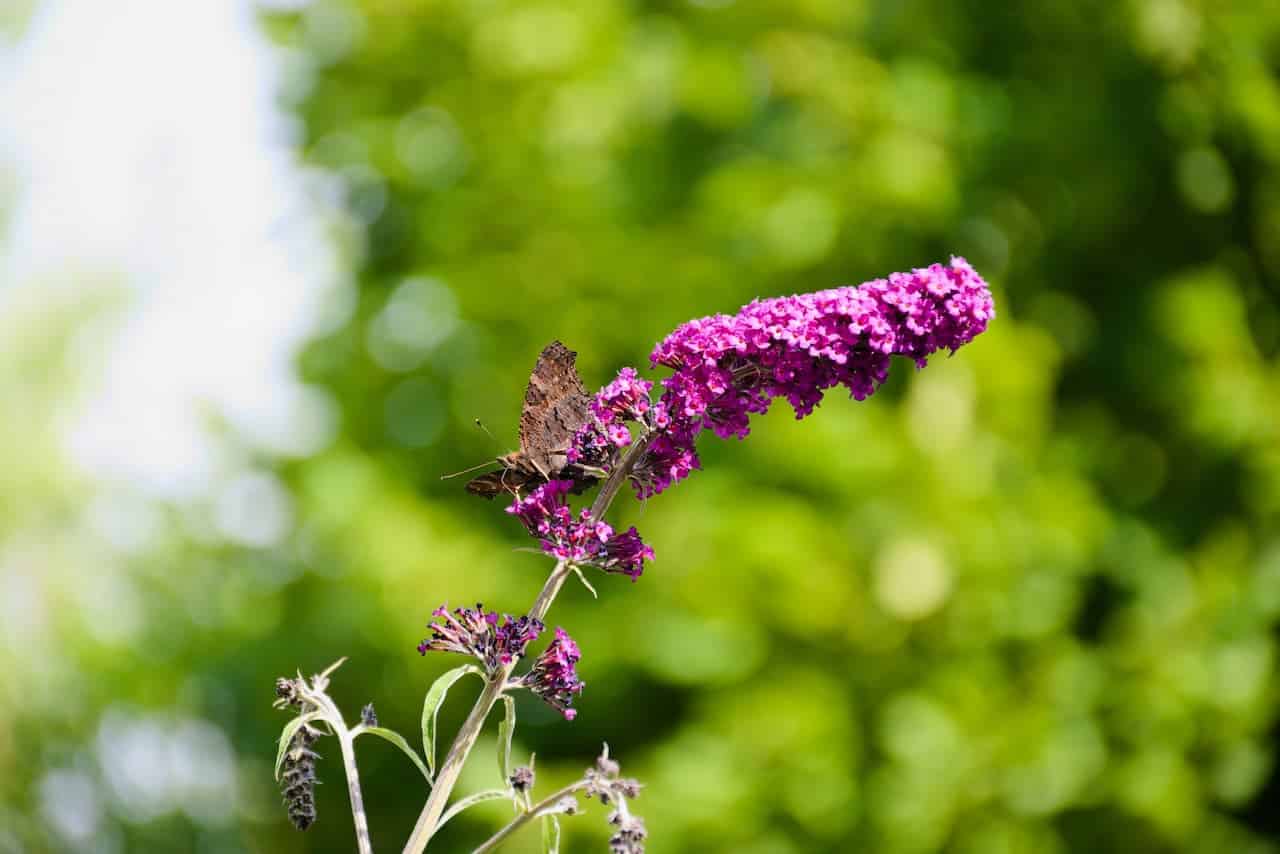
Buddleia is one of the most wildlife-friendly shrubs for UK gardens, particularly for butterflies, bees and other pollinators. The nectar-rich flowers attract a wide range of species including peacocks, tortoiseshells, red admirals and commas throughout summer. Pruning to maintain a healthy, well-flowered plant directly supports the wildlife value of the shrub. A neglected, sparsely flowering plant carries far less nectar than a well-pruned one carrying a full crop of large spikes.
Buddleia is not toxic to humans, pets or wildlife, and the foliage and flowers can be handled without protective gloves, though some people with sensitive skin may find the foliage slightly irritating on prolonged contact.
Long-term management
A buddleia that is pruned correctly every year remains productive and attractive for many years. The plant develops a tough, woody base over time, and from this structure it produces vigorous new growth each spring. There is rarely any need to replace a well-managed plant. Buddleia is generally shorter-lived than many garden shrubs, with an expected lifespan of around fifteen to twenty years before the framework becomes very gnarled and vigour declines noticeably. At that point, replacement is the practical solution rather than continued hard pruning.
If a plant has become genuinely too large for its position even after annual pruning, the options are renovation pruning as described above, or removal and replacement with a more compact cultivar such as the Buzz series or the dwarf Lo and Behold range, which are genuinely small and need only light annual tidying rather than hard cutting.
Watering
Established buddleias are very drought-tolerant and require no supplementary watering in normal UK conditions. Newly planted shrubs need consistent moisture in their first season to establish properly, particularly during dry spells in spring and early summer. Once the root system is established, the plant is largely self-sufficient. After hard pruning in spring, decent soil moisture helps support the flush of vigorous new growth that follows, so if the spring is unusually dry, watering the plant during April and May is worthwhile.
Propagation from cuttings
Buddleia is one of the easiest shrubs to propagate from cuttings, and the annual pruning session produces ample material. There are two practical methods: softwood cuttings in early summer and hardwood cuttings in late autumn.
For softwood cuttings, take shoots around ten centimetres long with two or three pairs of leaves from the tip growth, remove the lower leaves to leave a bare stem, and insert into free-draining cuttings compost. Keep moist and shaded; roots form within three to four weeks. For hardwood cuttings, cut a healthy stem into sections around twenty centimetres long, trimming just above a bud at the top and just below a bud at the bottom, then insert most of the length into gritty compost and leave to root over winter. By spring the cuttings will have rooted and can be potted on or planted out.
Share on socials: